
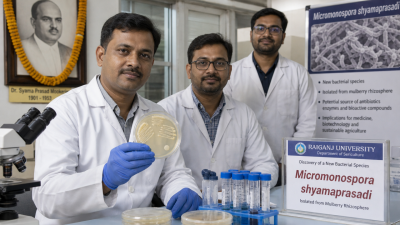
On 5 July 2026 researchers at the Department of Sericulture, Raiganj University announced the discovery of a new bacterial species, Micromonospora shyamaprasadi, isolated from the rhizosphere of mulberry plants.
Taxonomy & Nomenclature
- Species: Micromonospora shyamaprasadi; name commemorates the 125th birth anniversary of Syama Prasad Mookerjee.
- Genus: Micromonospora — filamentous, Gram-positive actinobacteria known for secondary metabolite production.
- Formal recognition: Name registered under the SeqCode — Code of Nomenclature of Prokaryotes Described from Sequence Data.
Source & Ecology
- Isolation source: Rhizosphere of mulberry (Morus spp.), the active soil zone adjacent to plant roots.
- Ecological niche: Soil and plant-associated microhabitats; rhizosphere strains often interact with host plants and soil microbes.
Biotechnological Potential
- Metabolic products: Potential producer of antibiotics, industrial enzymes and other bioactive compounds.
- Applications: Prospective utility in drug discovery, enzyme biotechnology and sustainable agriculture (bioinputs and biocontrol research).
IASPOINT Booster Facts
- SeqCode: Permits valid naming of prokaryotes described from sequence data; complements the ICNP requirement for cultured type strains.
- Classification: Genus Micromonospora belongs to family Micromonosporaceae, order Micromonosporales, phylum Actinobacteria.
- Sericulture link: Mulberry rhizosphere is relevant because mulberry (Morus spp.) is the primary host plant in silkworm cultivation.