
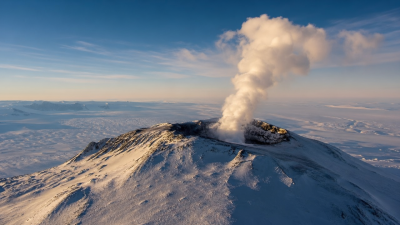
On 30 June 2026 scientists reported Mount Erebus on Ross Island continues to emit microscopic crystals of elemental gold into the atmosphere.
Key facts
- Location & status: Southernmost active volcano, Ross Island, Antarctica; ~1,350 km from the Geographic South Pole.
- Summit feature: Contains a permanent lava lake — a persistent molten surface within the crater.
- Emission rate: ~80 grams per day (≈2.8 oz); estimated value ≈ USD 6,000/day; >USD 2 million/year.
- Particle form: Individual, well-formed elemental gold crystals; sizes up to 60 micrometres in diameter.
- Dispersal: Gold microparticles can travel up to 1,000 km before depositing on Antarctic ice.
- Uniqueness: Only known volcano that consistently emits discrete elemental-gold crystals; other volcanoes (Kīlauea, Etna, Augustine, El Chichón) show gold only in traces.
- Scientific record: Emissions documented since 1991; gold detected in snow, air and volcanic-gas samples using electron microscopy and geochemical assays.
- Formation hypotheses: Crystallisation from chlorine-rich gases as they cool; or growth at the lava-lake surface followed by aerosolisation.
- Economic feasibility: Commercial recovery is unfeasible because crystals are microscopic and widely dispersed.
IASPOINT Booster Facts
- Antarctic legal regime: Antarctic Treaty System (1959) and Madrid Protocol (1991) prohibit mineral-resource exploitation; scientific sampling permitted under environmental rules.
- Unit: Micrometre (µm) = 10⁻⁶ metre; 60 µm is significantly smaller than typical human hair diameter.
- Analytical detection: Elemental Au0 crystals are identified by electron microscopy and mass-spectrometric geochemistry.