
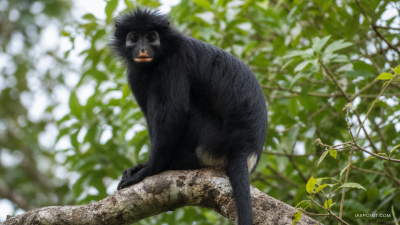
A new colobus monkey species, Colobus congoensis (local name Likweli), was described from the Democratic Republic of Congo and published in PLOS One on 15 July 2026.
Taxonomy and identification
- Scientific name: Colobus congoensis; local name Likweli.
- Group: Colobus monkeys — Old World monkeys, family Cercopithecidae.
- Diagnostic evidence: Genetic, anatomical and acoustic analyses.
- Phylogeny: Closest known relative Colobus satanas; divergence estimated 4–5 million years; separated by >1,200 km.
Physical features
- Colour and markings: Predominantly black; pinkish‑orange lips or orange‑cream patches around mouth and nose; white perianal patch.
- Craniofacial traits: Bare grey cheekbones used with vocal traits for species delimitation.
Distribution and habitat
- Range: Estimated ~1,700 km² between the Lomami and Lilo rivers, largely within Lomami National Park.
- Biome: Congo Basin rainforest ecosystem.
- Survey history: First photograph (2008); clearer sightings in 2018 led to targeted searches and formal description.
Conservation and exam facts
- Recommended status: Proposed IUCN Endangered owing to restricted range, small population, habitat loss and hunting pressure.
- Discovery context: Only the fifth new African monkey species described in the past ~75 years.
IASPOINT Booster Facts
- Congo Basin: World’s second‑largest tropical rainforest after the Amazon.
- IUCN Red List: Global framework for assessing species extinction risk and assigning categories from Least Concern to Extinct.
- Lomami National Park: Protected area where Lesula (Cercopithecus lomamiensis) was described in 2012.