
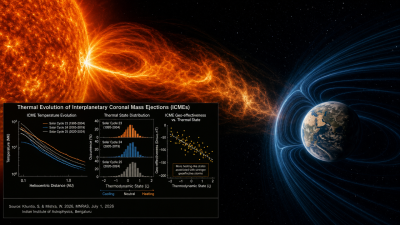
On 1 July 2026, the Indian Institute of Astrophysics published a 29‑year (1995–2024) statistical study of thermal evolution of Interplanetary Coronal Mass Ejections (ICMEs) at 1 AU.
Key findings
- Heating fraction: ~45% of ICME magnetic ejecta exhibit heating near Earth at 1 AU.
- Solar-cycle dependence: Heating-like states predominate near solar maximum; cooling-like states were more common in Solar Cycle 24 than in Cycle 23.
- Thermodynamic classes: ICMEs separate into distinct heating and cooling thermodynamic states linked to their interplanetary evolution.
- Geoeffectiveness: Heating-state ICMEs produce stronger geomagnetic disturbances, affecting satellites, GPS, HF radio, aviation and power grids.
Methodology & data
- Data span: 1995–2024 covering Solar Cycles 23–25 (rising phase of 25).
- Sources: OMNI database (NASA Space Physics Data Facility) and CDAWeb solar wind repositories.
- Measurements: In situ solar wind parameters near the L1 point — proton temperature, bulk speed and magnetic field were analysed.
Physics & classifications
- ICME: Magnetised plasma ejected from the solar corona; commonly contains magnetic ejecta or magnetic clouds.
- Expected vs observed: Radial expansion tends to cool ejecta, yet near‑Earth heating is frequently observed, implying additional heating processes en route.
- Geomagnetic metrics: Geoeffectiveness quantified using indices such as Dst and Kp.
IASPOINT Booster Facts
- Publication: Monthly Notices of the Royal Astronomical Society, 1 July 2026; lead authors Soumyaranjan Khuntia and Wageesh Mishra.
- L1 & 1 AU: L1 is the Sun–Earth Lagrange point at ~1 AU (~149.6 million km) used for upstream solar wind monitoring.
- OMNI: OMNI compiles near‑Earth interplanetary data for space‑weather research and operational forecasting.