
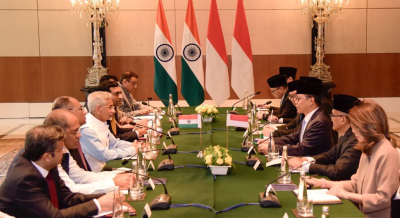
External Affairs Minister S. Jaishankar and Indonesian Foreign Minister Sugiono co-chaired the 8th India–Indonesia Joint Commission Meeting in New Delhi to review their Comprehensive Strategic Partnership. The high-level meeting builds directly upon the strategic momentum generated by Indonesian President Prabowo Subianto’s state visit to India in January 2025. Both nations focused on executing targeted frameworks across trade, maritime security, digital connectivity, space, and defense. This diplomatic engagement reinforces Indonesia’s position as a key pillar of India’s Act East Policy and advances the shared vision for a rules-based Indo-Pacific region.
Strategic Architecture and Bilateral Mechanisms
Evolution of Partnership Tiers
The bilateral structural relationship has grown systematically through defined diplomatic milestones. The formal engagement began with a Strategic Partnership agreement in 2005, which was upgraded to a Comprehensive Strategic Partnership in 2018 during Prime Minister Narendra Modi’s visit to Jakarta. The institutional core of this relationship relies on the Joint Commission Mechanism, established via a Memorandum of Understanding in January 2001.
Defense and Security Cooperation
Defense ties are operationalized through regular institutional channels that target maritime threats and counter-terrorism.
- Joint Defense Cooperation Committee (JDCC): This apex body reviews military-to-military exchanges, joint exercises, and defense technology collaboration.
- Counter-Terrorism Framework: Bilateral security agencies coordinate through the Joint Working Group on Counter Terrorism, executing tactical intelligence sharing under a foundational 2004 Memorandum of Understanding.
- Service-Level Exercises: The two nations regularly conduct Samudra Shakti, a bilateral maritime exercise, and Garuda Shakti, a joint army training exercise.
Maritime and Economic Connectivity
Shared Indo-Pacific Outlook
Both countries share a geographic focus on the Indo-Pacific region. India’s Indo-Pacific Oceans Initiative (IPOI) aligns with the ASEAN Outlook on the Indo-Pacific (AOIP). A primary geographic priority is developing connectivity between India’s Andaman and Nicobar Islands and Indonesia’s Aceh Province. This initiative aims to secure critical choke points like the Malacca Strait and promote sustainable blue economy industries.
Economic, Infrastructure, and Technological Trade
Trade relations focus on diversifying imports and exports away from traditional commodities toward advanced economic sectors.
| Cooperation Domain | Specific Core Initiatives |
| Bilateral Trade Profile | Focuses on crude palm oil, coal, refined petroleum, organic chemicals, and agricultural machinery. |
| Fintech & Digital Infrastructure | Linking India’s Unified Payments Interface (UPI) with Indonesia’s QRIS digital payment system. |
| Pharmaceuticals & Health | Establishing active pharmaceutical ingredient (API) supply chains and manufacturing partnerships. |
| Critical Minerals & Energy | Collaborative sourcing of nickel and lithium for electric vehicle battery supply chains. |
Multilateral and Regional Integration
ASEAN-India Framework
Indonesia plays a central role within the Association of Southeast Asian Nations (ASEAN). The Joint Commission Meeting emphasized aligning bilateral goals with the broader ASEAN-India Comprehensive Strategic Partnership (2026–2030) framework. India coordinates with Indonesia to secure freedom of navigation, combat transnational maritime crime, and maintain a rules-based order in the South China Sea.
Global South Alignment
Both nations operate as key voices within the G20 and the Non-Aligned Movement (NAM). They leverage their positions to champion the economic interests, food security, and climate adaptation needs of developing economies on global platforms.
IASPOINT Booster Facts for UPSC
- Sabang Port Strategic Location: Sabang Port is located on Indonesia’s Sumatra island, just about 90 nautical miles from India’s Andaman and Nicobar Islands. Deep-sea port development cooperation here enhances India’s maritime domain awareness near the Malacca Strait entrance.
- Maritime Boundary Agreement: India and Indonesia officially demarcated their continental shelf boundary through a bilateral agreement signed in 1974, establishing a clear maritime line in the Andaman Sea and the Indian Ocean.
- Project Mausam Alignment: India’s Project Mausam, which aims to reconnect ancient maritime cultural routes across the Indian Ocean footprint, complements Indonesia’s domestic “Global Maritime Fulcrum” maritime strategy.
- ASEAN-India Free Trade Area (AIFTA): Signed in 2009, AIFTA forms the legal foundation for trade relations between India and ASEAN member states, including Indonesia. It is currently undergoing a structural review to modernize rules of origin and reduce non-tariff barriers.
