
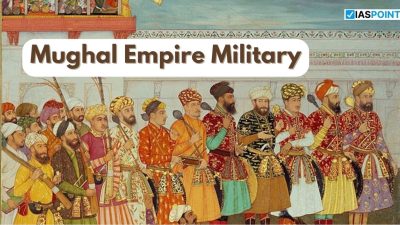
The Mughal army was essential for the establishment and expansion of the Mughal Empire in India from the 16th to the 18th centuries. Originating from Central Asia, the army evolved under Emperor Akbar into a sophisticated military force. By the 17th century, it was one of the largest military forces globally, comprising millions of personnel.
Structure of the Army
The Mughal army was primarily composed of cavalry, infantry, and artillery. The cavalry was the backbone, while infantry units provided support. Artillery, including heavy cannons and rockets, played a vital role in warfare. The army was organised under the command of Mansabdars, who were responsible for recruiting and maintaining troops.
Recruitment and Composition
Mansabdars recruited soldiers based on their ranks, which were determined by the number of horses they maintained. Ranks ranged from 10 to 25,000. The army included a diverse range of ethnicities, such as Persians, Turks, Rajputs, and local Indian Muslims.
Military Innovations
The Mughal army was notable for its use of gunpowder technology. Heavy artillery, including cannons and mortars, was crucial in battles. The Mughals also employed advanced logistical systems to support their military campaigns, ensuring efficient supply lines.
Naval Forces
The Mughal naval forces, known as Amla-e-Nawara, played role in controlling trade routes and combating piracy. The fleet included ships manned by foreign crews, particularly from Portugal. The Mughal navy was instrumental in maintaining maritime security.
Key Battles and Campaigns
The Mughal army engaged in numerous conflicts, including:
- First Battle of Panipat (1526)
- Battle of Khanwa (1527)
- Battle of Haldighati (1576)
- Second Battle of Panipat (1556)
- Mughal–Maratha Wars (1680-1707)
These battles showcased the military prowess and strategic capabilities of the Mughal forces.
Military Tactics
Mughal tactics often involved a combination of cavalry charges and artillery bombardments. The use of elephants in battle was also a key feature, providing both transport and shock value. The army frequently employed guerilla tactics against more powerful foes.
Logistics and Supply Chains
The logistical capabilities of the Mughal army were advanced for its time. Extensive supply chains ensured that troops were well-fed and equipped. The army maintained a large number of camp followers, including artisans and support staff, to sustain military operations.
Weapons and Equipment
The Mughals used a variety of weapons, including swords, bows, and firearms. The Firangi sword, a European-style weapon, became popular among Mughal nobles. Infantry units were equipped with matchlocks and other firearms, which were increasingly adopted during the reign of Akbar.
Role of Elephants
War elephants were a critical component of the Mughal military strategy. They were used for transport and as frontline shock troops. Elephants were often heavily armored and could carry artillery pieces, enhancing their battlefield effectiveness.
Cavalry Forces
The Mughal cavalry was renowned for its speed and agility. Cavalry units were well-trained, often employing archery while mounted. The cavalry’s effectiveness was enhanced by the high-quality horses imported from Central Asia and Arabia.
Infantry Units
Infantry units, while less prestigious than cavalry, were essential for ground operations. They included musketeers, swordsmen, and specialized troops like the Shamsherbaz, who were elite swordsmen used in close combat situations.
Artillery Corps
Mughal artillery was well-developed, featuring various types of cannons and field guns. The Mir-i-Atish commanded the artillery corps, which became increasingly important in sieges and open-field battles. The use of rockets was also notable during this period.
Decline of the Mughal Military
The Mughal military faced challenges in the 18th century, including internal strife and external invasions. The invasion by Nader Shah in 1738 weakened the Mughal military structure. Over time, the British East India Company capitalized on these weaknesses, leading to the eventual decline of Mughal power.
Comparative Analysis
Historians have compared the Mughal military to other great powers, such as the Roman Empire and the British Army. The Mughals’ logistical capabilities and military organisation were often viewed as superior for their time, enabling them to control vast territories.
Legacy of the Mughal Army
The Mughal military legacy influenced subsequent Indian military structures. The integration of diverse ethnicities and the use of advanced warfare techniques set a precedent for future military organisations in India. The Mughal emphasis on cavalry and artillery continued to shape Indian warfare long after the empire’s decline.
Last Modified: December 23, 2024