
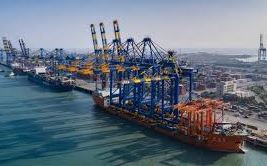
Mundra Port, operated by AdPorts and Special Economic Zone (APSEZ), exported 6,008 cars on a single vessel, becoming India’s largest automobile export hub. The port’s Roll-on/Roll-off (RoRo) terminal facilitates vehicle shipments to over 100 countries. This milestone reflects Mundra’s growing role in India’s automobile export sector.
Automobile Export Volume and Destinations
Mundra Port handles exports of passenger vehicles, two-wheelers, and commercial vehicles. Key export markets include Africa, Latin America, the Middle East, and parts of Europe. The port’s RoRo terminal enables efficient large-scale vehicle shipments, supporting automakers’ global distribution.
Port Infrastructure and Cargo Handling Growth
APSEZ recently crossed 500 million tonnes in cargo handling capacity. Chairman Gautam Adani announced a target of one billion tonnes by 2030. The company’s cargo handling growth accelerated from 100 million tonnes in 16 years to successive 100 million tonne increments in shorter intervals, reaching the latest milestones faster.
Role of Mundra in India’s Export Competitiveness
Mundra Port integrates manufacturing and logistics, enhancing India’s export infrastructure. The modern RoRo terminal supports the country’s position as a major global automobile supplier. The port’s capacity expansion aligns with rising demand for Indian-made vehicles internationally.
Adani Group’s Expansion Strategy
Adani Group emphasises vision and execution to compound growth momentum. The company’s rapid cargo handling increase demonstrates strategic infrastructure development. The expansion aims to strengthen India’s logistics network and global trade links by 2030.
What to Study for UPSC Exams?
- India’s Export Promotion Policies
- Maritime Infrastructure Development
- Global Automobile Trade Patterns
- Special Economic Zones in India
India’s Export Promotion Policies
India’s export promotion policies include schemes like MEIS (Merchandise Exports from India Scheme) and SEIS (Service Exports from India Scheme), aimed at incentivizing exporters. The Foreign Trade Policy (FTP) is revised every five years to boost exports. Export Promotion Councils (EPCs) facilitate sector-specific export growth and policy implementation.
Maritime Infrastructure Development
India’s maritime infrastructure includes 12 major ports and over 200 non-major ports. The Sagarmala Project aims to modernize ports and integrate logistics to reduce costs. India ranks among the top 20 global container ports, with increasing investments in port mechanization and digitalization.
Global Automobile Trade Patterns
Global automobile trade is dominated by Asia, Europe, and North America. China is the largest automobile producer and exporter. Electric vehicle (EV) exports are rapidly growing, reshaping trade flows. Free trade agreements influence tariff structures and supply chain locations.
Special Economic Zones in India
India established SEZs under the SEZ Act, 2005, to promote exports through tax incentives. SEZs contribute over 30% of India’s exports despite covering less than 2% of industrial land. They offer single-window clearances and duty-free imports of raw materials.
Last Modified: April 12, 2026