
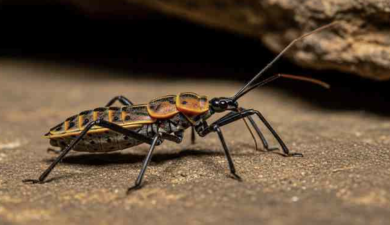
A rare thread-legged assassin bug, first described in 1924 from Siju Cave in Meghalaya, has been rediscovered in limestone caves of the Andaman Islands after a gap of about 100 years. The finding is important for understanding India’s subterranean biodiversity and the ecological value of cave habitats in the archipelago.
Rediscovery After a Century
Two specimens collected from Andaman caves in 2019 were identified as Myiophanes kempi. The species had not been reported since its original description by British entomologist W.E. China in 1924. It had also never been illustrated before. The rediscovery confirms that the species survives in another cave system far from its original locality.
Taxonomic Significance
The Andaman specimens were matched with photographs of one syntype female preserved at the Natural History Museum, London. The original type series was collected from Siju Caves in 1922. The study rediagnosed and redescribed the species after a century, helping clarify its identity within the assassin bug family Reduviidae.
Subterranean Adaptations
- The insect belongs to a specialised group of predators adapted to cave life.
- It completes its entire life cycle in darkness.
- Its long raptorial forelegs help it capture small arthropods.
- Such species are indicators of hidden cave biodiversity.
Conservation and Research Value
The discovery marks how little is known about subterranean ecosystems in the Andaman Islands. It also shows the need for further biological surveys in limestone caves, which may contain many more rare and endemic species. The study was supported by the Ministry of Environment, Forest and Climate Change and The Habitats Trust.
Last Modified: April 29, 2026