
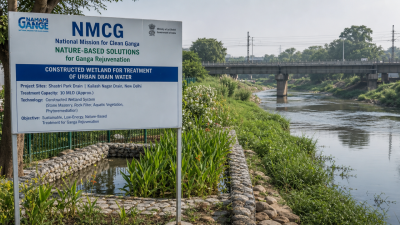
On 9 July 2026 NMCG launched two pilot Nature‑based Solutions (NbS) projects under the Sustainable River Rejuvenation (SRR) programme for in‑situ treatment of urban drains discharging into the Yamuna at Shastri Park and Kailash Nagar (New Delhi), combined capacity ~10 MLD.
Pilot projects & technology
- Sites and capacity: Shastri Park Drain and Kailash Nagar Drain in New Delhi; combined treatment ≈10 MLD.
- Constructed wetland components: stone masonry structures, rock filters, aquatic vegetation and planted beds for phytoremediation.
- Operational status: Kailash Nagar — desludging/desilting complete and brick lining underway; Shastri Park — preparatory cleaning ongoing.
- Design attributes: passive treatment for primary/secondary pollutant removal with lower energy and maintenance compared with conventional plants.
- Replicated example: Khatauli constructed wetland for River Kali (Ganga tributary) focused on low‑energy pollution control and ecological restoration.
Programme, institutions and training
- Programme: Sustainable River Rejuvenation (SRR) integrates NbS with conventional wastewater treatment for basin‑level river management.
- Implementing agency: National Mission for Clean Ganga (NMCG).
- Capacity building: KSDC ran six training programmes (Aug 2025–Mar 2026) for 100+ officials from Yamuna Task Force, District Ganga Committees, State Mission for Clean Ganga, Forest and Irrigation Departments.
IASPOINT Booster Facts
- Constructed wetland process: combines physical settling, filtration, microbial degradation and plant uptake (phytoremediation).
- In‑situ treatment: treats wastewater at source (urban drains) before river entry, reducing pollutant loads downstream.
- Scale note: 1 MLD = 1 million litres per day; pilot combined ≈10 MLD.
- River linkage: River Kali is a tributary of the Ganga; Khatauli project targets its rejuvenation using NbS.