
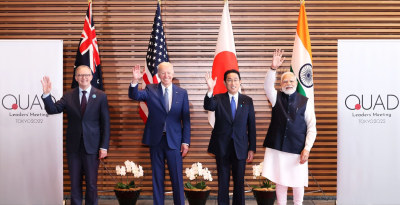
The year 2025 emerged as a moment of sharp geopolitical disruption, triggered most visibly by the return of Donald Trump to the White House. As strategic uncertainty deepened across regions, the Indo-Pacific consolidated its position as the world’s most contested geopolitical theatre, reflecting intensifying competition between China and the United States. In this churn, the Quadrilateral Security Dialogue (Quad) continued to occupy a central — though tested — role in Washington’s Indo-Pacific strategy.
Why the Indo-Pacific sits at the heart of global power shifts
The Indo-Pacific combines economic dynamism, critical sea lanes and geopolitical vulnerability. It hosts vital maritime chokepoints, underpins global supply chains and has become the primary arena where competing visions of regional order collide. For the U.S. and its partners, the idea of a “free, open and inclusive Indo-Pacific” signifies a commitment to international law, freedom of navigation and sovereign equality — principles increasingly challenged by China’s expanding strategic footprint.
The Quad, comprising India, Australia, Japan and the U.S., has positioned itself as a flexible platform to uphold this rules-based order without evolving into a formal military alliance.
From tsunami relief to strategic coordination
The Quad’s origins lie in 2004, when the four countries coordinated humanitarian assistance after the Indian Ocean tsunami. That early cooperation faded as members recalibrated ties with China. The grouping regained momentum in 2017, driven by converging threat perceptions and with “” playing a decisive role in its revival.
Since then, the Quad has expanded its agenda beyond maritime security to include health security, climate resilience, critical technologies and infrastructure — projecting itself as a provider of regional and global public goods.
‘America First’ and doubts around U.S. commitment
Trump’s emphasis on the “America First” doctrine initially raised concerns about the durability of U.S. engagement with multilateral groupings like the Quad. However, early diplomatic signals suggested continuity rather than withdrawal. The Foreign Minister-level Quad meetings hosted in Washington by U.S. Secretary of State “” in January and July 2025 underscored that the grouping remained a priority for the administration.
Despite this, the Quad was unable to convene a leader-level summit in 2025, one that was scheduled to be hosted by India, leading to speculation about waning political momentum.
A year of interregnum, not retreat
Since its revival, the Quad has held six leader-level summits between 2021 and 2024. The most recent, in Wilmington, Delaware, in 2024, also marked the farewell of U.S. President “”. These summits have historically been the primary venues for announcing new initiatives and signalling strategic intent.
The absence of a leaders’ summit in 2025 — especially amid leadership changes in both the U.S. and Japan under Prime Minister Sanae Takaichi — made the year one of pause rather than decline, exposing the Quad’s dependence on top-level political engagement.
Operational continuity amid political uncertainty
Even without a leaders’ meeting, the Quad demonstrated institutional resilience. Initiatives such as the Quad-at-Sea Ship Observer Mission advanced coast guard cooperation, while the Ports of the Future Partnership promoted sustainable and resilient port infrastructure across the Indo-Pacific. The Malabar naval exercise, though not formally under the Quad’s banner, further strengthened maritime interoperability among the four navies.
These developments indicate that the Quad has developed sufficient bureaucratic and strategic ballast to endure short-term political disruptions.
Why leader-level engagement remains indispensable
For a grouping without a treaty base or permanent secretariat, leader-level summits perform a critical function: they provide strategic direction, reinforce political trust and sustain momentum. Testifying before the in October 2025, U.S. Ambassador to India “” indicated that diplomatic efforts were underway to convene a leaders’ summit in early 2026.
Such a meeting would reaffirm the Quad’s relevance at a time when Indo-Pacific stability is under growing strain.
What to note for Prelims?
- Members of the Quad and its revival in 2017.
- Concept and significance of a free, open and inclusive Indo-Pacific.
- Major Quad initiatives and areas of cooperation.
- Difference between strategic groupings and formal alliances.
What to note for Mains?
- Evaluate the Quad’s role in maintaining a rules-based order in the Indo-Pacific.
- Impact of U.S. domestic political shifts on regional multilateralism.
- Strengths and limitations of the Quad’s non-institutional structure.
- India’s strategic interests in sustaining Quad cohesion.