
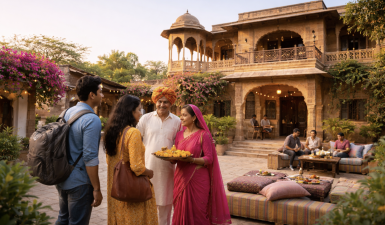
Rajasthan has unveiled a simplified ‘Rajasthan Homestay (Paying Guest House) Scheme – 2026’, aiming to deepen tourism penetration while strengthening rural livelihoods. Announced by Additional Chief Secretary (Tourism) Praveen Gupta, the policy comes at a time when the state has recorded robust tourist growth, positioning itself as one of India’s most visited destinations.
Tourism Growth Driving Policy Reform
Rajasthan witnessed a 9.74% rise in tourist footfall in 2025 compared to the previous year. Official data show that over 25.44 crore tourists visited the state, of which more than 25.25 crore were domestic travellers.
With heritage cities like [“Jaipur”,”rajasthan india”], desert destinations such as [“Jaisalmer”,”rajasthan india”], and cultural hubs like [“Udaipur”,”rajasthan india”], the state’s tourism economy continues to expand. The new homestay policy is designed to diversify accommodation options and spread tourism benefits beyond major urban centres.
What the Homestay Scheme 2026 Proposes
The revised policy simplifies licensing and promotes decentralised implementation.
Key reforms include:
- Single-window clearance system.
- Digital application and approval process.
- Reduced documentation requirements.
- Registration through local Tourism Department offices and Tourist Reception Centres (TRCs).
The objective is to encourage small investors, rural households, and women entrepreneurs to participate directly in tourism-driven economic activity.
Expanded Operational Flexibility
The 2026 policy introduces several structural changes:
- Maximum rooms per residential unit increased from five to eight.
- Maximum bed capacity capped at 24.
- Removal of the earlier rule mandating that the owner or family member reside on the premises.
- Provision for operation by owner, lessee, or designated caretaker.
This flexibility is expected to attract a broader range of stakeholders, including absentee property owners and professional operators.
Infrastructure and Compliance Requirements
To ensure quality and safety standards, each homestay must:
- Operate within a fully residential complex.
- Provide attached bathrooms and toilets for rented rooms.
- Ensure adequate water supply, electricity, ventilation, and sanitation.
- Meet prescribed fire safety norms.
- Comply with parking and waste disposal regulations.
Additionally, homestays must maintain guest registers for at least seven years and report foreign visitor details to relevant authorities, ensuring compliance with security and regulatory frameworks.
Boosting Rural Economy and Cultural Tourism
The scheme is positioned as a tool for rural income growth and self-employment. By enabling households to monetise spare rooms, the state aims to:
- Enhance income diversification in rural areas.
- Promote family-based tourism experiences.
- Encourage authentic cultural exchanges.
- Reduce pressure on conventional hotel infrastructure.
Homestays also align with the broader vision of sustainable and community-led tourism, where local participation ensures equitable distribution of economic gains.
Policy Implications and Challenges
While the simplified framework may accelerate growth, certain challenges remain:
- Monitoring quality standards across dispersed rural units.
- Balancing ease of doing business with safety compliance.
- Ensuring environmental sustainability amid increased tourism.
- Maintaining security protocols, especially for foreign guests.
Effective local-level governance and digital monitoring will be critical to avoid regulatory dilution.
What to Note for Prelims?
- Rajasthan Homestay (Paying Guest House) Scheme – 2026.
- Maximum eight rooms and 24 beds per unit.
- Single-window digital registration system.
- Owner residency requirement removed.
- Mandatory guest register maintenance for seven years.
- Over 25.44 crore tourists visited Rajasthan in 2025.
What to Note for Mains?
- Discuss the role of homestay policies in promoting rural tourism.
- Examine how tourism-led growth can strengthen local economies.
- Analyse regulatory challenges in decentralised tourism models.
- Evaluate the importance of balancing ease of doing business with safety and sustainability norms in the hospitality sector.