
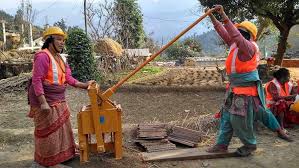
The Viksit Bharat – Guarantee for Rozgar and Ajeevika Mission (Gramin) Act, 2025 (VB-G RAM G Act), which replaces the Mahatma Gandhi National Rural Employment Guarantee Act, has received the President’s assent. The law marks a decisive shift in India’s approach to rural employment and welfare, raising fundamental questions about the constitutional idea of the right to livelihood, the federal balance, and the future of rights-based social protection.
MGNREGA and the constitutional idea of livelihood
Article 21 of the Constitution guarantees the right to life. In Olga Tellis v. Bombay Municipal Corporation (1985), the Supreme Court held that the right to livelihood is an intrinsic part of this guarantee, reasoning that life without the means of subsistence would be meaningless. MGNREGA translated this constitutional principle into a statutory, justiciable right.
Unlike earlier public works programmes, MGNREGA recognised:
- the right to demand work,
- the right to unemployment allowance if work was not provided within 15 days,
- the right to timely payment of wages and compensation for delays, and
- gender parity and minimum wages.
In doing so, it framed employment not as state benevolence but as a legal entitlement tied to citizenship and dignity.
Why MGNREGA was different from earlier schemes
MGNREGA was the product of sustained social mobilisation and was passed unanimously by Parliament. It also served multiple objectives simultaneously: income security, ecological regeneration through durable asset creation, and democratic decentralisation via Panchayati Raj institutions under the 73rd Constitutional Amendment.
Five broad outcomes became evident over time:
- its universal, non-targeted character,
- increased rural incomes and reduced poverty,
- mitigation of caste and gender inequalities,
- creation of productive rural assets, and
- community empowerment through local planning.
Empirical studies showed rising household incomes, improved school enrolment, and a decline in dependence on moneylenders. Women’s participation consistently hovered around 58%, with nearly half of female workers entering paid work for the first time through the programme. Even institutions such as the World Bank, initially critical, later described MGNREGA as a “stellar example” of rural development.
The slow erosion of a rights-based framework
Despite its achievements, MGNREGA was weakened over the past decade through chronic underfunding and administrative constraints. Wage delays became routine, forcing officials to ration work. Technocratic measures such as photo-based attendance systems and complex payment architectures increased exclusions and widened the gap between workers and administrators.
Oversight mechanisms, particularly social audits designed to check corruption, were themselves underfunded. Staff shortages further eroded accountability. Against this backdrop, the VB-G RAM G Act was passed, fundamentally altering the architecture of rural employment guarantees.
From demand-driven to command-driven employment
The most consequential shift lies in how work is allocated. Section 5(1) of the new Act grants the Union government wide discretion to decide where, what and how public works are undertaken. Section 4(5) introduces “State-wise normative allocations” determined by the Centre, replacing the demand-driven logic of MGNREGA with a centrally controlled, allocation-based model.
This compromises local autonomy and weakens the role of Panchayati Raj institutions. States become implementers rather than co-equal partners, undermining the spirit of decentralisation embedded in the original framework.
Fiscal restructuring and its implications
Under MGNREGA, roughly 90% of expenditure was borne by the Union government. The new Act alters this balance to a 60:40 Centre–State funding ratio for most States. Additionally, any expenditure beyond a State’s normative allocation must be borne entirely by the State.
Combined, these provisions risk:
- political favouritism in allocations,
- fiscal stress on poorer States, and
- suppression of work demand to avoid budget overruns.
Such constraints may lead to increased unemployment and distress migration, particularly among landless households and women.
Seasonal exclusions and social inequality
Section 6(2) of the new Act permits denial of employment for up to 60 days during the agricultural season. While framed as administrative rationalisation, this provision risks reinforcing existing land, caste and gender hierarchies. For landless labourers and women, year-round access to work has been critical for income stability and bargaining power.
By legally separating farmers’ interests from those of labourers, the Act overlooks evidence that MGNREGA also benefits small and marginal farmers through asset creation and local demand generation.
Promises without safeguards
The Act claims to guarantee 125 days of employment per household annually. However, with average employment under MGNREGA hovering around 50 days in recent years due to funding constraints, this promise appears aspirational rather than credible. Crucially, the new law introduces no additional anti-corruption mechanisms, nor does it strengthen existing ones.
It also departs from established judicial principles. In the Swaraj Abhiyan case, the Supreme Court held the Union government liable for compensation due to wage delays. The new Act imposes no such obligation on the Centre.
What to note for Prelims?
- VB-G RAM G Act, 2025 and its replacement of MGNREGA
- Right to livelihood under Article 21
- Olga Tellis judgment
- Shift from demand-driven to allocation-based employment
What to note for Mains?
- Rights-based welfare versus discretionary welfare models
- Federal implications of Centre-controlled funding norms
- Impact on rural employment, migration and inequality
- Constitutional status of the right to work and livelihood
MGNREGA embodied Mahatma Gandhi’s vision of local self-governance and B.R. Ambedkar’s insistence on enforceable rights for citizens. By formalising years of gradual dilution, the new Act signals a departure from that legacy. Whether this represents reform or retreat will shape the future of India’s rural social contract.
Last Modified: December 24, 2025