
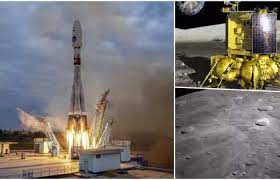
On August 11, the Russian space agency, Roscosmos, launched its Luna 25 spacecraft using a Soyuz 2 rocket from the Vostochny Cosmodrome. The primary objective of Luna 25 was to perform a soft landing near the moon’s south pole, conducting an in-depth study of moondust and soil, as well as analyzing the lunar atmosphere. However, on August 20, Roscosmos announced that Luna 25 had encountered a glitch, resulting in a crash on the lunar surface the previous day. This unexpected failure highlights not only the challenges of autonomously landing on the moon but also raises broader questions about the mission’s purpose and implications.
Objective behind Luna 25
The concept of Luna 25 dates back over two decades, originally known as Luna-Glob before being incorporated into the Luna series. This series has historical significance, with the last mission, Luna 24, launched in 1976. Roscosmos justified launching Luna 25 by emphasizing its aim to secure Russia’s access to the moon’s surface. This gesture serves as a symbolic statement in the context of the intensifying competition between major spacefaring nations like the United States and China, both of which are focusing on lunar exploration. Additionally, some experts speculate that Luna 25 may also represent President Vladimir Putin’s attempt to showcase Russia’s economic resilience, particularly in the wake of international sanctions following the country’s actions in Ukraine.
Lunar Missions Comparison
Contrary to popular perception, the notion that Luna 25 and Chandrayaan 3 (a mission by the Indian Space Research Organisation) were in direct competition is flawed. Both missions launched around the same time and aimed for soft landings on the moon. However, mission timelines are determined by factors such as spacecraft mass, launch vehicle capabilities, and trajectory considerations. Furthermore, the unforeseen impacts of the COVID-19 pandemic caused delays for both missions. It’s important to note that Russia’s withdrawal from contributing to Chandrayaan 2 due to its own setbacks underscores the complexity of interplanetary missions.
Communication Challenges and International Sanctions
The inability to rescue Luna 25 was amplified by Russia’s strained international relationships. Following its actions in Ukraine, Russia faced extensive economic sanctions and lost privileges to use satellite tracking systems operated by other countries. As a result, communication with Luna 25 was limited to Russian-operated stations, drastically reducing the window for communication and problem-solving. Unlike other lunar missions with widespread international support, Roscosmos faced unique communication challenges that affected its response to the mission failure.
Future Implications and Prospects
The failure of Luna 25 underscores Russia’s growing struggle to maintain a competitive edge in lunar exploration. While it had previously collaborated with NASA on lunar endeavors, Russia’s limited role in these partnerships was evident. In the context of the International Lunar Research Station (ILRS), Roscosmos had plans for Luna missions 26 and 27, aimed at technology demonstration and site selection for future lander missions. However, the failure of Luna 25 and the constraints posed by Western sanctions could lead to further delays in Russia’s lunar exploration efforts.
UPSC Mains Questions
- How does the failure of Luna 25 reflect the broader geopolitical competition between major spacefaring nations?
- To what extent have international sanctions impacted Russia’s space exploration capabilities and its ability to collaborate with other nations?
- How do the communication challenges faced by Roscosmos during the Luna 25 mission highlight the importance of international cooperation in space missions?
- Considering the setbacks and limitations, what strategies should Russia adopt to regain its position in lunar exploration and compete effectively with other space agencies?