
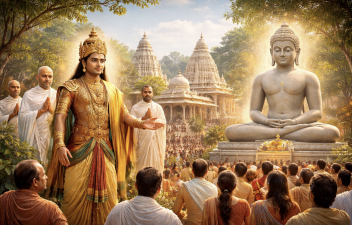
Recent developments mark recognition of Jain history. On Mahavir Jayanti, March 31, 2026, Prime Minister Narendra Modi inaugurated the Samrat Samprati Museum in Gandhinagar. The museum honours Samprati, grandson of Mauryan emperor Ashoka, who played a vital role in spreading Jainism. Unlike Ashoka, famed for promoting Buddhism, Samprati is celebrated for his dedication to Jain faith and its expansion across India and beyond.
Mauryan Empire and Religious Context
The Mauryan Empire thrived in the 3rd century BCE under Ashoka, who embraced Buddhism and spread its teachings widely. Despite this, Jainism remained influential. Ashoka’s family had Jain connections; his first wife, Padmavati, was Jain. His grandfather Chandragupta Maurya is also revered in Jain traditions, particularly by the Digambara sect. After Ashoka’s death, the empire likely split between his grandsons Dasharatha and Samprati.
Samprati’s Reign and Jain Patronage
Samprati ruled circa 230-220 BCE. Jain texts show his conversion under monk Suhastin, Mahavira’s eighth disciple. He adopted Jain rituals and icon worship. Unlike Ashoka’s Buddhist mission, Samprati’s efforts centred on temple building, icon installation, and supporting monks. He is credited with constructing over 125,000 temples and consecrating millions of icons, spreading Jainism deeply in western and southern India.
Geographical Spread and Cultural Impact
Samprati’s influence extended beyond India, reaching regions like China, Burma, Nepal, and Central Asia. His promotion of Jainism included facilitating monk travel and establishing charitable centres. This missionary zeal resembles Ashoka’s Buddhist propagation but focused on Jain ritual culture. His legacy remains strong in western India, where many ancient Jain temples are attributed to him.
Religious Legacy and Historical Significance
Samprati is a key figure in Jain history, paralleling Ashoka’s stature in Buddhism. His dedication ensured Jainism’s survival and growth during a period dominated by Buddhism. His temple-building and icon installations helped establish Jainism as a major religious tradition. The Samrat Samprati Museum now preserves and promotes this legacy.
Topics for Prelims:
Samrat Samprati
- Grandson of Emperor Ashoka.
- Reigned circa 230-220 BCE.
- Converted to Jainism under monk Suhastin.
- Built over 125,000 Jain temples.
- Spread Jainism across India and beyond.
Mauryan Empire
- Founded by Chandragupta Maurya in 4th century BCE.
- Ashoka expanded the empire and embraced Buddhism.
- Empire divided after Ashoka’s death among grandsons.
- Known for administrative order and religious patronage.
- Key role in spreading Buddhism and Jainism.
Jainism
- Ancient Indian religion focused on non-violence and asceticism.
- Mahavira is the 24th Tirthankara and key figure.
- Divided into Digambara and Shvetambara sects.
- Emphasises karma, liberation, and ethical conduct.
- Spread historically through temple building and missionary work.
Questions for Mains:
- Critically analyse the role of Mauryan rulers in the propagation of Buddhism and Jainism in ancient India. [GS-I-Modern Indian History]
- Explain the significance of temple building and iconography in the spread of Jainism and Buddhism during the Mauryan period. [GS-I-Indian Culture]
- With suitable examples, comment on how religion influenced political authority and empire-building in ancient India. [GS-II-Constitution of India & Polity]
- What are the challenges in interpreting ancient historical narratives from religious texts, and how can historians address these issues? [GS-I-Modern Indian History]
Answer Hints:
1. Critically analyse the role of Mauryan rulers in the propagation of Buddhism and Jainism in ancient India. [GS-I-Modern Indian History]
- Ashoka embraced Buddhism, spreading it widely via missions across India and beyond (Sri Lanka, SE Asia).
- He institutionalized Buddhist moral governance, promoting dhamma and non-violence.
- Despite Ashoka’s Buddhist patronage, Jainism remained influential, linked to Mauryan family (Padmavati, Chandragupta Maurya).
- Samprati, Ashoka’s grandson, converted to Jainism and actively propagated it through temple building and icon installation.
- Mauryan rulers used religion to legitimize authority and unify diverse populations.
- Religious patronage under Mauryas shows coexistence and competition between Buddhism and Jainism.
2. Explain the significance of temple building and iconography in the spread of Jainism and Buddhism during the Mauryan period. [GS-I-Indian Culture]
- Ashoka popularized stupas and Buddhist ritual culture, facilitating devotion and pilgrimage.
- Samprati constructed over 125,000 Jain temples and installed millions of icons, promoting Jain ritual worship.
- Temples and icons served as focal points for community identity and religious continuity.
- Material culture helped spread teachings beyond monks, engaging lay followers visually and ritually.
- Iconography standardized religious symbols, aiding recognition and transmission across regions.
- Temple-building supported missionary activities and cultural integration in distant lands.
3. With suitable examples, comment on how religion influenced political authority and empire-building in ancient India. [GS-II-Constitution of India & Polity]
- Mauryan rulers like Ashoka used Buddhism to legitimize moral governance and non-violent rule.
- Religious patronage helped consolidate political authority by uniting diverse ethnic and social groups.
- Samprati’s Jain patronage reinforced his sovereignty and expanded influence through religious networks.
- Religious leaders (e.g., monks) acted as advisors and diplomats, linking polity with spiritual authority.
- Religious ideology shaped laws and social norms, influencing empire administration.
- Temple and monument building symbolized imperial power and cultural hegemony.
4. What are the challenges in interpreting ancient historical narratives from religious texts, and how can historians address these issues? [GS-I-Modern Indian History]
- Religious texts often mix mythology, hagiography, and historical facts, complicating factual accuracy.
- Bias exists due to sectarian interests, promoting particular religious agendas.
- Chronological inconsistencies and lack of corroborating archaeological evidence pose dating difficulties.
- Historians use cross-disciplinary methods – archaeology, epigraphy, numismatics to validate narratives.
- Comparative study of multiple sources (Buddhist, Jain, Brahmanical) helps triangulate facts.
- Critical textual analysis and contextualization within socio-political settings mitigate interpretive errors.