Centre-State relations are fundamental to India's federal structure. They define the interaction between the central government and state governments. The Constitution of India outlines these relations in three...
Federalism is a governance structure where power is shared between a central authority and regional governments. It aims to balance independence and cooperation among different levels of government....
A parliamentary group, often termed a parliamentary party or caucus, is composed of members from the same political party or coalition within a legislative assembly. This assembly may...
Parliamentary committees are small groups formed by members of Parliament (MPs) to perform specific functions. They scrutinize legislation, examine policies, conduct inquiries, and oversee the functioning of government...
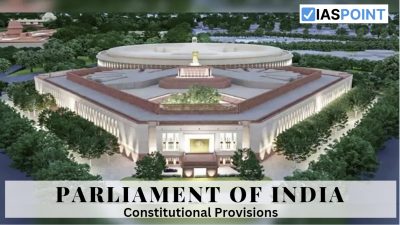
The Parliament of India is the supreme legislative body of the country. It operates under a bicameral system, comprising two houses - the Lok Sabha (House of the...
Urban local bodies (ULBs) in India have a rich history. Their origins can be traced back to ancient times when local councils managed urban affairs. These councils were...
Panchayati Raj is a three-tier system of local self-government in rural India. It aims to promote self-governance and community participation in development. This system is established in all...
The State Legislature in India typically consists of the Governor and the Legislative Assembly, known as the Vidhan Sabha. This structure is referred to as a unicameral legislature....
The State Council of Ministers (CoM) is the executive authority in states of India. The CoM operates under the guidance of the Chief Minister and is responsible for...
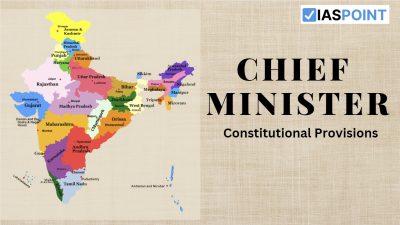
The Chief Minister (CM) is the real head of the state government in India. Unlike the Governor, who serves as the nominal executive, the CM is the real...