The Governor is the highest constitutional authority in a state in India. This role serves as both the nominal executive head and an agent of the Central Government....
Cabinet Committees are essential components of India's governance structure. They consist of senior ministers and are chaired by the Prime Minister. These committees facilitate focused discussions on critical...
The Union Council of Ministers (CoM) is the executive body of the Union Government of India. It plays important role in shaping national policy and implementing laws. The...
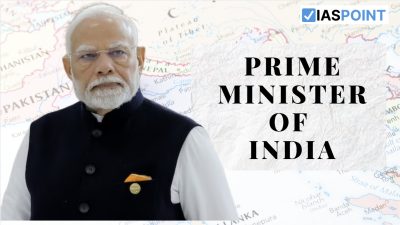
The Prime Minister of India is the real head of the government and the leader of the Council of Ministers. The position of the Prime Minister is central...
The Vice President of India is the second-highest constitutional office in the country, following the President. The Vice President serves as the ex-officio Chairman of the Rajya Sabha,...
The President of India serves as the head of state and the first citizen of the nation. The role is largely ceremonial but holds constitutional powers. The President...
The Constitution of India is a dynamic document that can be amended to address evolving societal needs. As of January 2025, there have been 106 amendments to the...
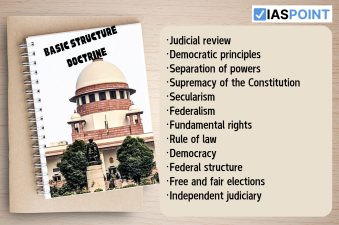
The Basic Structure Doctrine is a judicial principle in India. It asserts that certain fundamental features of the Constitution cannot be altered or destroyed by amendments. This doctrine...
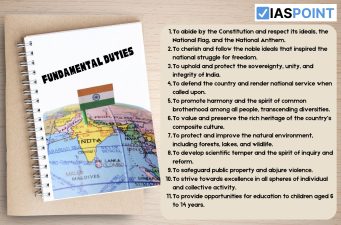
Fundamental Duties are a set of moral obligations for citizens in India. They were incorporated into the Constitution of India by the 42nd Amendment in 1976. This addition...
Directive Principles of State Policy (DPSP) are guidelines for the State in India. They are enshrined in Part IV of the Constitution of India, encompassing Articles 36 to...