
India’s solid waste crisis has long exposed the limits of landfill-centric urban governance. With the notification of the Solid Waste Management (SWM) Rules, 2026, the Union government has attempted a decisive reset — shifting the focus from dumping and disposal to reduction, segregation, and recovery. The new rules, notified by the Ministry of Environment, Forest and Climate Change, will come into force on April 1, 2026, replacing the decade-old SWM Rules of 2016.
Why the Centre felt the need for new rules
India generates more than 620 lakh tonnes of solid waste annually — about 1.85 lakh tonnes every day. Yet, despite improvements in collection, processing remains uneven. According to Central Pollution Control Board data for 2023–24, while most waste is collected, a large share is either poorly processed or dumped in landfills.
The 2016 rules laid the foundation for segregation and scientific disposal, but enforcement gaps, weak accountability of large waste generators, and over-dependence on landfills persisted. The 2026 rules respond to this reality by embedding circular economy principles directly into regulatory obligations.
From disposal to circular economy thinking
A defining feature of the 2026 framework is the explicit adoption of a waste hierarchy. Prevention and reduction now sit at the top, followed by reuse, recycling and recovery, with disposal treated strictly as a last resort.
This marks a conceptual shift. Instead of managing waste after it is generated, the rules seek to influence behaviour at the point of generation — especially among bulk waste producers — to reduce the load on municipal systems and landfills.
Four-way segregation replaces the old binary model
The earlier wet–dry segregation model has been expanded into a four-way system:
- Wet waste (biodegradable)
- Dry waste (recyclable)
- Sanitary waste (sanitary pads, tampons, condoms)
- Special care waste (medicines, paint cans, bulbs, tube lights)
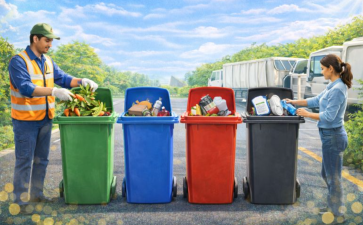
Urban local bodies are now required to align public infrastructure with this system, including separate colour-coded bins. This aims to improve downstream processing and reduce contamination that makes recycling unviable.
Bulk waste generators under sharper scrutiny
One of the most significant changes is the expanded responsibility placed on bulk waste generators — large residential societies, malls, hotels, institutions, and government establishments meeting specified thresholds of area, water use or waste generation.
These entities will be required to segregate waste at source, maintain waste accounts, and either process wet waste on-site or formally tie up with authorised processing facilities. Compliance will be monitored through mandatory registration on a centralised portal and annual returns.
This introduces a system of certification-based compliance, moving beyond voluntary or loosely enforced obligations.
Polluter pays principle enters everyday waste governance
The 2026 rules operationalise the polluter pays principle more clearly than before. Non-compliance — including failure to register, false reporting, or improper disposal — will attract environmental compensation.
Crucially, sending unsegregated waste to landfills will become more expensive through higher landfill fees. This creates a financial disincentive for mixed waste dumping, nudging both local bodies and bulk generators towards segregation and processing.
Digital tracking of the waste lifecycle
A centralised online portal will track waste from generation to disposal. Urban local bodies, bulk generators, transporters, processors, waste pickers, and large infrastructure operators such as airports and railways must register.
This system is intended to bring transparency to a sector historically plagued by weak data and fragmented oversight, enabling regulators to monitor compliance and flows in real time.
What changes for housing societies and institutions
Residential societies and institutions will face obligations similar to extended producer responsibility regimes seen in plastics and e-waste. They must either manage wet waste on-site through composting or secure certified arrangements with local bodies or private processors.
Annual disclosures by June 30 will become mandatory, and failure to comply will invite penalties. The intent is clear: decentralise waste processing and reduce municipal dependence on landfills.
Landfills as the last, not default, destination
The rules sharply restrict the role of landfills. Only non-recyclable, non-recoverable waste may be sent for final disposal. All urban local bodies must map legacy dumpsites by October 31, 2026, and prepare time-bound plans for biomining and bioremediation.
Waste with sufficient calorific value must be diverted to energy recovery, including refuse-derived fuel and co-processing in cement and thermal plants. Industries have been given phased targets to substitute conventional fuels with waste-derived alternatives.
Why the 2026 rules matter beyond waste
The SWM Rules, 2026 go beyond sanitation. They touch urban planning, public health, climate mitigation, and resource efficiency. By embedding circular economy principles into municipal regulation, the rules attempt to transform waste from an environmental liability into an economic and energy resource.
Whether this transition succeeds will depend less on the text of the rules and more on enforcement capacity, municipal finances, and behavioural change among citizens and bulk generators.
What to note for Prelims?
- SWM Rules, 2026: key features and enforcement timeline.
- Four-way waste segregation categories.
- Polluter pays principle in solid waste management.
- Biomining and bioremediation of legacy landfills.
What to note for Mains?
- Evaluate the shift from landfill-centric to circular economy-based waste governance.
- Discuss the role of bulk waste generators in urban environmental management.
- Analyse implementation challenges of solid waste rules in Indian cities.
- Link waste management reforms with climate and energy goals.