
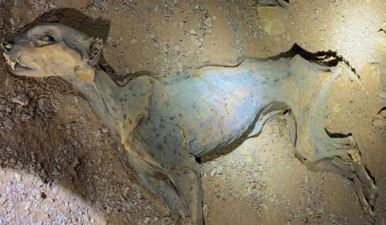
The cheetah, the world’s fastest land mammal, is also among its most vulnerable big cats. Once ranging across much of Africa and Asia, it has disappeared from over 90% of its historical range. A recent scientific discovery from caves in northern Saudi Arabia has reopened questions about the animal’s past distribution — and its possible future — in West Asia.
Why the cheetah matters in conservation debates
Cheetahs occupy a unique ecological niche as medium-sized apex predators adapted to open landscapes. Unlike other big cats, they rely on speed rather than strength, hunt during the day, and coexist uneasily with humans. Their decline is often seen as an early warning of ecosystem stress — signalling habitat fragmentation, prey loss, and breakdowns in human–wildlife coexistence.
The Saudi cave discovery: what was found
Scientists recently reported the discovery of seven naturally mummified cheetahs and skeletal remains of 54 individuals from the Lauga cave network in northern Saudi Arabia. Radiocarbon dating shows the remains span a wide period — from over 4,200 years ago to just over a century ago — indicating a long-term presence of cheetahs in the region rather than a brief or marginal one.
Advanced methods were used:
- Palaeo-chronological dating to establish timelines
- Genomic sequencing to identify subspecies
- Radiographic analysis to determine age and condition
What genetics reveals about lost populations
Genomic analysis identified two subspecies in the Saudi remains:
- Asiatic cheetah (Acinonyx jubatus venaticus)
- North-west African cheetah (Acinonyx jubatus hecki)
Neither subspecies survives today on the Arabian Peninsula. Interestingly, prehistoric Saudi cheetahs were found to be genetically closest to the north-west African subspecies, suggesting historical connectivity between Saharan Africa and Arabia — likely facilitated by climatic phases when deserts were greener and more hospitable.
Why did cheetahs vanish from Arabia?
While historical documentation is sparse, researchers point to a familiar combination of pressures:
- Habitat loss and fragmentation
- Decline of wild prey species
- Human–wildlife conflict
- Unregulated hunting and capture for trade or sport
Cheetahs’ diurnal hunting habits and preference for open terrain made them especially vulnerable to human persecution.
Rewilding ambitions and Saudi Arabia’s policy shift
Over the past five decades, Saudi Arabia has significantly reoriented its wildlife policy. Part of its biodiversity strategy now focuses on restoring species to their former biogeographic ranges. Successes include the revival of Arabian oryx, gazelles, and Nubian ibex. With ungulate populations recovering, researchers argue that conditions may be emerging for the return of extirpated carnivores such as the cheetah.
Ecological feasibility and expert concerns
According to wildlife biologist Ravi Chellam, who has tracked India’s Project Cheetah, reintroduction decisions are ultimately sovereign choices but must meet ecological thresholds. Evidence suggests that at least 1 lakh sq. km of contiguous, low-disturbance habitat with adequate prey density is needed to sustain a viable cheetah population in desert and semi-desert landscapes.
He also cautions against sourcing animals from critically endangered populations. With fewer than 50 Asiatic cheetahs surviving in Iran, removing individuals could jeopardise the subspecies’ survival.
The donor dilemma: where would cheetahs come from?
The north-west African cheetah, genetically closest to the prehistoric Saudi population, is itself endangered. This leaves conservation planners with difficult choices — potentially sourcing animals from more stable African subspecies, even if they are not genetically identical to the historical population.
Molecular ecologist Liz Kierepka has warned that relocating animals from already small populations can create new genetic and ecological risks. More data, she argues, is essential before any rewilding effort proceeds.
Why caves matter to biodiversity science
Beyond cheetahs, the discovery highlights caves as crucial archives of ancient biodiversity. In arid environments, natural mummification can preserve DNA for thousands of years, offering rare insights into species distribution, evolution, and extinction processes — especially outside ice-age permafrost regions.
What to note for Prelims?
- Asiatic cheetah is critically endangered; ~50 remain in Iran
- Cheetahs extinct in India since 1952; in Saudi Arabia for over a century
- Saudi cave finds date from ~4,200 years ago to recent historical times
- Two subspecies identified: A. j. venaticus and A. j. hecki
- Caves as repositories of ancient DNA in arid regions
What to note for Mains?
- Rewilding as a conservation strategy: ecological vs ethical trade-offs
- Role of genetics in species reintroduction decisions
- Human–wildlife conflict as a driver of large carnivore decline
- Comparative lessons from Project Cheetah and West Asian conservation
- Climate history and biogeographic connectivity between Africa and Arabia