
India’s decision to earmark ₹20,000 crore over five years for carbon capture, utilisation and storage (CCUS) marks a strategic shift in its climate policy. At a time when industrial output and infrastructure expansion are expected to push emissions upward, the budget signals recognition that renewable energy alone cannot deliver deep decarbonisation. Technologies that deal directly with industrial carbon dioxide are now central to India’s long-term net-zero pathway.
What are carbon capture, utilisation and storage solutions?
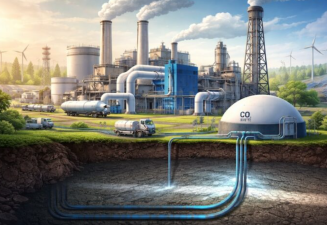
Carbon capture, utilisation and storage refers to a group of technologies aimed at preventing carbon dioxide (CO₂) released during industrial processes from entering the atmosphere. The first step involves capturing CO₂ at source — from power plants, cement kilns, steel furnaces or refineries. Once captured, the gas can either be stored for long periods in suitable geological formations beneath the Earth’s surface or converted into value-added products such as chemicals, fuels or construction materials.
CCUS is not a single technology but an umbrella term covering multiple approaches, including chemical absorption, membrane separation and mineralisation. While the scientific principles have been known for decades, large-scale deployment has remained limited because of high costs, safety concerns and difficulties in scaling these systems for continuous industrial use.
Why CCUS is critical to global climate goals
Globally, nearly 40 billion tonnes of CO₂ are emitted every year, while only about 50 million tonnes are currently captured and stored or utilised. This gap underlines why emission reductions alone are proving insufficient. Most global climate models now agree that without large-scale deployment of CCUS, limiting global warming and achieving net-zero emissions by mid-century will be extremely difficult, especially for sectors where emissions cannot be eliminated through clean energy substitution.
India’s emissions trajectory and net-zero commitment
India expects its emissions to rise in the near and medium term due to construction, urbanisation and industrial growth. In sectors such as cement and steel, carbon dioxide emissions are inherent to the production process itself, not merely a result of fossil fuel use. Even a complete switch to renewable electricity would leave a substantial portion of emissions untouched. For these hard-to-abate sectors, CCUS remains the only viable pathway to deep decarbonisation, making it central to India’s net-zero target for 2070.
Building indigenous CCUS capacity
Following its net-zero announcement at the Glasgow climate conference in 2021, India has stepped up efforts to develop homegrown CCUS solutions suited to domestic conditions. Pilot and demonstration projects are already underway in steel, cement and chemical industries, and potential sites for large-scale carbon storage have been identified. Dedicated research centres, including those at , are working on capture materials, transport safety and storage integrity. In December last year, the Department of Science and Technology released a CCUS R&D roadmap up to 2030, identifying technological, financial and policy bottlenecks.
Why the ₹20,000 crore allocation matters
The biggest obstacle for CCUS in India has been the transition from laboratory success to commercial deployment. Many capture and utilisation technologies have demonstrated promise in controlled settings but require large investments to test their performance, safety and cost-effectiveness at industrial scale. The budgetary support is aimed at bridging this gap by enabling field trials and scaling projects capable of handling hundreds of tonnes of CO₂ per day, which is essential for meaningful climate impact.
Economic and trade-related implications
Beyond climate goals, CCUS has clear economic relevance. Carbon-intensive industries such as cement, steel and chemicals face increasing pressure from climate-linked trade measures in global markets, including carbon border taxes. Reducing the carbon footprint of Indian exports through CCUS can help maintain competitiveness while allowing the country to continue meeting its infrastructure and development needs.
What to note for Prelims?
- CCUS refers to a set of technologies, not a single method.
- It targets emissions from hard-to-abate sectors like cement and steel.
- India has allocated ₹20,000 crore over five years for CCUS development.
- India’s net-zero emissions target year is 2070.
What to note for Mains?
- Why renewable energy alone cannot decarbonise industrial processes.
- The role of CCUS in long-term net-zero strategies.
- Challenges in CCUS adoption: cost, safety, infrastructure and policy gaps.
- Linkages between CCUS, industrial competitiveness and climate-related trade barriers.