
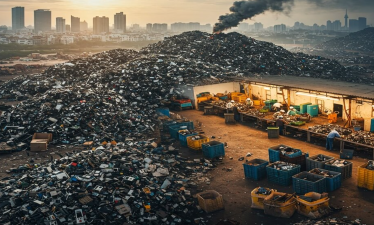
Every winter, Delhi’s toxic smog is blamed on vehicles, construction dust and industrial emissions. But a significant, largely invisible contributor lies much closer to home — the way the city handles its waste. Discarded lithium batteries and routine garbage burning, both on the streets and at landfills, have quietly become a persistent source of air pollution, adding a dangerous layer to Delhi’s annual air crisis.
Beyond cars and factories: an overlooked pollution source
Delhi’s smog is no longer driven only by external or seasonal factors. It is increasingly shaped by everyday consumption patterns — the batteries, electronics and plastics that enter the waste stream without segregation. Small lithium-ion batteries from earbuds, toys, LED lights and gadgets are routinely thrown into mixed garbage. When compacted in trucks or buried in landfills alongside flammable material, they can trigger slow-burning fires that release toxic fumes for days.
Landfill fires and their invisible emissions
Major dumping sites such as , and have repeatedly caught fire, sending dense plumes of chemical smoke into surrounding neighbourhoods. These emissions are rarely reflected accurately in official air quality data. Unlike traffic pollution, landfill fires release a complex mix of toxins, including heavy metals and persistent organic pollutants, which standard monitoring systems struggle to detect.
Street-level waste burning: a daily reality
Away from landfills, hundreds of small garbage fires burn daily under flyovers, near markets and along pavements. Overburdened sanitation workers, lacking equipment and alternatives, often resort to burning waste to manage overflowing piles. When plastics, PVC, thermocol and e-waste are burned, they emit ultra-fine particles and toxic gases far more harmful than conventional PM2.5 pollution. These emissions accumulate at night and intensify the morning smog across large parts of the city.
Why current pollution strategies fall short
Delhi’s pollution control efforts remain heavily skewed towards vehicles, construction and crop burning. Waste burning — despite being widespread and continuous — receives limited policy attention. As a result, a major contributor to urban air pollution remains unaddressed. This blind spot allows hazardous emissions to persist unchecked, even as emergency measures are imposed on other sectors every winter.
A waste system designed to fail
The roots of the problem lie in systemic weaknesses. Most households have no convenient way to dispose of used batteries or small electronics separately. Informal recyclers extract only high-value metals, discarding or burning the rest. Sanitation departments struggle to handle over 11,000 tonnes of waste daily, while landfills remain over capacity. In this context, open burning becomes the quickest, though most harmful, solution.
Turning waste into an economic opportunity
There is a clear alternative path. Advanced recycling systems can safely recover lithium, cobalt, nickel, copper and rare earth elements from discarded batteries and electronics. India currently imports many of these critical minerals for electric vehicles, electronics and renewable energy technologies. A formal, technology-driven recycling ecosystem could reduce import dependence, cut pollution and create skilled employment, while supporting a circular economy.
Long-term health risks of waste fires
The danger of waste burning extends far beyond visible smoke. Dioxins, heavy metals and persistent pollutants released during combustion can remain in soil, water and air for decades. These substances are linked to cancer, respiratory illness, hormonal disorders and developmental damage in children. What appears as seasonal smog risks evolving into a prolonged public health emergency.
What needs to change
Tackling this dimension of Delhi’s pollution crisis requires structural reform. Battery and e-waste disposal must be made simple and accessible. Producers should be held accountable for collecting end-of-life products. Sanitation workers need equipment, training and alternatives to burning waste. Landfills require early detection systems to prevent battery-triggered fires before they start.
What to note for Prelims?
- Lithium-ion batteries can trigger landfill and waste fires.
- Waste burning releases toxins beyond standard PM2.5 pollution.
- Delhi generates over 11,000 tonnes of solid waste daily.
- Critical minerals can be recovered through advanced recycling.
What to note for Mains?
- Link between poor waste management and urban air pollution.
- Health impacts of dioxins and heavy metals from waste fires.
- Role of circular economy and battery recycling in pollution control.
- Policy gaps in addressing non-vehicular pollution sources.