
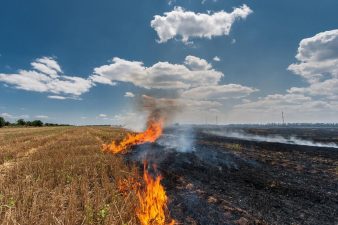
In October 2024, the Supreme Court of India addressed the persistent issue of stubble burning, denoting the inadequacies in enforcement by the Punjab and Haryana governments. The court emphasised that citizens have a fundamental right under Article 21 of the Constitution to live in a pollution-free environment. This ruling comes amid rising air pollution levels in Delhi, particularly during winter months when stubble burning peaks.
About Stubble Burning
Stubble burning refers to the practice of setting fire to the straw left over after the harvest of crops, primarily rice and wheat. This method is often used by farmers to quickly clear fields for the next planting season. While it is a cost-effective solution, it contributes to air pollution, releasing harmful pollutants into the atmosphere. Interestingly, stubble burning is not unique to India; it is also prevalent in countries like China and Russia, where similar agricultural practices exist.
Legal Framework
The Environment (Protection) Act, 1986, provides a legal framework for addressing environmental violations, including stubble burning. Section 15 of this Act stipulates penalties for environmental offences, including fines and imprisonment. However, the Supreme Court noted that enforcement of these provisions has been inconsistent, with many violators escaping penalties. This inconsistency raises questions about the effectiveness of current environmental regulations.
Government Response
Despite numerous court orders aimed at curbing pollution, the response from state governments has been lacklustre. The Supreme Court pointed out that both Punjab and Haryana had identified numerous cases of stubble burning but had failed to prosecute offenders adequately. For example, Punjab recorded over a thousand instances but only penalised a fraction of the offenders. This selective enforcement undermines the rule of law and contributes to ongoing air quality issues.
Impact on Air Quality
The toxic haze that envelops Delhi each winter is exacerbated by stubble burning, along with vehicular emissions and industrial pollution. Air quality in Delhi often deteriorates to hazardous levels during this period, leading to public health crises. Notably, the World Health Organization has classified air pollution as a leading environmental risk to health, linking it to respiratory diseases and cardiovascular issues.
Judicial Oversight
The Supreme Court’s active role in monitoring air quality and enforcing environmental laws is critical. The court has repeatedly called for comprehensive action plans from the central and state governments to address pollution. This includes not only penalising offenders but also promoting sustainable agricultural practices to reduce reliance on stubble burning.
Community and Environmental Solutions
To combat the issue of stubble burning, various non-governmental organisations and community groups are advocating for alternative farming practices. Techniques such as mulching, using bio-decomposers, and crop rotation can reduce the need for burning. Additionally, government initiatives to provide financial support for adopting these practices are essential for achieving long-term sustainable solutions.
Last Modified: October 23, 2024Questions for UPSC:
- Discuss the legal provisions under the Environment (Protection) Act, 1986, related to stubble burning.
- Analyse the impact of stubble burning on air quality in urban areas like Delhi.
- Evaluate the role of the Supreme Court in addressing environmental issues in India.
- What are the alternative practices to stubble burning that can be promoted among farmers?
- Examine the socio-economic factors that contribute to the prevalence of stubble burning in India.