Law is a system of rules. It governs behaviour and maintains order. In India, law is rooted in the Constitution. It reflects the country’s diverse culture and values. Legal frameworks address various issues, from civil rights to economic regulations. Courts interpret laws and ensure justice. The legal profession plays a crucial role in upholding democracy and protecting individual freedoms.
The Telangana Legislative Assembly has unanimously passed four Bills, including a key amendment to the Panchayat Raj law that removes the long-standing two-child norm for contesting local body...
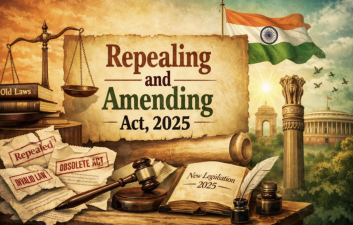
The Repealing and Amending Act, 2025 was passed in the winter session of Parliament to streamline India’s legal framework. It removes obsolete laws from the statute book and...
The Centre has notified draft rules for the four new Labour Codes, marking a major step towards implementing a unified labour law framework in India. These codes cover...
Karnataka's political landscape has been marred by intense disputes over Waqf properties, primarily between the ruling Congress and the opposition BJP. Allegations have surfaced regarding the Waqf Board...
Recently, the Supreme Court of India is deliberating on the constitutionality of the Uttar Pradesh Board of Madarsa Education Act, 2004. This case follows a controversial ruling by...
In an important development, the Supreme Court of India has overturned its previous ruling from August 2022 regarding the Benami Transactions (Prohibition) Act, 1988. This decision comes after...
The National Human Rights Commission (NHRC) is an independent statutory body in India. It was established to protect and promote human rights. These rights include life, liberty, equality,...