
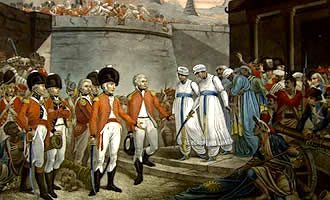

The onset of British influence in India differed both in manner’and in kind from that of other historical invasions. The British’did not come either as a migrating group seeking a new home’or, at least originally, as armies seeking plunder. Similarly’they had no missionary zeal. Yet eventually they did more to’transform India than did any earlier ruling power. There were’several aspects of this impact.
Political Effects
At first the British were only one group of foreign traders among’several, fortunate to find in the Mughals a firm government’ready to foster trade. Their entry into politics was gradual,’first as allies of regional powers, then as their virtual overlords,’and finally as complete masters. At each step they received’significant assistance from local powers that often preferred’British influence to that of their neighbours. It was mainly in’the 20 years from 1798 to 1818 that they became deliberately’imperialistic and thereafter India came to be treated as a’conquered rather than an acquired country. Ultimately the’defunct Mughal regime and the abortive Maratha successor’empire were replaced with the hegemony of the British.
As a result of the British imperial success their military’model had considerable effect on Indian rulers. From the time’of Mir Qasim in Bengal, Indian rulers began to train troops’in the European manner and to form artillery units in their’armed forces. Some of these bodies, especially the Sikh army’under Ranjit Singh, attained a very high degree of efficiency and’effectiveness. Their problem was maintenance, for most Indian’rulers lacked the resources necessary to regularly pay their men’and officers and maintain their armaments.
British foreignness was no novelty because even earlier’regimes, such as the Mughal, had had foreign personnel within’the government. What was novel was the artificial division’between British India and Indian-governed India, with little’contact between the two in contrast to the Mughals and the’Sultanate rulers.
Economic Effects
British rule had much more dramatic impact in the economic’field. Up to the year 1750 the effect of the East India Company’s’operations on the national economy was marginal. Production’of cotton and silk goods, indigo, saltpetre, and, later, opium’was stimulated in particular areas such as Bengal, Gujarat, and’Malwa, with some advantage to the middlemen but no effect’on general living standards. India was then mainly agricultural,’and its industries, though significant, were not critical to its’whole economy.
With the acquisition of Bengal, however, the situation’changed noticeably. The bias in favour of British merchants’diverted trade from their Indian counterparts, weakening their’position considerably. The extravagant present giving, a big’abuse of a traditional system, also drained off much money to’Britain. Still more, the pressure on the zamindars for more revenue,’and theirs in turn on the cultivators, further diminished the’income of the peasantry. The creation and operation of a variety’of monopolies, public and private added to the impact. When the’Bengal famine of 1770 affected one-third of the population, little’attempt at relief was made, though it would have been practicable’given Bengal’s network of waterways. The cruel harshness with’which the revenue was still collected despite the famine delayed’recovery for many years. Economic recovery was further delayed’by Warren Hastings’s improvised revenue arrangements; and’even the social structure was considerably dislocated, with its’own effect on economic life.
Cornwallis’s permanent settlement (1793), after an initial’period of dislocation, gave relief and security to the zamindars,’who benefited by the rise in prices and the cultivation of’wastelands. In contrast the cultivators themselves, now the’zamindars’ tenants-at-will, remained as poor as before or’often found themselves worse off. Apart from the zamindars,’the principal class to benefit from the British was that of the’entrepreneurs of Calcutta, who acted as agents and bankers to’the British. In Madras, the economic settlement turned on the’working of the ryotwari revenue system; regularity of collection’was offset by severity of assessment, and the same may be said’of both western and northern India.
In the nineteenth century a new factor emerged: machinemade cotton goods from Britain. These steadily undermined’the Indian handicraft industries until all but the highest and’coarsest grades of cloth were squeezed out. Beginning in 1836,’tea was grown in Assam and coffee was cultivated in the south.’Coal mining also began, but its growth, with that of the jute and’cotton machine industries, had to wait for the second half of’the century. While the population was more secure than before'(except during the occurence of a famine) it was generally not’better-off. India gradually moved toward the status of a colonial’economy, a supplier of raw materials, a market for manufactured’articles, to the profit of the foreign rulers.
Social Effects
The social effects of British rule were also considerable. They’took mainly the form of the displacement of classes. As already’noted, there was a general disturbance in Bengal caused by the’permanent settlement, whereby the lesser landholders were’reduced to the condition of tenants-at-will. But there was also’disturbance among the zamindars. The first upset followed the’famine of 1770 , when the cultivators were often too few for the’revenue demand to be met, and “farming” the revenue-that is,’selling the right of taxation to a second party-for some time’took the place of a revenue settlement. The second upset came’with the permanent settlement of 1793 , when the revenue figure’fixed was in many cases too high for the existing cultivation.’By 1820 it was calculated that more than one-third of the’estates had changed hands through sale for arrears of land tax.’The purchasers were in the main the Calcutta entrepreneurs’newly enriched by their contacts with the British. Many were’absentees. The social link between landholder and cultivator had’been broken, cash nexus replacing traditional rights.
In Calcutta itself, these same rentiers formed a fashionable’and intellectual society from which came the first significant’cultural contacts with the West. It was composed of the’prosperous section of the three Bengali upper castes, with such’others as had gained acceptance by their wealth or education.’Collectively, this literate class of gentry was known as the’bhadralok (“respectable people”).
In the north there was less dislocation, though the’landholders, many of whom had no title but the sword, tended’to be repressed. There was a general recognition of rights and’broadly of their protection. The chief sufferers were ruling’families, who lost power, and the official aristocracy, who’lost office. In the south, chiefs whom Sir Thomas Munro’dispossessed were largely in the class of robber barons.’In western India a balance between aristocratic and’cultivating rights was perhaps better-maintained than’elsewhere, and relations were more harmonious. Of significance’was the rapid development of Bombay from the time it came to’possess a large hinterland in 1818 . With it came the rise of the’enterprising Parsi community.
In general, apart from Bengal, there was some repression’of the old aristocracy, a regulation and preservation of lesser’landholders’ rights, and an encouragement of the commercial’classes. Communities did not break up, but their fortunes rose’and fell with their ability to adjust to changing conditions.
Social Reforms
A campaign by British officials and reformers led ultimately to’a law banning infanticide being enacted as Regulation’V1’of’1802. The abolition of infanticide which appears to have been’effective in Bengal did not result in any significant opposition’by the public. However, the banning of infanticide in other parts’of India does not appear to have been effective, as this practice’continued even after its prohibition.
From the 1820 s to the 1850 s the British demonstrated’a strong urge to change Indian social institutions, and to’Westernise India. A significant state intervention in Indian’social life was the suppression of sati. This practice was’widespread in all the three Presidencies at the beginning of the’19 th century with the larger number of reported incidents being’in the lower districts of Bengal. In spite of the mounting demand’in India and Britain for its abolition, the company authorities’in England did not want to take any decision themselves, being’uncertain about the reaction it would produce in India. Finally’it was Bentinck, who legislated against sati in December 1829.’The abolition of sati by the government did not result in any’visible disaffection or resentment among the Indians.
Subsequently the British also abolished slavery and’eliminated dacoits from the highways. They legalised the’remarriage of widows and allowed Hindu converts to’Christianity to lay claim to their share of joint family property.’They also took steps to introduce a penal code based on British’law, which helped inculcate some ideas of equality. Under’traditional law, caste discrimination was inbuilt. Under the new’law, brahmins and shudras were liable to the same punishment for’the same offence.


