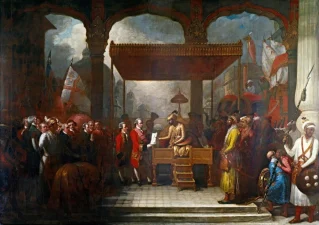
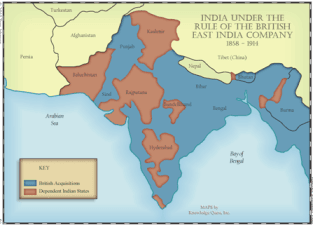
The First Century of British Influence marked a shift in India. It began with trade and gradually expanded to political control. The British established laws and governance structures. This period saw the introduction of Western education and culture. It also led to economic changes, impacting local industries. The effects of this influence are still felt in modern India.
"The growth and the development of the national movement in India went a long way to develop certain values and ethos, which contributed a lot to the constitution-making...
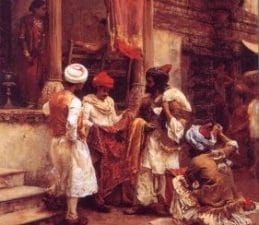
The trade relations between England and India can be studied through the English East India Company in two phases: (a) between 1600 and 1757; (b) between 1757 and...
Sumit Sarker (Modern India : 1885-1947) refers to three forms of'reaction against moderates' agitation in which India found itself'in years after 1905: (a) a somewhat non-political trend towards'self-development...
The idea of forming an all-India organization was nurturing for'sometimes among the educated middle class Indians, mostly'having studied or studying in English in 1860s and 1870s and in'fact,...
The British policy of racial discrimination characterized by repressive measures and anti-national enactments also gave rise to Indian nationalism. This invidious policy was, in fact, being followed since...
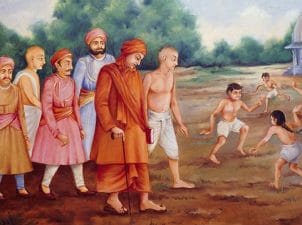
One of the greatest figures in 19th century Bengal was Narendra'Nath Datta, better known as Swami Vivekananda. His spiritual'preceptor was Ramakrishna Paramhansa (1834-1886).'Ramakrishna stressed universalism in religions and...
Bal Shastri Jambhekar: Was the pioneer of the intellectual movement in Maharashtra in the first half of the'19th''century,'through his numerous writings Dodoba Pandjurang Tarkhadkar: A social reformer; was...
The cultural effects of British influence during the century'from 1757 to 1857 , though less spectacular, were in the long'run far-reaching. At first there was very little impact....
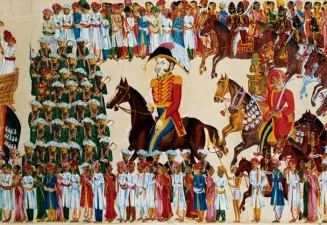
The onset of British influence in India differed both in manner'and in kind from that of other historical invasions. The British'did not come either as a migrating group...
Even after the settlement of 1818 , some parts of the subcontinent'remained out of British control. These included the Himalayan'states to the north, the valley and hill tracts...