
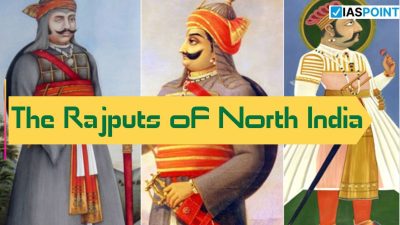
During medieval India, the Rajputs emerged as major political players, particularly between 647 AD and 1200 AD.
Origins of the Rajputs
Rajputs are believed to have emerged during the early medieval period. The origins of the Rajputs are debated among historians. Several theories exist, which are discussed as follows:
Agni Kula Theory
The Agni Kula Theory suggests that certain Rajput clans originated from a ritual fire pit (Agni Kunda) on Mount Abu. According to legend, these clans were created by the sage Vashistha to protect the land from invaders. Prominent clans such as the Pratiharas, Solankis, Parmars, and Chauhans are associated with this theory.
Tribal Origin Theory
The Tribal Origin Theory posits that Rajputs originated from indigenous tribes who gradually rose to prominence by adopting the Kshatriya status. Historians suggest that these tribes assimilated into Hindu society during the early medieval period and were later recognised as Rajputs.
Foreign Origin Theory
The Foreign Origin Theory asserts that the Rajputs descended from foreign invaders, such as the Scythians (Shakas) and Huns, who settled in India. Over time, these groups adopted Indian culture, language, and customs, integrating into the social fabric and becoming part of the Kshatriya class.
Kshatriya Origin Theory
The Kshatriya Origin Theory claims that the Rajputs are direct descendants of the ancient Kshatriya warrior class mentioned in Vedic literature. This theory emphasises continuity with early Hindu traditions and the hereditary warrior status of the Rajputs.
Mixed Origin Theory
The Mixed Origin Theory suggests that the Rajputs arose from a combination of different groups, including indigenous tribes, foreign settlers, and existing Kshatriyas. This theory acknowledges the complex socio-political circumstances of medieval India, which led to the emergence of a new warrior class known as the Rajputs.
Major Rajput Clans
There were approximately 36 Rajput clans, with notable ones including:
- The Palas of Bengal
- Tomars of Delhi
- The Chauhans of Delhi and Ajmer
- The Rathors of Kanauj
- The Guhilas or Sisodiyas of Mewar
- The Chandellas of Bundelkhand
- The Paramaras of Malwa
- The Senas of Bengal
- The Solankis of Gujarat
The Palas of Bengal
The Pala Dynasty ruled over northern and eastern India. Key rulers include:
- Gopala (765-769 AD): Founder of the Pala Dynasty.
- Dharmapala (769-815 AD): Expanded the dynasty, known for his patronage of Buddhism.
- Devapala (815-855 AD): Maintained territorial integrity and expanded into Assam and Orissa.
- Mahipala (998-1038 AD): Strengthened the dynasty before its decline.
Tripartite Struggle for Kanauj
The struggle for Kanauj involved the Palas, Pratiharas, and Rashtrakutas. It lasted 200 years and weakened all three, paving the way for future invasions.
The Tomars of Delhi
The Tomars ruled parts of Delhi and Haryana from the 8th to the 12th century. Key figures include:
- Anangapala I: Founded the Tomar Dynasty.
- Anangpal II: Established Dhillikapuri, the precursor to modern Delhi.
The Chauhans of Delhi and Ajmer
The Chauhans declared independence in the 11th century. Prithviraj Chauhan was a notable ruler who captured Delhi and expanded his territory.
The Rathors of Kanauj
The Rathors ruled Kanauj from 1090 to 1194 AD. Jaichand was the last ruler, defeated by Muhammad of Ghori.
The Chandellas of Bundelkhand
The Chandella Dynasty, founded in the 9th century, ruled for about 500 years. They are known for the temples at Khajuraho, including the Kandariya Mahadeva Temple.
The Guhilas or Sisodiyas of Mewar
Originating from Kashmir, the Guhilas migrated and established their rule in Mewar. Bappa Rawal was a notable early ruler, and Maharana Pratap is celebrated for his resistance against Mughal rule.
The Paramaras of Malwa
The Paramaras emerged as vassals of the Pratiharas and later declared independence. Raja Bhoja (1010-1055 AD) was a prominent ruler known for his contributions to literature and architecture.
Society and Culture Under the Rajputs
Rajput society was feudal. Each kingdom was divided into jagirs, held by jagirdars. Rajputs were known for their warrior ethos and adherence to Hinduism, alongside patronage of Buddhism and Jainism.
Literary Contributions
The medieval period saw literary works such as:
- Kalhana’s Rajatarangini (River of Kings)
- Jayadeva’s Gita Govindam
- Chand Bardai’s Prithviraj Raso
- Bhaskara Charya’s Siddhanta Shiromani
Art and Architecture
Rajputs are renowned for their contributions to art and architecture. Notable examples include:
- Temples at Khajuraho
- Lingaraja Temple at Bhubaneshwar
- Sun Temple at Konark
- Dilwara Temples at Mount Abu
Impact of Rajput Culture
Despite the decline of Rajput power, their cultural influence remained . Rajputs contributed to the arts, architecture, and the feudal system in India, shaping the socio-political landscape of the region.
Last Modified: December 23, 2024