
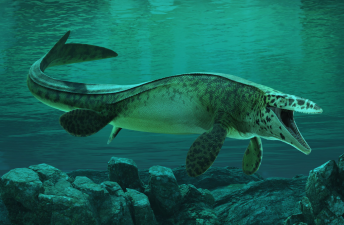
Scientists have formally identified Tylosaurus rex as a distinct species within the Mosasauridae family. Living approximately 80 million years ago in the Late Cretaceous Period, it was an apex marine predator that dominated the Western Interior Seaway roughly 14 million years before the terrestrial Tyrannosaurus rex evolved.
Evolutionary and Anatomical Adaptations
- Classification: Not a dinosaur; belongs to the order Squamata (related to modern lizards and snakes).
- Morphology: Reached lengths of 12–14 meters with a skull exceeding 1.5 meters.
- Specialized Jaws: Featured a flexible intramandibular joint to swallow large prey whole and pterygoid teeth on the roof of the mouth for gripping.
- Predatory Mechanics: Possessed a heavy, bony snout used for ramming prey and a powerful, downward-curved (hypocercal) tail for rapid acceleration.
- Reproduction: Exhibited viviparity (live birth), an essential adaptation for a fully aquatic existence.
Paleoecology and Habitat
- Western Interior Seaway: A massive, shallow epicontinental sea that divided North America into Laramidia and Appalachia.
- Diet: Opportunistic apex predator consuming sharks, marine turtles, pterosaurs, plesiosaurs, and other mosasaurs.
- Fossil Sites: Key specimens found in the Niobrara Chalk (Kansas) and the Taylor Group (Texas).
IASPOINT Booster Facts
- Extinction: All mosasaurs perished during the K-Pg mass extinction event (66 million years ago).
- Nomenclature: Tylosaurus derives from Greek, meaning “knob lizard,” referring to its bony snout protrusion.
- Lagerstätte: The Niobrara Formation is a globally significant site known for extraordinary fossil preservation, including soft tissue.