
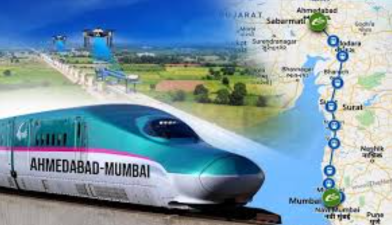
The Mumbai–Ahmedabad High-Speed Rail project represents the vanguard of India’s transport infrastructure overhaul, serving as the country’s first high-speed rail corridor. Spanning 508 km across Maharashtra, Gujarat, and Dadra and Nagar Haveli, the project aims to reduce travel time between Mumbai and Ahmedabad to under two hours. Grounded in the Union Budget 2026–27 vision, which expanded high-speed rail plans nationwide, MAHSR introduces advanced Japanese Shinkansen technology. This corridor sets the structural benchmark for domestic technical expertise and industrial growth through the Make in India initiative.
Geographic Alignment and Regional Coverage
The corridor connects major economic hubs across two western states and one Union Territory.
State-Wise Alignment and Distribution
- Total Length: 508 km.
- Gujarat Coverage: 348 km with eight stations.
- Maharashtra Coverage: 156 km with three stations.
- Dadra and Nagar Haveli Coverage: 4 km with one station.
Station Network
The route features 12 designated stations designed for integration into local transit ecosystems: Mumbai (Bandra-Kurla Complex), Thane, Virar, Boisar, Vapi, Bilimora, Surat, Bharuch, Vadodara, Anand, Ahmedabad, and Sabarmati.
Technical Specifications and Infrastructure Innovation
The engineering layout relies on civil construction techniques to handle high velocity operations up to 320 km/h.
Elevated Viaducts and Bridges
- Elevated Corridor: Nearly 90% of the route is elevated to eliminate level crossings and minimize land acquisition conflicts.
- Construction Methodology: Full Span Launching Method is deployed for the first time in India, operating ten times faster than conventional segmental methods.
- River Crossings: The route spans major rivers including the Sabarmati, Mahi, Narmada, Tapi, Jagani, and Vaitarna.
Advanced Tunneling Systems
- Thane Creek Undersea Tunnel: Features a 21 km tunnel section in Maharashtra, incorporating a 7 km undersea rail stretch beneath Thane Creek. It utilizes a single tunnel tube measuring 13.1 meters in diameter to accommodate both tracks.
- Tunneling Technology: Combines the New Austrian Tunnelling Method for variable rock formations and heavy Tunnel Boring Machines for deep subterranean sections.
- Mountain Passes: Includes specific mountain tunnel breakthroughs achieved across the fragile topography of Palghar district in Maharashtra.
| Technical Component | Feature and Type | Operational Purpose |
| Track System | J-Slab Ballastless Track | Shinkansen-based reinforced concrete bed ensuring stability at 320 km/h |
| Power Supply | 2×25 kV Overhead Traction | Employs heavy-duty Shinkansen-based cantilevers and 12 traction substations |
| Noise Mitigation | Double-sided Noise Barriers | Installed along 291 km of elevated viaducts to control sound pollution |
| Maintenance Facilities | Rolling Stock Depots | Three dedicated facilities located at Sabarmati, Surat, and Thane |
Safety Mechanisms and Real-Time Monitoring
High-speed operations mandate a zero-failure safety paradigm backed by automated technology.
Early Earthquake Detection System
The entire alignment incorporates 28 specialized seismometers. This system tracks primary seismic waves ahead of secondary destructive waves, automatically triggering a traction power shutdown to stop moving trains via emergency braking.
Meteorological Sensing Networks
An automated Rainfall Monitoring System utilizes instrumented rain gauges along critical spots of the corridor. Wind monitoring systems are similarly integrated to track atmospheric changes that could compromise stability on exposed river bridges.
Economic Impact and Local Manufacturing Push
The project operates as an economic catalyst by boosting domestic industrial capacity and generating skilled employment.
Indigenisation and Steel Fabrication
The project directly drives the Make in India initiative through local manufacturing contracts. This includes the successful fabrication and launch of specialized 100-meter-long steel structures and heavy portal beams over operational conventional railway tracks in Ahmedabad and Bharuch.
Expansion Framework under Union Budget 2026–27
MAHSR serves as the blueprint for the expansion announced in the Union Budget 2026–27. The budget allocates a 2.93 trillion INR capital expenditure for railways to initiate seven new high-speed rail corridors spanning 4,000 km with an outlay of 16 lakh crore INR. These proposed routes include:
- Northern & Eastern Corridors: Delhi–Varanasi (3 hours 50 minutes travel time) and Varanasi–Siliguri via Patna (2 hours 55 minutes travel time).
- Western & Southern Corridors: Mumbai–Pune (45 minutes travel time), Pune–Hyderabad, Hyderabad–Bengaluru, Hyderabad–Chennai, and Chennai–Bengaluru.
IASPOINT Booster Facts for UPSC
- Implementing Agency: National High Speed Rail Corporation Limited, a joint venture of the Central Government and participating State Governments.
- Funding Ratio: Japan International Cooperation Agency provides an 81% soft loan at 0.1% interest with a 50-year repayment moratorium.
- First Partial Operational Target: The initial operational section between Surat and Bilimora in Gujarat is targeted for launch by August 2027.
- Kavach Integration: Separate from the Shinkansen system, the budget allocated 1,20,000 crore INR for general safety measures including the rapid rollout of the indigenous Kavach Automatic Train Protection system across conventional networks.
- Dedicated Freight Connection: The 2026-27 budget simultaneously announced a new dedicated freight corridor linking Dankuni in West Bengal to Surat in Gujarat to complement high-speed passenger initiatives.
