
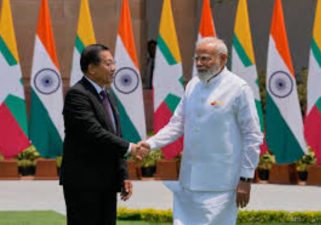
India and Myanmar have deep historical ties, but bilateral dynamics altered after the 2021 military coup in Naypyidaw. The official visit of Myanmar President U Min Aung Hlaing to New Delhi in mid-2026 marked a pivotal moment. India maintains a pragmatic policy of constructive engagement with the military administration rather than choosing diplomatic isolation. This stance is dictated by immediate geographical factors, cross-border security concerns, and the need to preserve regional trade corridors. New Delhi balances its historical support for democratic transitions with realpolitik priorities on its eastern frontier.
Geopolitical and Strategic Imperatives
Myanmar represents the only Association of Southeast Asian Nations (ASEAN) country that shares a direct land border with India. It acts as a land bridge connecting South Asia to Southeast Asia, making it central to India’s Act East Policy.
Countering Chinese Regional Footprint
China actively expands its presence in Myanmar through the China-Myanmar Economic Corridor (CMEC) and the construction of the Kyaukpyu deep-sea port. India’s steady diplomatic involvement aims to check this growing Chinese strategic footprint in the Bay of Bengal. By offering developmental assistance, India provides Naypyidaw an alternative to complete dependence on Beijing.
Act East and Neighbourhood First Framework
Myanmar provides alternative transit routes to landlocked Northeast Indian states. Bilateral ties are sustained under regional frameworks like the Bay of Bengal Initiative for Multi-Sectoral Technical and Economic Cooperation (BIMSTEC) and the Mekong-Ganga Cooperation (MGC).
Security and Border Management Challenges
India and Myanmar share a porous 1,643-km land border across four northeastern states: Arunachal Pradesh, Nagaland, Manipur, and Mizoram.
Counter-Insurgency and Territorial Assurances
Anti-India insurgent groups like the United National Liberation Front (UNLF) and National Socialist Council of Nagaland (NSCN) have historically used safe havens in the thick jungles of western Myanmar. During the 2026 summit, Myanmar reiterated its commitment that its territory would not be used for activities hostile to India.
Suspension of Free Movement Regime
The Free Movement Regime (FMR), which allowed tribes living along the border to travel up to 16 km into either country without visas, has been suspended. India took this decision to halt illegal migration, check narcotics trafficking, and stop arms smuggling caused by Myanmar’s internal conflicts. Fencing of the entire border is underway to create a structured boundary.
Transnational Cybercrime Networks
Both nations face threats from specialized online scam centres operating in lawless border zones of Myanmar. Bilateral law enforcement cooperation has led to the successful rescue of over 2,400 Indian nationals trapped in these facilities.
Economic Cooperation and Infrastructure Projects
Bilateral trade between the two nations reached approximately 1.95 billion USD during the fiscal year 2025-26. India is Myanmar’s fourth-largest trading partner, dominated by agricultural imports.
| Sector | Core Initiatives and Elements | Current Status |
| Trade Settlement | Rupee-Kyat Mechanism via Special Rupee Vostro Accounts | Operational since May 2024 to bypass third-country currencies |
| Primary Imports | Black gram, pigeon peas, timber, forest products | Comprises nearly 90% of India’s imports from Myanmar |
| Energy Cooperation | ONGC Videsh and GAIL investments exceeding 1.2 billion USD | Deep-water gas exploration blocks and pipeline development |
| Critical Minerals | Rare-earth extraction and mining cooperation | Strategic discussions initiated to secure supply chains |
Progress on Key Mega-Projects
- Kaladan Multi-Modal Transit Transport Project: This project connects Kolkata port to Sittwe deep-water port in Rakhine State by sea. From Sittwe, the route uses the Kaladan River waterway to Paletwa, followed by a highway to Zorinpui in Mizoram. While maritime and riverine components are operational, construction of the 109-km road segment through Chin State is delayed due to ethnic conflict. Full operationalization is projected for 2027.
- India-Myanmar-Thailand Trilateral Highway: This 1,360-km road link starts from Moreh in Manipur and ends at Mae Sot in Thailand via Myanmar. Future plans include extending the corridor to Cambodia, Laos, and Vietnam. Instability in central Myanmar has stalled the completion of key bridges and road upgrades.
Cultural and Humanitarian Diplomacy
India utilizes historical civilizational links to build long-term goodwill among the people of Myanmar.
Buddhist Circuit and Heritage Restoration
The regular flow of pilgrims from Myanmar to Bodh Gaya, home of the Mahabodhi Temple, underpins bilateral cultural ties. India funded the structural restoration of the historic Ananda Pagoda at Bagan, which was damaged during earthquakes.
Disaster Relief Operations
India acts as a primary responder during natural disasters in its eastern neighborhood. Recent major rescue operations include:
- Operation Sadbhav (2024): Delivery of emergency relief, food grains, and medical supplies after devastating severe weather.
- Operation Brahma (2025): Mobilization of field hospitals, technical engineers, and financial aid following a high-intensity earthquake in the Shan state region.
Educational and Capacity Building Boost
In 2026, India increased the number of annual Indian Council for Cultural Relations (ICCR) scholarships allocated to Myanmar students under the Mekong-Ganga framework from 36 to 100 slots.
IASPOINT Booster Facts for UPSC
- Four States Sharing Border: Arunachal Pradesh (520 km), Mizoram (510 km), Manipur (398 km), and Nagaland (215 km).
- INS Sindhuvir: In 2020, India gifted its first-ever submarine, a refurbished Kilo-class attack submarine, to the Myanmar Navy to augment maritime security.
- Major Ethnic Armed Organizations (EAOs): The Arakan Army (AA) in Rakhine, the Kachin Independence Army (KIA) in the north, and the Three Brotherhood Alliance control significant areas adjacent to Indian transit paths.
- Mekong India Economic Corridor: A planned corridor designed to connect Chennai port with Dawei port in Myanmar, extending further to Bangkok and Ho Chi Minh City.
