
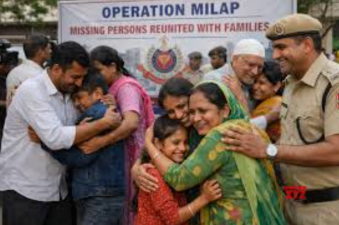
The Gujarat Police concluded “Operation Milap,” a targeted, month-long investigative campaign launched on May 7, 2026, to trace missing individuals and reunite them with their families. The enforcement drive was designed to resolve a backlog of over 24,000 missing person cases pending across various police jurisdictions in the state since 2007. By deploying a combination of advanced technical surveillance, grassroots human intelligence networks, and cross-border law enforcement coordination, the operation successfully located 1,470 individuals. The demographic breakdown of those traced includes 852 women, 384 men, and 234 minor girls, highlighting adolescent girls as a particularly vulnerable demographic in missing person profiles.
Operational Strategy and Enforcement Mechanisms
Digital Tracking and Data Integration
The Gujarat Police utilized specialized technical intelligence cells to fast-track long-pending investigations. Cyber crime units tracked active digital footprints by analyzing historical Call Detail Records (CDRs), monitoring Subscriber Detail Records (SDRs), and tracing the IP addresses of social media accounts linked to missing individuals. This digital profiling allowed investigators to pinpoint locations even if the individuals had changed their mobile numbers or moved to different states.
Inter-State Police Coordination
Since many missing individuals cross state boundaries, Operation Milap relied heavily on formal inter-state intelligence sharing. The Gujarat Police established operational links with law enforcement agencies in neighboring states, including Rajasthan, Madhya Pradesh, Maharashtra, and the Union Territory of Dadra and Nagar Haveli and Daman and Diu. Dedicated tracing squads traveled outside the state to verify identities and execute safe recoveries in coordination with local police stations.
Human Intelligence and Local Governance Linkages
Parallel to technical tracking, the campaign used traditional human intelligence (HUMINT) systems. Anti-Human Trafficking Units (AHTUs) worked alongside village-level police mitras, local ASHA workers, and non-governmental organizations. These groups conducted field verifications, reviewed unregistered migrant shelters, and audited local labor colonies to locate individuals who had lost contact with their families.
Socio-Economic Drivers of Disappearances
Romantic Elopement and Social Pressures
Investigative disclosures from Operation Milap revealed that a significant portion of missing cases involving adolescent girls and young adults stemmed from voluntary elopements. Driven by rigid caste structures or parental disapproval, young couples frequently left their homes without prior notice to marry or cohabitate in distant urban centers, leading families to file formal missing person complaints.
Domestic Conflict and Emotional Distress
An evaluation of cases involving adult women and men highlighted domestic friction, marital discord, and financial stress as major push factors. Individuals frequently abandoned their households voluntarily to escape abusive environments, matrimonial disputes, or overwhelming debt burdens, cutting off communication with their immediate family networks to establish separate identities.
Unorganized Labor Migration
The investigation also identified unregulated labor migration as a primary cause of disappearances. Economically vulnerable individuals often move to industrial hubs, brick kilns, or construction sites across state lines for seasonal work. Due to a lack of digital literacy, lost mobile devices, or exploitative working conditions imposed by informal contractors, these workers frequently lose contact with their home villages, placing them on official missing person registries.
Statutory Framework for Missing Persons in India
| Statutory Component / Mechanism | Institutional Role | Enforcement Mandate |
| Anti-Human Trafficking Units (AHTUs) | Specialized Investigation | Set up at the district level to handle cases involving organized kidnapping, commercial exploitation, and forced labor. |
| TrackChild Portal | National Digital Registry | Maintained by the Ministry of Women and Child Development to map missing and sighted children across all police stations. |
| Standard Operating Procedure (SOP) | Supreme Court Mandate | Dictates the mandatory registration of a First Information Report (FIR) under kidnapping provisions if a minor is not traced within 24 hours. |
IASPOINT Booster Facts for UPSC
- Bachpan Bachao Andolan vs. Union of India (2013): The landmark Supreme Court judgment that issued mandatory directives to all States and UTs regarding the handling of missing children, making the registration of an FIR compulsory upon receiving a missing complaint for a minor.
- National Crime Records Bureau (NCRB) Tracking: The NCRB maintains the “Crime and Criminal Tracking Network & Systems” (CCTNS), which integrates missing persons databases nationally, allowing real-time matching of unidentified dead bodies with active missing person records.
- Operation Muskaan / Operation Smile: A recurring national initiative spearheaded by the Ministry of Home Affairs, executed by state police forces to rescue and rehabilitate missing, abducted, and trafficked children.
- Juvenile Justice Act Provisions: Section 94 of the Juvenile Justice (Care and Protection of Children) Act, 2015, mandates strict age determination protocols using school certificates or medical bone-ossification tests during the rehabilitation phase of recovered minors.
