
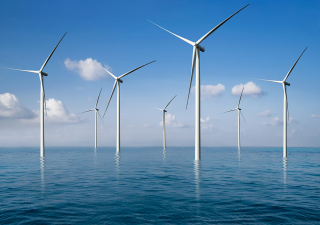
The Global Wind Energy Council (GWEC) released its Global Offshore Wind Report, projecting a massive expansion where global offshore wind capacity will quadruple from 92.5 GW in 2025 to 420 GW by 2035. This growth is driven by energy security goals and climate targets following recent global energy crises. However, the report highlights that nearly 25 GW of ready-to-build projects outside China remain stalled. GWEC urges governments to fast-track deployment by treating offshore wind as critical national infrastructure and implementing supportive regulatory policies to overcome mounting structural barriers.
Global Expansion Trajectory and Targets
The offshore wind sector is transitionary, moving from a niche technology to a primary driver of utility-scale renewable power.
Decadal Capacity Projections
The global offshore wind market maintained a 10% average annual growth rate over the past decade. Annual installations are expected to double, triple by 2031, and exceed 50 GW per year by 2035. This trajectory will add more than 327 GW of new capacity over the next ten years.
Regional Market Dominance
The global offshore wind ecosystem is highly concentrated. Five major markets account for 90.3% of the total worldwide capacity.
- China: Holds global leadership with 48.4 GW of cumulative installations, accounting for 52% of the global market.
- Europe: Possesses over 38 GW of total capacity, which makes up 42% of the global share. The United Kingdom leads Europe with over 1 GW of new additions connected in a single year, followed by Germany and the Netherlands.
- Asia-Pacific (Excluding China): Taiwan and South Korea are emerging as key deployment centers for fixed and floating structures.
Primary Structural Barriers and Project Stagnation
Despite the long-term projections, a massive gap exists between planned capacity and actual construction due to multiple operational bottlenecks.
Grid Constraints and Integration Bottlenecks
The lack of subsea transmission cables and onshore grid reinforcement is a leading cause of project delays. Offshore wind farms require specialized high-voltage direct current (HVDC) converter platforms to transport power over long distances, which suffer from long manufacturing lead times.
Auction Failures and Design Flaws
Only 11.4 GW of offshore wind capacity was awarded globally through auctions, representing just one-fifth of the total volume procured during the previous year. This drop stems from un-bankable auction frameworks, failed bidding rounds in Europe, and contract cancellations in the United States.
Macroeconomic Pressures and Financing Hurdles
Project development costs increased by 40% to 60% due to high inflation, supply chain disruptions, and rising global interest rates. These factors stall Final Investment Decisions (FIDs) for 25 GW of permitted, shovel-ready projects.
Technical and Financial Differences: Offshore vs. Onshore
Offshore wind generation has distinct operational and financial characteristics compared to land-based wind farms.
| Characteristic | Onshore Wind Energy | Offshore Wind Energy |
| Turbine Capacity Size | Typically 2 MW to 5 MW per unit | Ranges up to 15 MW per unit |
| Capacity Utilization Factor | Lower (averages 25% to 35%) | Higher and predictable (averages 40% to 55%) |
| Logistical Constraints | Road transport limitations for blade length | Requires specialized heavy-lift installation vessels |
| Capital Expenditures (CAPEX) | Lower structural and foundation costs | Higher due to marine environment and subsea cabling |
Policy Interventions and the GWEC Action Plan
To unlock the stalled pipeline, the industry advocates for a fundamental shift in how governments manage marine renewable energy assets.
Critical Infrastructure Status
Granting offshore wind and its associated supply chains, ports, and storage facilities the status of critical national infrastructure accelerates the permitting process. This status reduces regulatory delays, lowers project risks, and cuts financing costs for developers.
Market Mechanism Refinement
The adoption of predictable, index-linked Contracts for Difference (CfDs) helps protect developers from inflation and volatile commodity prices, making large-scale investments more bankable.
IASPOINT Booster Facts for UPSC
- National Nodal Agency in India: The Ministry of New and Renewable Energy (MNRE) is the nodal ministry for offshore wind development in India’s Exclusive Economic Zone (EEZ). The National Institute of Wind Energy (NIWE) in Chennai acts as the nodal agency for resource assessment and allocation of seabed blocks.
- India’s Technical Potential: Initial assessments by NIWE indicate an offshore wind potential of 71 GW off the coast of India, split almost equally between Gujarat (36 GW) and Tamil Nadu (35 GW).
- India’s Offshore Target: India aims to achieve 30 GW of offshore wind capacity by 2030, supported by the Offshore Wind Energy Lease Rules.
- Viability Gap Funding (VGF): The Union Government approved 7,453 crore INR in VGF to support the initial 1 GW of offshore wind projects, divided as 500 MW each for Gujarat and Tamil Nadu, to mitigate high initial setup costs.
- Bilateral Tender Reset: Following the cancellation of initial 4.5 GW offshore wind tenders due to low developer interest, India is restructuring its bidding models into three distinct categories (Model-A, Model-B, and Model-C) to share development risks between the government and private entities.
- FOWIND and FOWPI: The First Offshore Wind Project of India (FOWIND) and the Facilitating Offshore Wind in India (FOWPI) are key collaborative programs that established early feasibility, metocean studies, and layout designs for the western and southern coasts.
