
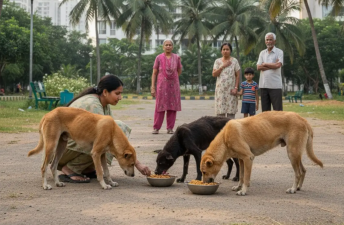
The transition of India’s street dog issue from a neighborhood fixture to a national crisis is driven by a convergence of legal interpretations, massive public health data, and systemic failures in urban management. You’ve hit on something that is much more than just a “dog problem”—it is a perfect storm of urban friction. The shift from seeing street dogs as “community pets” to “public threats” reflects a breakdown in the traditional social contract of Indian neighbourhoods, driven by several complex layers. The core of the legal conflict lies in the tension between two sets of rights. On one side, Article 21 of the Constitution guarantees the Right to Life for humans, which many argue includes the right to safe, bite-free public spaces. On the other side, the Animal Birth Control (ABC) Rules (updated in 2023) and the Prevention of Cruelty to Animals Act emphasize that street dogs are “community animals” that cannot be relocated. This creates a legal stalemate: Municipalities are often forbidden from removing dogs but are legally liable if those dogs harm citizens. Courts are increasingly forced to balance the Right to Life (Article 21) for humans against the Fundamental Duty to show compassion for living creatures (Article 51A(g)). In the landmark 2014 Jallikattu Case, the Supreme Court extended the protection of Article 21 to include animal life, establishing that animals have inherent dignity and the right to live peacefully. This expansion creates a “legal stalemate” where municipalities are held liable by courts for dog-bite injuries or fatalities among citizens while being legally barred from relocation.
The Crisis of Governance Capacity and Implementation Gaps
The scientific solution—Mass Animal Birth Control (ABC) and Anti-Rabies Vaccinations (ARV)—is internationally proven to work. However, its success depends on reaching a 70% coverage threshold in a very short window. While the policy framework exists, the execution at the local level has largely failed to achieve results. Most Indian municipalities lack the budget, skilled staff, and consistent data to hit that 70% mark. The science-backed Catch-Neuter-Vaccinate-Return (CNVR) model only works if a high percentage of the population is sterilized quickly. Improper implementation leads to the “vacuum effect,” where new, unsterilized dogs move into an area to fill the ecological niche left by removed or poorly managed packs. This makes it look like the “scientific method” has failed, which then fuels public anger and calls for culling. Furthermore, contradictory directives complicate the landscape. Recent court orders have sometimes diverged from the ABC Rules. For instance, in August 2025, the Supreme Court issued a suo motu order to permanently remove and shelter all stray dogs from Delhi-NCR streets, directly contradicting the “return to original location” mandate of the ABC Rules 2023.
Urban Density, Waste Management, and “Feeding Wars”
In the past, street dogs survived on waste. Rapid urbanization and poor garbage disposal create abundant food sources, leading to dog clustering and heightened territorial aggression. As cities have improved garbage collection and “gated” themselves, dogs have become dependent on human feeders. This has turned “feeding spots” into battlegrounds. Residents who fear for their children’s safety view feeders as “irresponsible enablers,” while animal lovers view their work as a compassionate duty and a legal right. The ABC Rules 2023 mandate designated feeding spots by Resident Welfare Associations (RWAs), but disputes over these spots often lead to “feeding wars.” When dogs are fed in specific spots, they become more territorial over those spots, which can lead to increased aggression toward “intruders” such as delivery bikers or morning walkers.
Escalating Public Safety Crisis and Rabies Burden
The scale of the problem has reached a point where it is now a national public health priority. India reported over 3.7 million dog bite cases in 2024 alone, representing a 70% increase over just two years. India accounts for approximately 36% of global rabies deaths (roughly 18,000–20,000 annually), with the burden falling disproportionately on children and the elderly. The financial strain on families and the healthcare system is significant, with rabies post-exposure prophylaxis (PEP) costing an average of ₹5,128 per case.
Effectiveness of Existing Approaches
1. Sterilisation (Animal Birth Control – ABC)
Sterilisation is considered the only humane and scientifically proven method for long-term population control. It is highly effective but requires reaching a critical threshold. While 70% coverage is often cited, some research suggests that over 80–83% of fertile females must be sterilised to successfully interrupt the breeding cycle. Sterilised dogs often show reduced aggression and better overall body condition. However, many Indian programs are non-systematic, leading to “population rebound.”
2. Mass Vaccination (Anti-Rabies Vaccination – ARV)
Vaccination is the primary tool for eliminating rabies. A 70% vaccination coverage is the gold standard recommended by the WHO to achieve herd immunity. Cities like Jaipur, Goa, and Kodaikanal have achieved near-zero human rabies deaths through intensive ARV programs. New approaches, such as oral rabies vaccines (ORV), are being developed to increase coverage more cost-effectively.
3. Sheltering and Relocation
Mass sheltering is often proposed during crises but is generally considered impractical and ineffective for large populations.
- The “Vacuum Effect”: Removing dogs creates a resource vacuum quickly filled by new, unvaccinated, and often more aggressive dogs.
- Capacity Issues: India’s street dog population (estimated at over 60 million) far exceeds available shelter capacity. Delhi, for example, has roughly 1 million stray dogs but fewer than 5,000 shelter spots.
- Cost: Maintaining dogs in shelters for their 10–12 year lifespan is far more expensive than a one-time sterilisation and vaccination. One estimate for Delhi-NCR alone exceeded ₹15,000 crore.
4. Community Feeding
Feeding is a strategic utility. Regular feeding by familiar humans makes dogs calmer and significantly easier to catch for sterilization. Hungry dogs are more likely to scavenge and engage in resource-driven pack aggression; structured feeding reduces this anxiety. Best practices require feeding in designated spots away from high-traffic areas to prevent conflict.
Global Comparisons and the “No-Kill” Policy
India is one of the few places in the world attempting a “No-Kill” policy on a national scale. In most developed nations, unowned dogs are sheltered or euthanized. India’s experiment is deeply rooted in a cultural ethos of Ahimsa, but that ethos is being tested by the sheer scale of the population and the tragic reality of rabies.
| Country | Primary Model | Key Success Factors / Current Status |
| India | ABC/ARV (Sterilise & Return) | Focuses on humane stabilization. Success limited by implementation gaps and waste management. |
| Netherlands | CNVR (Collect & Return) | First “stray-free” country. Achieved through adoption taxes on purebreds and strict anti-abandonment laws. |
| Turkey | Hybrid / Transitioning | Transitioned in 2024 to mandate sheltering and allow euthanasia for aggressive dogs, sparking protests. |
| Thailand | Targeted TNVR | In Phuket, this cut the stray population by 90% and nearly eliminated rabies. |
| Bhutan | National ABC | Achieved 100% sterilisation and vaccination by integrating animal welfare into national health planning. |
| Brazil | Regional Integration | São Paulo saw a 60% decrease in strays by combining sterilization with public education. |
India’s challenges are unique due to the “Garam Masala” Factor, where a massive category of community-owned dogs exists, and the Ecological Niche, where dogs serve as biological waste managers. Removing them often leads to rat or jackal populations increasing, as seen in the 1994 Surat plague linked to scavenger declines.
Risks of Poorly Designed Policies
Poorly designed policies can backfire and worsen safety risks:
- Mass Removal: Triggers the “Vacuum Effect” and territorial instability.
- Weak Vaccination: Breaks the “shield” of herd immunity. If only 30-40% are vaccinated, the virus circulates unchecked. Poor cold chains or sub-standard vaccines can lead to vaccine failures.
- Unregulated Feeding: Creates “conflict hotspots” where dogs congregate in high-traffic areas, leading to “feeding wars” and erosion of community cooperation.
- Administrative Strain: Mass sheltering programs are logistically impossible and create an immense economic burden.
A Sustainable Policy Framework for the Future
Addressing the conflict requires a shift to a proactive framework balancing public safety, animal welfare, and scientific evidence:
- Strengthening ABC-ARV: Scaling up to meet the 70% coverage threshold and following AWBI 2025 SOPs to ensure humane handling. Efforts must align with the National Action Plan for Dog-Mediated Rabies Elimination (NAPRE) to eliminate rabies by 2030.
- Modernizing Infrastructure: Integrating animals into urban planning through Designated Feeding Zones and Closed Waste Management to reduce the street’s carrying capacity. Specialized shelters should be reserved only for aggressive or incurably ill dogs.
- Legislative Reforms: Defining municipal liability to incentivize funding. Introducing mandatory microchipping, registration, and fines for abandonment (preventing “leaks” from the pet population). Promoting the adoption of native Indian Pariah dogs.
- Community-Driven Coexistence: Using a “One Health” approach. Establishing Conflict Resolution Committees involving RWAs and feeders, and implementing public education on dog body language to reduce accidental bites among children.
The debate has become highly polarized. The “Safety” camp feels gaslit by activists, while the “Compassion” camp fears mass poisonings. This polarization prevents collaborative local management—the only thing that actually works—where feeders and residents ensure dogs are sterilized, vaccinated, and fed in non-confrontational areas.
Questions
- Critically Analyse the legal stalemate arising from the conflict between the Right to Life under Article 21 and the Fundamental Duty of compassion toward animals in the context of India’s stray dog management. {GS-II: Constitution of India & Polity}
- Examine the socio-economic impact of the rabies burden in India. How do systemic failures in municipal governance exacerbate the public health crisis in urban areas? {GS-II: Social Justice}
- With suitable examples, discuss the concept of the “Vacuum Effect” in urban ecology. Why is mass relocation of stray animals considered scientifically ineffective for population control? {GS-III: Environment & DM}
- Point out the administrative challenges in implementing the Animal Birth Control (ABC) Rules 2023. How can a “One Health” approach bridge the gap between public safety and animal welfare? {GS-II: Governance}
- Estimate the effectiveness of the “No-Kill” policy in India compared to international models like the Netherlands. What legislative reforms are necessary to prevent pet abandonment and manage community dog populations? {GS-II: International Relations}
- Critically discuss the role of urban waste management and designated feeding zones in mitigating human-animal conflict. How does the lack of standardized urban infrastructure contribute to “feeding wars”? {GS-I: Indian Society}