
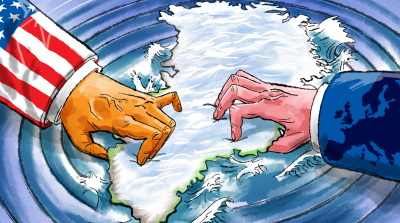
The possibility—however remote—of an American military takeover of Greenland has unsettled strategic and diplomatic circles. Beyond its shock value, the idea exposes deep contradictions within the transatlantic security order, threatens the credibility of alliances, and risks triggering wider geopolitical and nuclear instability.
Why Greenland has become strategically sensitive
Greenland, an autonomous territory administered by Denmark, occupies a pivotal position in the Arctic and North Atlantic security architecture. Climate change has opened new maritime routes, while the region is believed to hold significant reserves of hydrocarbons and rare earth minerals. For the United States, Greenland already hosts critical strategic infrastructure, notably the Thule Air Base, which plays a role in missile warning and space surveillance.
Crucially, Washington already enjoys extensive access under a 1951 defence agreement with Denmark. The US once operated 17 military facilities on the island and later chose to scale them down. From a purely strategic standpoint, this makes any talk of annexation or military takeover difficult to justify.
The Article 5 contradiction at NATO’s core
The most serious implication of any American move against Greenland would be for the . NATO’s foundation rests on Article 5, which treats an attack on one member as an attack on all. Ironically, Article 5 has been invoked only once—in 2001, after the 9/11 attacks—to support the United States.
Denmark was among the earliest to respond, later losing 43 soldiers in Afghanistan, one of the highest per-capita casualty rates among NATO allies. If the US were to violate Danish territorial integrity, NATO would face an unprecedented dilemma: its most powerful member acting as the aggressor. Denmark has indicated it would invoke Article 5, but the treaty was never designed for such an internal rupture. The alliance’s credibility would be fundamentally shaken.
A strategic windfall for Russia and China
Any fracture within NATO would benefit America’s principal adversaries. would welcome a weakened alliance or a diversion of Western attention away from Ukraine. China, too, would gain from the erosion of rules-based alliances that constrain great-power unilateralism.
Paradoxically, while Greenland is often framed as a counter to Russian and Chinese Arctic ambitions, US defence assessments suggest that the primary arena of concern lies elsewhere. The Pentagon’s 2024 Arctic Strategy highlights growing Sino-Russian cooperation—commercial and military—mainly in waters around Alaska, not Greenland. Targeting Danish territory would therefore undermine, rather than enhance, Western strategic coherence in the Arctic.
Domestic drivers behind the Greenland push
The renewed American interest in Greenland appears less rooted in strategic necessity and more in domestic political and ideological currents. US President has repeatedly framed the issue in transactional terms, including the possibility of purchasing the territory.
Several influential figures close to Trump—ranging from technology investors to real estate magnates—have floated ideas involving resource extraction, strategic settlements, or even experimental “post-nation” projects. However, Denmark has categorically ruled out any sale, and the issue has become so politically charged in Copenhagen and Nuuk that even discussing a deal risks destabilising governments.
Ripple effects on the global nuclear order
The consequences of a NATO rupture would extend well beyond Europe. Canada, which would find itself strategically hemmed in if Greenland were annexed, has already begun debating whether its long-standing non-nuclear posture remains viable. Similar debates could emerge in Germany and Poland if NATO’s security guarantee is discredited. In Asia, US allies such as South Korea and Japan might also reassess their reliance on American extended deterrence.
What begins as a territorial dispute could thus cascade into renewed global nuclear proliferation pressures.
Power, alliances and strategic restraint
At its core, the Greenland question highlights a fundamental tension in international politics: whether a dominant power can override alliance norms without destroying the very institutions that sustain its influence. NATO’s endurance has depended on trust, respect for sovereignty, and predictability. Undermining these principles would hollow out the alliance from within, weakening the security architecture that has underpinned the Euro-Atlantic order for over seven decades.
What to note for Prelims?
- Strategic importance of Greenland in Arctic geopolitics.
- Article 5 of the NATO Treaty and its implications.
- US–Denmark defence agreement of 1951.
- Key features of the US Department of Defense Arctic Strategy (2024).
What to note for Mains?
- Limits of alliance politics when a dominant member challenges sovereignty norms.
- Impact of Arctic geopolitics on NATO and global security.
- Implications of alliance breakdowns for nuclear proliferation.
- Balancing strategic interests with institutional credibility in foreign policy.