
The collapse of Bashar al-Assad’s regime in December 2024 was widely expected to end Syria’s prolonged civil war. Instead, the transition under interim leader Ahmed al-Sharaa has reopened old fault lines, particularly over the future of Kurdish autonomy in the country’s north and east. Renewed clashes between government forces and the Kurdish-led Syrian Democratic Forces (SDF) now threaten to dismantle a decade-old experiment in self-rule that emerged during the civil war.
How Kurdish self-rule emerged during Syria’s war
Syria’s Kurds constitute roughly 10% of the population and are concentrated in the northern and northeastern regions. When the Assad government withdrew troops from the northeast in 2012 to fight battles elsewhere, Kurdish political groups and militias stepped in to fill the vacuum.
Over time, several Kurdish-majority areas were organised into autonomous “cantons”, eventually forming the Democratic Autonomous Administration of North and East Syria (DAANES), commonly known as Rojava. This system combined local councils, armed self-defence units, and parallel administrative institutions operating outside Damascus’s control.
The key Kurdish actors in northeast Syria
The dominant political force in Rojava is the Democratic Union Party (PYD), which draws ideological inspiration from the doctrine of “democratic confederalism” articulated by Abdullah Ocalan. Alongside it operates the Kurdistan National Council (KNC), which is closer to the Iraqi Kurdistan Democratic Party and often critical of PYD dominance.
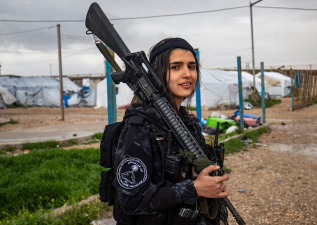
Militarily, the backbone of Kurdish power has been the People’s Protection Units (YPG) and its women’s wing, the YPJ. These groups rose to international prominence during the 2014–15 battle for Kobane, when they inflicted a major defeat on the Islamic State (IS).
In 2015, with U.S. backing, Kurdish leaders formed the Syrian Democratic Forces (SDF), an umbrella coalition of Kurdish, Arab, and minority militias, with the YPG as its core.
Why fighting resumed after Assad’s fall
The fall of Assad immediately brought the question of Kurdish autonomy to the fore. Interim president Ahmed al-Sharaa—formerly associated with al-Qaeda’s Syrian branch—has sought to rebuild Syria as a centralised state governed from Damascus.
In March 2025, Sharaa and SDF commander Mazloum Abdi signed a preliminary integration agreement, outlining the incorporation of SDF forces and Kurdish administrative units into the Syrian state. However, talks stalled over one fundamental issue: the Kurds refused to surrender the autonomy they had exercised since 2012.
As negotiations dragged on, Damascus proposed deploying government troops in Kurdish areas. Kurdish leaders argued that losing military control would inevitably mean losing political autonomy. In early January, government forces moved into Kurdish-controlled neighbourhoods of Aleppo, triggering clashes and forcing the SDF to retreat toward the northeast.
What Damascus wants from the Kurds
The Sharaa government’s position is shaped by both sovereignty concerns and security calculations. During the civil war, Kurdish forces—especially the YPG and later the SDF—were the most effective ground force against IS, operating with U.S. air support. Damascus tolerated Kurdish autonomy largely because it lacked the capacity to challenge it.
Now emboldened by international recognition, Sharaa wants to end this parallel power structure. His approach combines cultural accommodation with military centralisation. In January 2026, he formally recognised Kurdish as a national language, offered citizenship to Syrian Kurds, and declared Newroz a national holiday—while remaining silent on political autonomy.
Turkiye and the United States: converging interests
Turkiye views the PYD and YPG as extensions of the Kurdistan Workers’ Party (PKK), which Ankara designates as a terrorist organisation. Sharaa’s group, Hayat Tahrir al-Sham (HTS), maintains close ties with Turkiye, which supports the integration—and effective dismantling—of Kurdish military structures in Syria.
The U.S., meanwhile, relied heavily on the SDF to defeat IS and still maintains around 900 troops in northeastern Syria. However, Washington’s priorities have shifted since Sharaa consolidated power and joined the U.S.-led coalition against IS. Both the U.S. and Turkiye now see value in a centralised Syrian state that could limit Iranian and Russian influence, even if it comes at the expense of Kurdish autonomy.
What the latest ceasefire actually says
After rapid government advances across Raqqa and Deir al-Zour—former IS strongholds—SDF positions weakened, exacerbated by internal splits among Arab militias. On January 18, Mazloum Abdi agreed to a ceasefire and a new integration framework.
The agreement requires the SDF to:
- Hand over Raqqa and Deir al-Zour administratively and militarily
- Transfer control of border crossings and oil and gas fields
- Integrate institutions in al-Hassaka into state structures
- Expel all non-Syrian PKK members from Syria
However, sharp disagreements remain. While Damascus insists on integrating SDF fighters individually rather than as units, Kurdish leaders want to retain control over core areas such as Kobane, Qamishli, and al-Hassaka. The text’s vague promise to protect the “special character” of Kurdish areas leaves ample room for dispute.
Why the Kurdish question remains unresolved
At its core, the conflict reflects incompatible visions of Syria’s future. The Sharaa regime seeks a strong, centralised state with a monopoly over force. The Kurds, shaped by years of self-governance and armed struggle, fear that surrendering military autonomy will hollow out all political guarantees.
With reports of mobilisation in Kurdish areas and Kobane under siege, the fragile ceasefire appears more like a pause than a resolution.
What to note for Prelims?
- DAANES (Rojava) emerged after Syrian troop withdrawal in 2012.
- SDF is a U.S.-backed coalition led by Kurdish YPG.
- Turkiye views PYD/YPG as PKK affiliates.
- Newroz has been declared a national holiday by Syria’s interim government.
What to note for Mains?
- Kurdish autonomy in Syria is a product of civil war state collapse.
- The conflict highlights tensions between centralisation and federal/autonomous demands.
- External actors (U.S., Turkiye) shape outcomes through shifting strategic interests.
- The Kurdish issue has implications for regional stability and counter-terrorism efforts.