
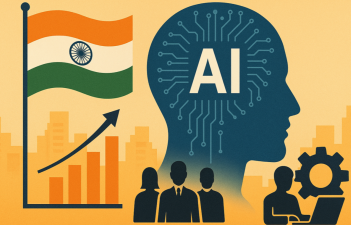
India’s rise in artificial intelligence (AI) is no longer limited to its reputation as an IT outsourcing hub. It is increasingly seen as a country capable of building, deploying and governing AI at population scale. This shift has been driven by strong digital public infrastructure, targeted policy interventions, and a deep pool of technical talent. As AI reshapes economic and geopolitical power, India’s trajectory carries both domestic and global implications.
From IT Services to AI Systems at Scale
For decades, India was identified primarily with software services and global IT talent. The transformation underway today is structural. Over the last ten years, India invested heavily in digital public infrastructure such as Aadhaar, UPI and DigiLocker. These platforms created interoperable systems and standardised data flows across sectors.
Such digital foundations are critical for AI deployment. Artificial intelligence systems require structured, high-quality datasets and seamless integration across services. India’s digital public goods architecture allows AI applications to be embedded into governance, financial inclusion, health systems and welfare delivery at a scale unmatched by most developing countries. This integration of technology with public administration marks a shift from service provider to systems architect.
IndiaAI Mission and the Compute Imperative
A decisive push came with the launch of the IndiaAI Mission in 2024. The Mission seeks to strengthen the entire AI ecosystem by investing in computing capacity, datasets, research institutions, start-ups and skilling programmes.
A national AI compute platform with more than 38,000 GPUs has been established, with over 22,000 GPUs already allocated to hundreds of users including government departments, researchers, students and MSMEs. In the global AI race, access to high-performance computing has become a strategic bottleneck. Many countries in Africa, Southeast Asia and Latin America face severe constraints in compute infrastructure.
By lowering this barrier, India is attempting to ensure that domestic researchers and start-ups are not structurally disadvantaged. This intervention reflects a broader recognition that AI capability is closely tied to control over computing infrastructure, similar to how industrial power once depended on energy and manufacturing capacity.
Human Capital as Strategic Advantage
India’s demographic and educational profile provides a structural advantage. The country ranked second in talent according to the Global AI Vibrancy Rankings published by Stanford University. With one of the largest pools of engineers, coders and data scientists in the world, India possesses the workforce needed to integrate AI across sectors.
AI adoption is not limited to frontier research labs. It requires large numbers of professionals capable of embedding AI tools into supply chains, healthcare systems, agricultural advisory networks and administrative processes. India’s broad talent base enables diffusion rather than concentration of innovation. In contrast, many advanced economies face ageing populations and talent shortages, limiting rapid scaling.
AI for Public Welfare and Start-up Innovation
India’s AI journey is distinctive for its public-sector orientation. Rather than focusing solely on high-end defence or corporate applications, India is applying AI to population-scale challenges.
Start-ups in HealthTech, AgriTech, FinTech, logistics and education are building solutions tailored to Indian realities — affordability, linguistic diversity and uneven infrastructure. AI-driven diagnostic tools, crop advisory systems, tutoring platforms and governance dashboards are being designed to serve millions of users.
This approach positions AI not merely as a productivity tool but as an instrument of social transformation. It also generates exportable models for countries in Southeast Asia, Africa and West Asia that share similar developmental challenges. In this sense, India’s AI ecosystem aligns technological ambition with Global South needs.
Balancing Innovation and Responsible Governance
Artificial intelligence presents risks alongside opportunities — algorithmic bias, misinformation, privacy concerns and cybersecurity vulnerabilities. The regulatory challenge is to build trust without stifling innovation.
India’s approach aims to combine ecosystem development with responsible governance. As its domestic AI capabilities grow, India is likely to gain greater influence in global discussions on AI safety norms, standards and ethical frameworks. Technological power increasingly shapes diplomatic and economic leverage, making AI governance part of strategic statecraft.
The broader debate concerns whether AI will remain concentrated in a handful of technologically advanced nations or become accessible to large, diverse societies. India’s model could influence how inclusive the global AI order becomes.
Bridging Capability Gaps and Strengthening Foundations
Despite progress, significant challenges remain. Research intensity must deepen to move from applied solutions to frontier innovation. Domestic semiconductor and hardware capabilities require sustained investment to reduce import dependence. Data quality standards and cybersecurity frameworks must evolve continuously.
Global forums such as the AI Impact Summit 2026 are likely to become arenas where questions of access, governance and deployment at scale are debated. India’s ability to shape these conversations will depend on strengthening its internal ecosystem.
What to Note for Prelims?
- Key components of India’s Digital Public Infrastructure: Aadhaar, UPI, DigiLocker.
- Objectives and components of the IndiaAI Mission.
- Concept of AI compute infrastructure and GPUs.
- Global AI Vibrancy Rankings and indicators of AI capability.
- Issues of AI governance: bias, safety, cybersecurity, data protection.
What to Note for Mains?
- Discuss how digital public infrastructure strengthens India’s AI ecosystem.
- Examine the role of state intervention in building AI compute capacity.
- Analyse the link between AI capability and geopolitical power.
- Evaluate challenges in balancing AI innovation with regulation and ethical safeguards.
- Assess how India’s AI model can support Global South cooperation.