
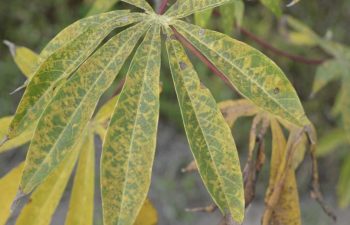
Cassava Brown Streak Disease (CBSD) is a viral disease causing root rot in cassava. It poses a serious threat to food security in sub-Saharan Africa. Cassava is a vital crop for millions due to its drought tolerance and ability to grow in poor soils. The disease damages roots, often unnoticed until harvest, leading to heavy crop losses. Scientists warn that CBSD could spread further if unchecked.
Geographical Spread and Risk Areas
About 54.6% of Africa’s land, or 16.2 million sq km, is suitable for cassava farming. Around 33.7% of the continent, approximately 10.2 million sq km, is at risk of CBSD infection. The disease has been endemic for over 70 years on the coasts of Tanzania and Mozambique. Recently, it has spread to Uganda and other East and Central African countries. There is growing concern about its possible westward expansion into major cassava-producing countries like Nigeria and Ghana.
Role of Whitefly and Farming Practices
CBSD spreads mainly through the whitefly species Bemisia tabaci. Specific whitefly groups in sub-Saharan Africa, known as SSA1 and SSA2, are highly efficient virus carriers. Their populations have surged due to climate change and intensified agriculture. Smallholder farmers often reuse infected cassava cuttings, unknowingly spreading the disease. Formal systems to provide clean planting material are weak in Africa, unlike in countries like Thailand where certified disease-free seeds are distributed.
Impact of Climate Change and Control Efforts
Climate change influences CBSD spread by affecting whitefly populations and cassava growth conditions. Warmer temperatures and altered rainfall patterns increase disease risk in some areas. However, the main cause of new outbreaks remains the informal trade of infected cuttings. Scientists have found natural resistance to CBSD in South American cassava varieties. Breeding programmes using this germplasm aim to develop cassava strains resistant to multiple viruses. Trials are ongoing in several African countries and abroad.
Challenges and Future Directions
Many high-yield cassava varieties resistant to Cassava Mosaic Disease are vulnerable to CBSD. This has created a large susceptible host population. Efforts focus on breeding dual-resistant varieties that meet farmers’ needs. Strengthening clean seed systems and educating farmers on disease management are critical to controlling CBSD spread.
Topics for Prelims:
Cassava Brown Streak Disease (CBSD)
- Viral disease causing root necrosis in cassava.
- Primarily spread by whitefly Bemisia tabaci.
- Endemic in East and Central Africa, risk expanding westward.
- Symptoms often visible only at harvest.
- Causes yield and quality losses.
Whitefly Bemisia tabaci
- Vector for CBSD virus transmission.
- Exists as genetically distinct groups SSA1 and SSA2 in Africa.
- Population growth driven by climate change and agriculture.
- Efficient virus carriers in sub-Saharan Africa.
- Control essential to managing CBSD spread.
Cassava Crop in Africa
- Staple food crop for millions in sub-Saharan Africa.
- Thrives in drought and poor soils.
- About 54.6% of Africa’s land suitable for cultivation.
- Smallholder farmers often reuse planting cuttings.
- Breeding efforts focus on disease-resistant varieties.
Questions for Mains:
- Critically analyse the impact of viral diseases on staple food crops and suggest sustainable management strategies. [GS-III-Economic Development]
- With suitable examples, estimate the role of climate change in altering pest and disease dynamics in agriculture. [GS-III-Environment & DM]
- Point out the challenges faced by smallholder farmers in adopting clean seed systems and discuss policy measures to strengthen them. [GS-II-Governance]
- Underline the significance of international cooperation in plant breeding and germplasm exchange for food security. How can this be enhanced in the context of emerging crop diseases? [GS-II-International Relations]
Answer Hints:
1. Critically analyse the impact of viral diseases on staple food crops and suggest sustainable management strategies. [GS-III-Economic Development]
- Viral diseases (e.g., CBSD in cassava) cause severe yield and quality losses, threatening food security.
- Symptoms often latent or visible only at harvest, complicating timely detection and control.
- Spread facilitated by vectors (whiteflies) and contaminated planting material, leading to rapid disease dissemination.
- Sustainable management includes breeding resistant/tolerant varieties and integrated pest management (IPM).
- Strengthening clean seed systems and farmer education reduces infection cycles and spread.
- Climate-resilient approaches and monitoring systems are essential to adapt to changing disease dynamics.
2. With suitable examples, estimate the role of climate change in altering pest and disease dynamics in agriculture. [GS-III-Environment & DM]
- Climate change alters temperature and rainfall patterns, affecting pest/vector populations and crop susceptibility.
- Example – Whitefly populations (Bemisia tabaci) increased in Africa due to warmer climate, intensifying CBSD spread.
- Shifting agro-ecological zones may expand or reduce suitable habitats for crops and pests.
- Extreme weather events can stress crops, making them more vulnerable to diseases.
- Climate change is a contributing but not sole driver; human activities (e.g., movement of infected material) also critical.
- Adaptive agricultural practices and surveillance needed to mitigate emerging pest/disease threats.
3. Point out the challenges faced by smallholder farmers in adopting clean seed systems and discuss policy measures to strengthen them. [GS-II-Governance]
- Smallholders often reuse infected cuttings due to lack of access to certified disease-free planting material.
- Formal clean seed systems are weak or poorly structured in many African regions.
- Limited awareness and resources restrict adoption of improved disease management practices.
- Policy measures – invest in seed certification infrastructure and extension services to educate farmers.
- Promote public-private partnerships to develop affordable, accessible clean seed supply chains.
- Encourage community-based seed multiplication and regulation to ensure quality and traceability.
4. Underline the significance of international cooperation in plant breeding and germplasm exchange for food security. How can this be enhanced in the context of emerging crop diseases? [GS-II-International Relations]
- International germplasm exchange enables access to diverse genetic resources, e.g., South American cassava varieties with CBSD resistance.
- Collaborative breeding programs accelerate development of multi-virus resistant varieties adapted to local needs.
- Global cooperation facilitates knowledge sharing, surveillance, and rapid response to emerging threats.
- Enhancing cooperation requires streamlined phytosanitary protocols and trust among countries.
- Investment in joint research, capacity building, and funding mechanisms strengthens resilience.
- Integration of international frameworks (e.g., ITPGRFA) with national policies ensures equitable access and benefit sharing.