
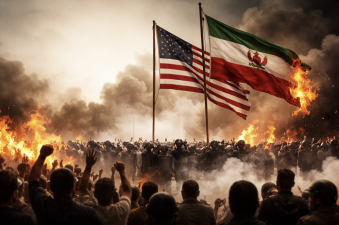
The United States has moved two aircraft carrier strike groups closer to Iran, fuelling speculation of possible military action — either unilateral or coordinated with Israel. President Donald Trump’s objective appears clear: compel Tehran to abandon nuclear enrichment, curb its ballistic missile programme, and withdraw support from regional non-state actors. Yet the critical question is whether military pressure can alter Iran’s behaviour — or whether it might instead consolidate the clerical regime’s grip on power.
Why Washington is Raising Military Pressure
The US demands centre on three pillars:
- Ending Iran’s uranium enrichment programme.
- Halting ballistic missile development.
- Ceasing support for groups such as Hezbollah, Hamas, and the Houthis.
Negotiations remain underway, but Tehran has repeatedly framed enrichment as a sovereign right. Any perceived violation of sovereignty risks outright rejection. For Washington, the deployment of carrier strike groups is therefore both coercive diplomacy and signalling — an attempt to strengthen bargaining leverage without immediate escalation.
Iran’s Internal Fault Lines and Regime Resilience
Recent nationwide protests — triggered by economic distress and currency devaluation — evolved into broader anti-regime demonstrations. Despite their scale and intensity, the state’s core security apparatus remained unified. Internet shutdowns and forceful crackdowns eventually subdued unrest.
Two structural features explain regime durability:
- The cohesion of security forces, particularly the Islamic Revolutionary Guard Corps (IRGC).
- The fragmentation of the opposition, lacking unified leadership or ideological coherence.
Although discontent runs deep, a significant segment of Iran’s population continues to support or depend upon the regime. This creates a power imbalance in favour of the state. External military action, rather than fracturing this alignment, may reinforce nationalist solidarity.
Can Military Action Change Tehran’s Behaviour?
The United States could target missile facilities or nuclear infrastructure. However, such strikes would likely:
- Delay but not eliminate technical capabilities.
- Strengthen hardline factions within the regime.
- Justify expanded internal repression.
Decapitation strategies — such as targeting Supreme Leader Ayatollah Ali Khamenei — are highly improbable given security realities. Without ground intervention, regime change remains unlikely.
Historical precedents in West Asia suggest that external force often entrenches ideological regimes rather than dismantling them. Nationalism, especially in societies with memories of foreign intervention, can override internal dissent.
Trump’s Strategic Calculus and the Oil Factor
President Trump’s approach appears influenced by an energy-centric worldview shaped by the oil shocks of the 1970s. In this logic, hydrocarbon wealth underpins geopolitical power.
Iran, like Venezuela, holds vast oil and gas reserves. A normalised relationship could theoretically expand global supply and lower energy prices — an outcome with domestic political benefits in the United States.
However, rapid transformation of Iran’s political order to unlock energy flows is improbable. Structural sanctions, infrastructure constraints, and elite factionalism complicate any swift realignment.
Regional Constraints and Gulf Calculations
Arab Gulf states have signalled reluctance to support direct military confrontation, fearing retaliation through missile strikes or proxy escalation. Iran’s regional network — stretching through Lebanon, Syria, Iraq, and Yemen — provides asymmetric leverage.
Any US strike risks:
- Attacks on Gulf energy infrastructure.
- Disruption of shipping in the Strait of Hormuz.
- Escalatory cycles involving Israel and non-state actors.
The regional security environment is therefore tightly interconnected, raising the cost of unilateral action.
Nationalism as the Regime’s Shield
A central miscalculation in coercive strategies is underestimating nationalism. Across social and ideological divides, many Iranians view external pressure as imperial interference rather than humanitarian concern.
External military threats may:
- Reframe domestic dissent as betrayal.
- Allow the regime to present itself as defender of sovereignty.
- Marginalise reformist voices.
Thus, pressure intended to weaken the regime could paradoxically reinforce it.
What to Note for Prelims?
- Key Iranian institutions: Supreme Leader, President, Islamic Revolutionary Guard Corps (IRGC).
- Strategic importance of the Strait of Hormuz.
- Concept of nuclear enrichment under the Non-Proliferation Treaty (NPT).
- Major regional non-state actors linked to Iran.
What to Note for Mains?
- Effectiveness and limits of coercive diplomacy.
- External intervention and regime consolidation in West Asia.
- Energy geopolitics and its influence on foreign policy.
- Interplay between nationalism and authoritarian resilience.
- Risks of escalation in the Gulf security architecture.
The coming weeks will test whether Washington’s pressure campaign compels negotiation or entrenches confrontation. Given the Islamic Republic’s institutional cohesion and nationalist reflexes, regime collapse appears unlikely. The deeper question is not whether Tehran can survive external pressure — but whether coercion can produce durable behavioural change without triggering wider regional instability.
Last Modified: February 16, 2026