
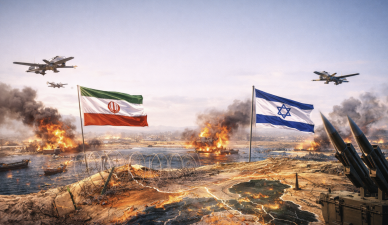
The Iran-Israel conflict escalated sharply in early 2026 after a failed mediation effort by Oman’s Foreign Minister. Despite Iran’s promise to forgo nuclear weapons, the United States and Israel launched a surprise attack killing Iran’s Supreme Leader Ayatollah Ali Khamenei and senior officials. Israel termed this a pre-emptive strike against existential threats. The conflict has since expanded, marking one of the most dangerous moments in West Asia’s recent history.
Background of the Conflict
The tension stems from Israel’s long-standing desire for regime change in Iran. Israel views Iran as a major threat due to its size, missile programme, and regional influence. While Arab states have either normalised relations with Israel or accepted its dominance, Iran remains the last revisionist power opposing Israeli supremacy. The 2015 nuclear deal under Obama failed to satisfy Israel because it did not cover Iran’s missile programme or support for militias.
Decapitation Strategy and Military Actions
Israel’s strategy focused on decapitating Iran’s leadership to force regime collapse without a ground invasion. The 2025 war lasted 12 days, ending in a ceasefire after initial Israeli gains. The 2026 strike was broader and killed Khamenei, aiming for quick regime change. However, Iran has survived the blows and retaliated by attacking U.S. bases in the Gulf and Israel, escalating the conflict into a regional war.
Regional and Global Implications
Iran’s closure of the Strait of Hormuz threatens global oil supply, risking economic disruption worldwide. The conflict risks drawing Gulf countries into the war. Missile defence systems protecting U.S. and Israeli assets may be overwhelmed if the war prolongs. The conflict challenges the U.S.-Israel alliance’s objective of swift victory, as Iran’s guerrilla warfare doctrine aims to outlast superior conventional forces.
Geopolitical Stakes and Future Prospects
The war is driven by geopolitics rather than Iranian freedom. Removing Iran would shift West Asia to a unipolar order centred on Israel and U.S. influence. However, Iran’s geographic and political resilience complicates this goal. The conflict’s outcome will shape West Asia’s power balance for decades, with risks for global stability.
Topics for Prelims:
Ayatollah Ali Khamenei
- Supreme Leader of Iran until 2026.
- Killed in the 2026 U.S.-Israel airstrike.
- Central figure in Iran’s Islamic Republic.
- Opposed to nuclear disarmament demands by Israel.
- His death intensified the Iran-Israel conflict.
Strait of Hormuz
- Key maritime chokepoint linking Persian Gulf and Arabian Sea.
- Transits about one-third of global oil supply.
- Closed temporarily by Iran during 2026 conflict.
- Closure risks global energy market disruption.
- Strategic focus in Iran-U.S.-Israel tensions.
Decapitation Strike
- Military tactic targeting leadership to destabilise regime.
- Used by Israel and U.S. against Iran in 2025-26.
- Aimed to force regime change without ground invasion.
- Failed to quickly topple Iranian government.
- Led to wider regional conflict escalation.
Questions for Mains:
- Critically analyse the impact of regime change policies on regional stability with reference to the Iran-Israel conflict. [GS-II-International Relations]
- Point out the strategic importance of the Strait of Hormuz and estimate the consequences of its closure on the global economy. [GS-III-Economic Development]
- With suitable examples, underline the challenges of using decapitation strikes as a military strategy in contemporary conflicts. [GS-III-Internal & External Security]
- Critically analyse the role of geopolitics in shaping West Asia’s power dynamics post-Second World War and how it influences current conflicts. [GS-I-Modern World History]
Answer Hints:
1. Critically analyse the impact of regime change policies on regional stability with reference to the Iran-Israel conflict. [GS-II-International Relations]
- Regime change attempts in Iran aimed at removing the Islamic Republic to establish a pro-Israel/U.S. friendly government.
- Past regime changes in Iraq, Libya, and Syria led to prolonged instability, civil wars, and power vacuums in the region.
- Iran’s geographic size, political resilience, and lack of armed opposition complicate regime change efforts and prolong conflict.
- Decapitation strikes failed to topple Iran, instead escalating regional tensions and widening conflict to Gulf states and beyond.
- Regime change policies risk destabilising energy markets (e.g., Strait of Hormuz closure) and global economy.
- Such policies deepen mistrust, fuel proxy wars, and undermine long-term regional peace and security.
2. Point out the strategic importance of the Strait of Hormuz and estimate the consequences of its closure on the global economy. [GS-III-Economic Development]
- Strait of Hormuz is a narrow chokepoint connecting the Persian Gulf to the Arabian Sea, vital for maritime oil transit.
- Approximately one-third of the world’s seaborne crude oil passes through this strait daily.
- Closure or disruption by Iran during conflict threatens global oil supply security and spikes crude oil prices.
- Energy market volatility can trigger inflation, disrupt industries, and slow global economic growth.
- Closure pressures Gulf monarchies and global powers, potentially drawing more actors into the conflict.
- Highlights vulnerability of global energy routes to regional geopolitical conflicts.
3. With suitable examples, underline the challenges of using decapitation strikes as a military strategy in contemporary conflicts. [GS-III-Internal & External Security]
- Decapitation strikes target leadership to quickly destabilise or topple regimes without ground invasion.
- In Iran-Israel conflict, killing Supreme Leader Khamenei failed to cause regime collapse or popular uprising.
- Geographical size, political structure, and popular support can enable regimes to survive leadership losses.
- Past examples – Israel’s prolonged conflict with Hamas despite heavy strikes; Libya and Syria required prolonged campaigns and ground involvement.
- Decapitation can escalate conflicts, provoke retaliations, and regionalise wars rather than end them swiftly.
- Limited effectiveness if no viable political alternative or armed opposition exists to fill power vacuum.
4. Critically analyse the role of geopolitics in shaping West Asia’s power dynamics post-Second World War and how it influences current conflicts. [GS-I-Modern World History]
- Post-WWII West Asia shaped by colonial legacies, Cold War rivalries, and emergence of Israel in 1948.
- U.S. and Israel’s strategic alliances aimed at containing revisionist powers like Iran, Iraq, Syria, and militant groups.
- Regime changes in Iraq, Libya, Syria shifted regional balances but created instability and power vacuums.
- Arab states’ normalization with Israel weakened collective Arab opposition; Iran remains primary challenger to Israeli supremacy.
- Geopolitical competition centers on control of resources, strategic waterways (Strait of Hormuz), and influence over proxy militias.
- Current Iran-Israel conflict reflects enduring geopolitical contest for unipolar dominance in West Asia backed by U.S. power projection.