
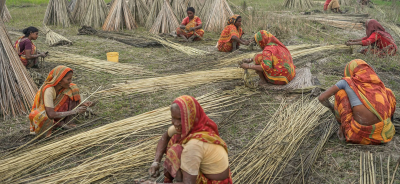
For decades, jute — the famed “Golden Fibre” — has been woven into the economic and cultural fabric of West Bengal. Districts such as Murshidabad, Nadia, Hooghly and North 24 Parganas built rural livelihoods around this crop. Yet rising labour costs, volatile prices and competition from synthetic fibres pushed many farmers away from jute. Today, a quiet revival is underway, driven by agronomic innovation and renewed global demand for sustainable materials, placing jute once again at a critical crossroads.
Why jute cultivation had declined
The retreat from jute was not sudden but structural. Traditional broadcasting of seeds caused overcrowding, poor fibre quality and high labour requirements for thinning. Manual weeding added to costs, while retting remained heavily dependent on rainfall and access to clean water bodies. At the same time, synthetic alternatives eroded jute’s market share, reducing price certainty for farmers. For small and marginal cultivators, the risk-return balance became increasingly unfavourable.
How modern sowing practices are changing outcomes
One of the most significant shifts has been the adoption of line sowing with recommended spacing. Farmers in Murshidabad and Nadia report that this method ensures uniform plant growth, better sunlight penetration and easier intercultural operations. The result has been finer fibre quality and improved market prices. Reduced plant competition also lowers the need for labour-intensive thinning, directly cutting production costs.
Integrated weed management and labour constraints
Weed pressure during early crop stages remains a major challenge, especially in Hooghly and North 24 Parganas where labour shortages are acute. Integrated weed management — combining selective herbicides, mechanical weeders and limited hand weeding — has emerged as a practical solution. This approach reduces dependence on manual labour while ensuring healthier crop growth and higher yields, making jute cultivation more economically viable.
Nutrient management and soil health revival
Balanced fertilisation is increasingly recognised as central to productivity gains. Research by ICAR-CRIJAF has highlighted the importance of sulphur and micronutrients such as zinc, alongside nitrogen, phosphorus and potassium. Farmers adopting integrated nutrient management — combining organic manure with recommended fertilisers — report stronger fibres and sustained soil health, reducing yield volatility over successive seasons.
Improved varieties and climate resilience
The introduction of high-yielding, disease-resistant jute varieties suited to West Bengal’s agro-climatic conditions has boosted farmer confidence. These varieties mature earlier and produce more uniform fibre, helping farmers cope with erratic rainfall and weather uncertainty. Certified seeds have been particularly impactful in Murshidabad, where yield stability has improved noticeably.
Reforming retting: the weakest link addressed
Retting has long been the most problematic stage of jute cultivation. Conventional water retting often produces uneven fibre quality due to pollution and water scarcity. New techniques such as ribbon retting and microbial retting are transforming this stage. They require less water, shorten retting duration and produce cleaner, stronger fibre with better colour — translating into higher grades and better prices for farmers.
Rising demand in a plastic-constrained world
The global push against plastic pollution has revived jute’s relevance. As a biodegradable and renewable fibre, jute is finding expanded use in packaging, geotextiles, handicrafts and eco-friendly consumer goods. Government policies promoting natural fibres and restricting single-use plastics have further strengthened demand, opening new income avenues for jute-growing regions.
Persisting challenges for small farmers
Despite positive trends, constraints remain. Climate change has made rainfall unpredictable, affecting sowing and retting cycles. Small and marginal farmers often lack access to mechanisation, quality seeds and timely extension services. Delayed procurement and price fluctuations continue to undermine confidence, discouraging long-term investment in the crop.
What policy support can make the difference
Sustaining the jute revival requires coordinated intervention. Strengthened extension services, targeted farmer training, affordable mechanisation, assured procurement and timely price support are essential. Without these, productivity gains may not translate into stable incomes, particularly for smallholders.
What to note for Prelims?
- Jute as a biodegradable natural fibre and its uses.
- Major jute-growing districts of West Bengal.
- Role of ICAR-CRIJAF in jute research.
- Ribbon retting and microbial retting techniques.
What to note for Mains?
- Analyse the causes behind the decline and revival of jute cultivation in India.
- Discuss how modern agronomic practices can improve farmer incomes.
- Examine the role of natural fibres in sustainable development and climate policy.
- Suggest policy measures to make jute cultivation economically sustainable.