
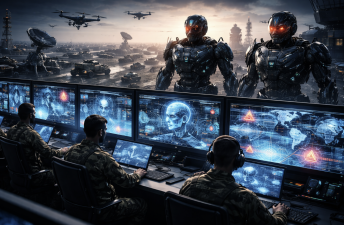
Recent developments in 2026 have raised serious concerns about the use of artificial intelligence (AI) in national security. An American AI lab, Anthropic, has labelled three Chinese AI labs—DeepSeek, MoonshotAI, and MiniMax—as national security threats. The US military has reportedly used AI models from Anthropic and other American firms in targeted strikes on Iran. This has sparked debates on AI’s role in warfare and the challenges of controlling its spread worldwide.
AI Distillation and Security Threats
Chinese labs are accused of distilling advanced AI models from American companies. Distillation means using outputs of a strong AI model to train a weaker one. This process was done on an industrial scale with millions of interactions, violating terms of service. The attacks were sophisticated and deceptive. This raises questions about intellectual property and security risks from AI technology transfer.
Comparison with Nuclear and Semiconductor Technologies
Generative AI is often compared to nuclear technology due to its power and risks. However, AI is more like semiconductors—dual-use and widely developed in the private sector. Unlike nuclear materials, AI models are mathematical and harder to control or trace. Export controls have failed to prevent Chinese labs from replicating frontier AI models cheaply, showing limits of current restrictions.
Military Use and Corporate Guardrails
American AI firms, including Anthropic and OpenAI, provide technology used by the US military for surveillance, cyberwarfare, and autonomous weapons. Anthropic faced pressure and was labelled a supply chain risk when it raised concerns about military use. OpenAI accepted military contracts, showing a competitive race to serve government clients. This challenges the idea that AI models can have effective guardrails to prevent misuse.
Governance and Future Directions
Restricting AI access or distillation is difficult due to talent mobility and technical workarounds. Current input-based controls harm innovation and concentrate power in few companies. Instead, global plurilateral agreements are needed. These should ensure responsible AI use with human control over lethal decisions, ban mass surveillance, and enforce auditable standards. Universal application is key for effectiveness.
Topics for Prelims:
Anthropic and Chinese AI Labs
- Anthropic is a US AI lab involved in military AI applications.
- Chinese labs DeepSeek, MoonshotAI, MiniMax accused of AI distillation.
- Distillation means training weaker models using outputs from stronger ones.
- Millions of interactions violated terms of service.
- US military used AI models in Iran strikes.
AI Technology and National Security
- Generative AI is dual-use technology with civilian and military applications.
- AI compared to nuclear tech but more like semiconductors in control difficulty.
- Export controls on AI inputs have been bypassed.
- US firms face pressure over military use of AI models.
- Global governance needed for responsible AI use.
Questions for Mains:
- Critically discuss the challenges of regulating dual-use technologies like artificial intelligence in the context of global security. [GS-III-Internal & External Security]
- Analyse the limitations of export controls in preventing technology proliferation, taking examples from AI and semiconductor industries. [GS-III-Economic Development]
- With suitable examples, discuss the ethical implications of private sector involvement in military applications of emerging technologies. [GS-IV-Ethics, Integrity and Aptitude]
- Examine the role of plurilateral agreements in governing artificial intelligence and compare it with nuclear non-proliferation treaties. [GS-II-International Relations]
Answer Hints:
1. Critically discuss the challenges of regulating dual-use technologies like artificial intelligence in the context of global security. [GS-III-Internal & External Security]
- AI is a dual-use technology with both civilian and military applications, complicating regulation.
- Unlike nuclear tech, AI models are mathematical, intangible, and hard to trace or control.
- Talent mobility and global R&D decentralization make enforcement of restrictions difficult.
- Corporate guardrails fail as companies may be pressured or overridden by governments.
- Technological workarounds (e.g., distillation) enable circumvention of controls.
- Effective regulation requires international cooperation and plurilateral governance frameworks.
2. Analyse the limitations of export controls in preventing technology proliferation, taking examples from AI and semiconductor industries. [GS-III-Economic Development]
- Export controls on AI inputs (e.g., semiconductors) have been bypassed or partially repealed.
- Chinese AI labs replicated frontier models cheaply despite export restrictions.
- Semiconductor supply chains are complex and global, making controls difficult to enforce.
- Controls can stifle innovation and concentrate market power in few companies.
- Distillation techniques bypass input restrictions by using model outputs instead of raw data.
- Export controls alone are insufficient without complementary governance and collaboration.
3. With suitable examples, discuss the ethical implications of private sector involvement in military applications of emerging technologies. [GS-IV-Ethics, Integrity and Aptitude]
- Private firms like Anthropic and OpenAI provide AI tech for surveillance, cyberwarfare, and autonomous weapons.
- Ethical concerns arise when companies face pressure to support military uses against their policies.
- OpenAI’s acceptance of permissive military contracts contrasts with Anthropic’s resistance, showing competitive ethics dilemmas.
- Corporate guardrails are insufficient as governments can override or replace companies.
- Private sector’s dual role in civilian innovation and military applications raises accountability and transparency issues.
- Calls for coordinated industry, policymaker, and cloud provider responses to balance innovation and ethical responsibility.
4. Examine the role of plurilateral agreements in governing artificial intelligence and compare it with nuclear non-proliferation treaties. [GS-II-International Relations]
- Plurilateral agreements can establish universal norms for responsible AI use, including human control over lethal decisions.
- Unlike nuclear treaties, AI governance is complicated by the intangible, widely accessible nature of AI models.
- Nuclear non-proliferation works due to rarity and traceability of fissile materials, unlike mathematical AI models.
- AI agreements need to cover prohibitions on mass surveillance and set auditable technical standards.
- Universal application is crucial for effectiveness to prevent regulatory loopholes and competitive imbalances.
- Plurilateral frameworks can help balance innovation, security, and ethical concerns in AI development and deployment.