
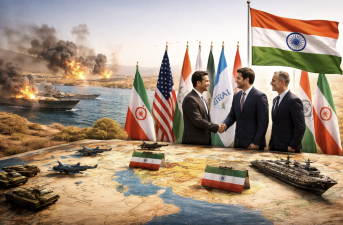
The 2026 war in West Asia between Israel, the U.S., and Iran has raised global concerns. Prime Minister of India Narendra Modi’s visit to Israel just before the conflict and India’s silence on Iran’s Ayatollah Khamenei’s killing have sparked debate. The war impacts energy prices, economic stability, and the safety of millions of Indians in the region. This article explores India’s stance and the broader geopolitical effects.
India’s Diplomatic Approach
India has maintained a cautious and somewhat detached position. Despite having major stakes in regional peace, energy security, and protecting 10 million Indians in West Asia, India has avoided taking sides openly. Modi’s visit to Israel signalled a closer bond but did not translate into active diplomatic pressure for restraint. India’s External Affairs Minister held limited talks with Gulf and Arab League ministers but no unified regional security approach emerged.
Impact on Regional Security and Gulf States
Gulf countries are defensive, intercepting Iranian missile attacks without declaring war. Their air defences face strain and prolonged conflict may force a shift to offensive actions. Such moves risk deeper involvement against Iran, which the Gulf states want to avoid. The instability threatens regional security and energy supplies vital to the global economy.
India’s Strategic Interests and Economic Concerns
India’s ties with Iran remain strategically important, especially for connectivity projects like Chabahar Port and cooperation on Afghanistan and Pakistan. However, economic interactions beyond oil appear limited. India’s silence on Iran’s sovereignty violations reflects a complex balancing act. The conflict has stalled the India-Middle East-Europe Economic Corridor (IMEC), a key trade initiative, due to rising instability and lack of investor confidence.
Influence of the U.S. and Future Outlook
India’s West Asia policy is influenced by its relationship with the U.S., complicated by tensions over trade and geopolitical expectations. Modi’s engagement with the U.S. and Israel contrasts with muted responses to Iran’s plight. The war’s trajectory remains uncertain. A ceasefire may require U.S. intervention. Regional security platforms are lacking, but emerging dialogues involving India, China, Russia, and Southeast Asian nations could encourage peace talks.
Topics for Prelims:
India’s West Asia Policy
- India’s strategic interests in West Asia include energy, trade, and diaspora welfare.
- Modi’s 2026 Israel visit indicated closer ties but no formal alliance.
- India maintains strategic ambiguity to keep options open.
- India’s ties with Iran focus on connectivity and regional stability.
- India has limited direct condemnation of Iran-related conflicts.
Israel-U.S.-Iran Conflict
- The 2026 war erupted after Hamas attacks and escalated with joint Israeli-U.S. strikes on Iran.
- Iran uses drones and missiles targeting Gulf states.
- Gulf countries defend but avoid offensive military roles.
- Conflict affects global energy prices and regional security.
- Political instability threatens projects like the India-Middle East-Europe Economic Corridor.
India-Middle East-Europe Economic Corridor (IMEC)
- IMEC aims to boost trade connectivity between India, West Asia, and Europe.
- Conflict in West Asia has delayed IMEC progress.
- Investor confidence is low amid regional instability.
- Track-two dialogues continue but government-level momentum is lacking.
- IMEC’s future depends on regional peace and economic stability.
Questions for Mains:
- Critically analyse the impact of India’s strategic ambiguity in West Asia on its energy security and diaspora welfare. [GS-II-International Relations]
- With suitable examples, estimate the role of Gulf countries in maintaining regional security amid the Israel-U.S.-Iran conflict and its implications for global energy markets. [GS-III-Economic Development]
- Point out the challenges and opportunities in implementing the India-Middle East-Europe Economic Corridor in the current geopolitical scenario. [GS-III-Economic Development]
- Underline the influence of U.S. foreign policy on India’s West Asia strategy and discuss how India can balance its relations with conflicting powers. [GS-II-International Relations]
Answer Hints:
1. Critically analyse the impact of India’s strategic ambiguity in West Asia on its energy security and diaspora welfare. [GS-II-International Relations]
- India maintains strategic ambiguity to avoid alienating either Israel or Iran, preserving diplomatic flexibility.
- This ambiguity helps safeguard energy imports, as Iran is oil supplier and Gulf states are crucial energy partners.
- It prevents escalation of tensions that could jeopardize the safety of over 10 million Indians residing in West Asia.
- However, perceived closeness to Israel (e.g., Modi’s visit) risks Iran’s trust and complicates India-Iran ties.
- Limited condemnation of Iran’s actions reflects India’s balancing act but may reduce its influence in regional security dialogues.
- Strategic ambiguity thus supports energy security and diaspora welfare but constrains India’s assertiveness in conflict resolution.
2. With suitable examples, estimate the role of Gulf countries in maintaining regional security amid the Israel-U.S.-Iran conflict and its implications for global energy markets. [GS-III-Economic Development]
- Gulf states adopt a defensive posture, intercepting Iranian missile and drone attacks without engaging offensively.
- This cautious approach aims to avoid direct involvement against Iran, maintaining regional stability.
- Cracks in Gulf air defenses indicate vulnerability and risk of escalation if attacks persist.
- Gulf instability threatens global energy supplies, as the region is a major oil exporter influencing prices worldwide.
- Prolonged conflict risks disrupting oil exports, causing price volatility and economic shocks globally.
- Gulf countries’ security decisions thus directly impact global energy markets and geopolitical balance.
3. Point out the challenges and opportunities in implementing the India-Middle East-Europe Economic Corridor in the current geopolitical scenario. [GS-III-Economic Development]
- IMEC aims to enhance trade connectivity between India, West Asia, and Europe, boosting economic integration.
- Current West Asia conflict and regional instability have stalled progress and dampened investor confidence.
- Hamas-Israel war (Oct 7 attack) dealt a major institutional blow, pushing IMEC to the back burner.
- Track-two dialogues continue but lack government-level momentum and clear strategic prioritization.
- Opportunities exist if peace is restored, enabling smoother trade flows and regional cooperation.
- Success depends on resolving security risks, attracting capital, and aligning geopolitical interests.
4. Underline the influence of U.S. foreign policy on India’s West Asia strategy and discuss how India can balance its relations with conflicting powers. [GS-II-International Relations]
- U.S. policy under Trump was unpredictable, imposing tariffs and expecting public credit from India, straining ties.
- India’s close engagement with U.S. and Israel contrasts with muted response to Iran, reflecting U.S. influence.
- Modi’s Israel visit before the conflict signaled alignment but India avoided overtly taking sides.
- Balancing requires strategic ambiguity, maintaining relations with Iran for connectivity and regional stability.
- India can leverage multilateral dialogues and regional groupings (e.g., Arab League, GCC) to keep options open.
- Effective balancing involves diplomatic finesse, avoiding alienation of any key power while protecting national interests.