
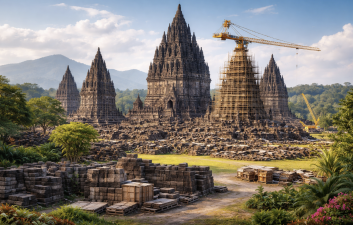
The restoration of the Prambanan Temple complex in Indonesia has gained momentum in 2026. India and Indonesia are collaborating to preserve this 9th-century Hindu heritage site. Indonesian Culture Minister Fadli Zon recently met with the Archaeological Survey of India (ASI) team to discuss restoration plans. The project focuses on conserving Prambanan along with nearby temples Sewu and Plaosan, maintaining the entire cultural landscape.
Restoration Approach and Techniques
The ASI experts have chosen the anastylosis technique for restoration. This method involves reassembling the temple using original stones found onsite. New stones may be added only to support structural stability. The scattered stone blocks pose a challenge, requiring detailed cataloguing to match each piece correctly. The project aims to preserve the temple’s authenticity while ensuring safety.
Integration of Technology in Preservation
Indonesia is open to using advanced technology for restoration. Digital tools and artificial intelligence (AI) will assist in identifying and fitting stone components. These innovations can speed up the process and improve accuracy. Combining traditional methods with modern technology is expected to enhance conservation efforts.
Cultural and Historical Importance
Prambanan is a UNESCO World Heritage Site from the 9th century. It is dedicated to the Trimurti, the Hindu trinity of Brahma, Vishnu, and Shiva. The temple complex is part of a wider cultural ecosystem including Sewu and Plaosan temples. Preserving this heritage safeguards religious and historical values and promotes cultural tourism.
India-Indonesia Cultural Cooperation
This partnership marks growing cultural ties between India and Indonesia. Both countries share historical Hindu influences. The collaboration strengthens bilateral relations and promotes shared heritage conservation. It also showcases India’s expertise in archaeological restoration on an international platform.
Topics for Prelims:
Prambanan Temple
- Located in Yogyakarta, Indonesia.
- Built in the 9th century CE.
- Dedicated to Hindu Trimurti – Brahma, Vishnu, Shiva.
- UNESCO World Heritage Site status.
- Part of a cultural landscape with Sewu and Plaosan temples.
Anastylosis Technique
- Restoration method using original stones.
- New stones added only for structural support.
- Preserves authenticity of ancient structures.
- Requires detailed cataloguing of scattered blocks.
- Used globally in heritage conservation.
India-Indonesia Cultural Relations
- Shared Hindu cultural heritage.
- Collaborative restoration projects like Prambanan.
- Exchange of archaeological expertise.
- Strengthens bilateral diplomatic ties.
- Promotes tourism and cultural diplomacy.
Questions for Mains:
- Critically analyse the role of international cooperation in cultural heritage conservation with examples from India and Indonesia. [GS-II-International Relations]
- Explain the significance of anastylosis in preserving ancient monuments and its challenges in modern restoration projects. [GS-I-Indian Culture]
- With suitable examples, comment on the integration of digital technology and artificial intelligence in archaeology and heritage management. [GS-III-Science & Technology]
- What are the impacts of preserving cultural landscapes on local communities and tourism? Analyse with reference to UNESCO World Heritage Sites. [GS-III-Economic Development]
Answer Hints:
1. Critically analyse the role of international cooperation in cultural heritage conservation with examples from India and Indonesia. [GS-II-International Relations]
- International cooperation facilitates sharing of expertise, technology, and resources for heritage preservation.
- India-Indonesia partnership on Prambanan Temple restoration exemplifies bilateral cultural diplomacy and shared historical ties.
- Such collaborations enhance global awareness and commitment to protecting shared human heritage.
- Challenges include coordinating cross-border policies, respecting local sensitivities, and ensuring sustainable involvement.
- Successful examples include UNESCO-led projects and India’s ASI assisting in restoration abroad.
- Promotes soft power and strengthens diplomatic relations beyond conventional political spheres.
2. Explain the significance of anastylosis in preserving ancient monuments and its challenges in modern restoration projects. [GS-I-Indian Culture]
- Anastylosis involves reassembling original architectural elements to preserve authenticity of monuments.
- It maintains historical integrity by using original stones, with minimal new materials only for structural support.
- Widely accepted by UNESCO and conservation bodies as a best practice for restoration.
- Challenges include meticulous cataloguing of scattered fragments and matching stones correctly.
- Requires skilled craftsmanship and sometimes advanced technology for accurate reconstruction.
- Balancing preservation with modern safety standards can be complex.
3. With suitable examples, comment on the integration of digital technology and artificial intelligence in archaeology and heritage management. [GS-III-Science & Technology]
- Digital tools like 3D scanning, photogrammetry, and GIS aid precise documentation and analysis of sites.
- AI assists in pattern recognition, stone matching, and predictive modeling in restoration projects (e.g., Prambanan restoration).
- Technology accelerates restoration timelines and improves accuracy in reassembling fragmented artifacts.
- Virtual reality and augmented reality enhance public engagement and education about heritage sites.
- Challenges include high costs, data management, and need for skilled personnel.
- Integration of traditional methods with tech ensures holistic conservation approaches.
4. What are the impacts of preserving cultural landscapes on local communities and tourism? Analyse with reference to UNESCO World Heritage Sites. [GS-III-Economic Development]
- Preservation sustains cultural identity and pride among local communities.
- Boosts tourism, generating employment and economic opportunities locally.
- Encourages infrastructure development and improved public services.
- May cause challenges like commercialization, environmental stress, and cultural commodification.
- UNESCO status attracts global attention, funding, and stricter conservation norms.
- Balanced management needed to ensure benefits reach communities without harming heritage integrity.