
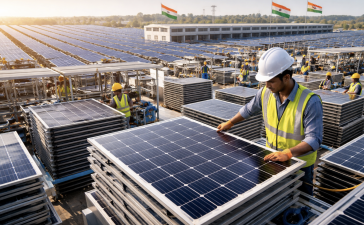
India has extended its domestic sourcing mandate for solar equipment to include wafers and ingots from June 2028. This move targets government-backed and large-scale solar projects. The policy aims to reduce import dependence on critical solar components and strengthen domestic manufacturing.
Extension of Domestic Sourcing Mandate
The government’s mandate now covers wafers and ingots, in addition to solar PV modules and cells. Previously, only modules had strict domestic sourcing rules. From June 2026, solar cells must be domestically made. By 2028, wafers and ingots must also be sourced locally for specific projects. This applies to government and utility-scale projects, commercial and industrial sectors, and schemes like PM Surya Ghar.
Solar Manufacturing Value Chain
The solar manufacturing process starts with polysilicon refining. Polysilicon is made into ingots, which are sliced into wafers. Wafers are then used to produce solar cells. Cells are assembled into modules. India has strong capacity in modules (172 GW) and cells (27.2 GW), but wafer and ingot manufacturing is limited (about 2 GW). Wafers are a critical intermediate product, making this extension vital.
Implementation and Approval Process
The Ministry of New and Renewable Energy (MNRE) will notify a list of approved domestic wafer manufacturers. To qualify, there must be at least three independent units with combined capacity of 15 GW. Manufacturers must also produce ingots matching wafer capacity. A new Approved List of Models and Manufacturers (ALMM) List-III will be created for wafers. Projects must source modules, cells, and wafers from respective ALMM lists to qualify.
Challenges in Upstream Manufacturing
Upstream solar segments like polysilicon refining, ingots, and wafers face challenges due to high capital costs and competition from low-priced imports, mainly from China. India’s Production Linked Incentive (PLI) scheme supports both upstream and downstream manufacturing. However, progress in upstream segments remains slow. As of June 2025, only 10% of wafer-ingot and 14% of polysilicon capacity targets were operational. Downstream module assembly achieved 59%.
Topics for Prelims:
Solar Manufacturing Value Chain
- Polysilicon refining is the first step in solar manufacturing.
- Ingot production follows polysilicon refining.
- Wafers are sliced from ingots for solar cell manufacturing.
- Cells are assembled into solar modules.
- India’s wafer capacity is about 2 GW, much lower than modules and cells.
Domestic Sourcing Mandate and ALMM
- Domestic sourcing now includes wafers and ingots from June 2028.
- Mandatory for government-backed and utility-scale solar projects.
- ALMM lists certify eligible domestic manufacturers.
- Separate ALMM List-III created for wafer manufacturers.
- Projects must procure from ALMM-listed manufacturers for modules, cells, and wafers.
Production Linked Incentive (PLI) Scheme
- Launched in 2021 to boost solar manufacturing capacity.
- Allocated Rs 24,000 crore across two tranches.
- Supports upstream and downstream solar segments.
- Upstream capacity achievement lags behind downstream.
- As of mid-2025, only 29% of total awarded capacity was operational.
Questions for Mains:
- Critically analyse the challenges faced by India in developing upstream solar manufacturing capacity and estimate the impact of government policies like the Production Linked Incentive scheme. [GS-III-Economic Development]
- Point out the significance of domestic sourcing mandates in renewable energy projects and underline their role in India’s energy security strategy. [GS-III-Environment & DM]
- With suitable examples, discuss the role of government-backed schemes in promoting local manufacturing in strategic sectors and estimate their long-term socio-economic benefits. [GS-II-Governance]
- Critically analyse the global solar supply chain dynamics and their implications for India’s renewable energy goals, and suggest policy measures to reduce import dependence. [GS-II-International Relations]
Topics for Prelims:
Solar Manufacturing Components
- Polysilicon – Raw material for ingots, derived from purified silicon.
- Ingot – Solid block formed from molten polysilicon.
- Wafer – Thin slices cut from ingots to make solar cells.
- Solar Cell – Converts sunlight to electricity.
- Solar Module – Assembly of solar cells into panels.
Government of India’s Solar Policy
- Mandates domestic sourcing in solar projects.
- Extends coverage to wafers and ingots from 2028.
- Uses Approved List of Models and Manufacturers (ALMM).
- Supports schemes like PM Surya Ghar.
- Includes transitional exemptions for existing projects.
Production Linked Incentive (PLI) Scheme
- Launched in 2021 to boost solar manufacturing.
- Initial outlay Rs 4,500 crore, increased to Rs 24,000 crore.
- Targets 65 GW manufacturing capacity per year.
- Focuses on both upstream and downstream segments.
- Upstream segments lag in capacity operationalisation.
Answer Hints:
1. Critically analyse the challenges faced by India in developing upstream solar manufacturing capacity and estimate the impact of government policies like the Production Linked Incentive scheme. [GS-III-Economic Development]
- Upstream segments (polysilicon refining, ingot & wafer manufacturing) are highly capital intensive with long gestation periods.
- India’s installed upstream capacity is very limited (~2 GW for wafers/ingots) compared to downstream (172 GW modules, 27.2 GW cells).
- Price pressures and aggressive competition from Chinese imports hinder domestic upstream growth.
- PLI scheme launched in 2021 with Rs 24,000 crore outlay aims to boost integrated manufacturing capacity, covering upstream and downstream segments.
- Operationalisation under PLI is slow upstream – only ~10% wafer-ingot and 14% polysilicon capacity achieved by mid-2025, vs 59% for module assembly.
- Implementation gaps, infrastructure and technology challenges continue to restrict upstream capacity expansion despite policy support.
2. Point out the significance of domestic sourcing mandates in renewable energy projects and underline their role in India’s energy security strategy. [GS-III-Environment & DM]
- Mandates ensure use of domestically manufactured solar modules, cells (from 2026), wafers & ingots (from 2028) in government and utility-scale projects.
- Reduces import dependence on critical components, especially from geopolitically sensitive countries like China.
- Strengthens domestic manufacturing ecosystem, creates jobs and promotes technology development.
- Supports energy security by localizing supply chains and minimizing vulnerabilities from global supply disruptions.
- Encourages investments in upstream solar manufacturing, addressing gaps in polysilicon and wafer production capacity.
- Enhances self-reliance (Atmanirbhar Bharat) in clean energy transition and aligns with India’s renewable energy capacity targets.
3. With suitable examples, discuss the role of government-backed schemes in promoting local manufacturing in strategic sectors and estimate their long-term socio-economic benefits. [GS-II-Governance]
- PLI scheme for solar PV modules incentivizes both upstream and downstream manufacturing with financial support (Rs 24,000 crore total outlay).
- ALMM lists promote quality domestic manufacturers by mandating procurement from approved units, e.g., new ALMM List-III for wafers.
- Schemes like PM Surya Ghar promote adoption of domestically manufactured solar equipment in residential sector.
- Long-term benefits include job creation, technology transfer, industrial growth, and reduced import bills.
- Strengthens strategic autonomy and supply chain resilience in critical sectors like renewable energy.
- Boosts regional development and inclusive growth by encouraging manufacturing hubs across India.
4. Critically analyse the global solar supply chain dynamics and their implications for India’s renewable energy goals, and suggest policy measures to reduce import dependence. [GS-II-International Relations]
- Global solar supply chain is dominated by China, which controls polysilicon refining, wafer and cell manufacturing, resulting in price and supply vulnerabilities.
- India imports large volumes of solar PV cells (~$1.64 billion FY25), wafers, and polysilicon, creating strategic and economic risks.
- Geopolitical tensions and trade restrictions (e.g., US tariffs) add uncertainty to supply continuity and cost stability.
- India’s limited upstream capacity constrains ability to meet ambitious renewable energy targets independently.
- Policy measures – strengthen PLI scheme focus on upstream segments, incentivize R&D, facilitate technology partnerships, and create robust ALMM certification.
- Promote import substitution via diversified sourcing, infrastructure investments, and trade policies favoring domestic manufacturing.