
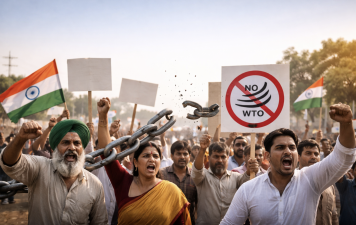
Recent developments at the World Trade Organisation (WTO) have intensified debates around the China-backed Investment Facilitation for Development (IFD) Agreement. Ahead of the 14th WTO Ministerial Conference in Cameroon, scheduled for March 26, 2026, support for the IFD has surged to 128 out of 166 members. India remains a key opponent, raising concerns about the agreement’s implications for WTO’s multilateralism and developing countries’ interests.
What is the Investment Facilitation for Development Agreement?
The IFD Agreement aims to improve the global investment climate. It focuses on easing the flow of Foreign Direct Investment (FDI), especially to developing and Least-Developed Countries (LDCs). The agreement promotes transparency, reduces bureaucratic delays, and encourages responsible business conduct. It excludes market access, investment protection, and investor-State dispute settlements. The WTO Director-General supports it as a tool for sustainable development and economic diversification.
India’s Concerns and Opposition
India opposes the IFD because it is a plurilateral deal, binding only on participating members, which challenges WTO’s principle of consensus-based multilateralism. India fears such agreements could marginalise developing countries and weaken negotiations on critical issues like agricultural subsidies. It also worries about creating a two-tier WTO system dominated by wealthy nations. India’s stance is partly linked to its demand for a permanent solution on public stockholding of food grains under WTO rules.
China’s Role and Strategic Implications
The IFD overlaps with China’s Belt and Road Initiative (BRI). Of the 128 IFD supporters, 98 are BRI members. This overlap may enhance China’s economic influence by standardising investment regulations across many countries, including those near India. This convergence raises geopolitical concerns for India about China’s expanding footprint and influence through multilateral trade agreements.
WTO’s Current Challenges and Future Outlook
The WTO faces challenges after the US blocked its dispute settlement mechanism during the Trump administration. The IFD is seen as a way to revive investment flows and maintain WTO relevance. However, India’s opposition marks tensions between traditional multilateralism and emerging plurilateral agreements. The upcoming Ministerial Conference will be crucial in deciding the IFD’s future and the WTO’s direction.
Topics for Prelims:
Investment Facilitation for Development Agreement
- Focuses on easing Foreign Direct Investment flows globally.
- Targets developing and Least-Developed Countries.
- Excludes market access and investment protection issues.
- Plurilateral agreement binding only on participants.
- Supported by WTO Director-General Ngozi Okonjo-Iweala.
India’s WTO Position and Public Stockholding Issue
- Opposes plurilateral IFD for undermining WTO consensus.
- Seeks permanent solution for food grain subsidies under WTO.
- Uses ‘peace clause’ to avoid WTO legal action on subsidies.
- Concerned about two-tier WTO system favouring rich countries.
- Links IFD opposition to broader trade negotiation strategies.
China’s Belt and Road Initiative and WTO
- BRI overlaps with IFD membership in 98 countries.
- Enhances China’s cross-border infrastructure and investment reach.
- May increase China’s economic influence in India’s neighbourhood.
- Standardises investment regulations among participating countries.
- Raises geopolitical concerns for India’s trade and security.
Questions for Mains:
- Critically analyse the impact of plurilateral agreements on the multilateral trading system of the World Trade Organisation. With suitable examples, discuss India’s concerns regarding such agreements. [GS-II-International Relations]
- Point out the strategic implications of China’s Belt and Road Initiative on India’s economic and geopolitical interests. Estimate how multilateral trade agreements may influence this dynamic. [GS-II-International Relations]
- Underline the challenges faced by the World Trade Organisation in maintaining its dispute settlement mechanism and relevance in the current global trade environment. How can developing countries safeguard their interests within this framework? [GS-II-International Relations]
- Critically analyse the role of public stockholding policies in food security and international trade. With examples, discuss the WTO’s approach to balancing these concerns among developing countries. [GS-III-Economic Development]
Answer Hints:
1. Critically analyse the impact of plurilateral agreements on the multilateral trading system of the World Trade Organisation. With suitable examples, discuss India’s concerns regarding such agreements. [GS-II-International Relations]
- Plurilateral agreements bind only participating WTO members, unlike multilateral deals requiring consensus of all members.
- They allow smaller coalitions to advance specific agendas, potentially sidelining non-participating developing countries.
- Example – Investment Facilitation for Development (IFD) Agreement – supported by 128 members but opposed by India and South Africa.
- India’s concerns include erosion of WTO’s consensus principle, marginalisation of developing countries, and creation of a two-tier WTO system.
- Plurilateral deals may neglect critical issues like agricultural subsidies, which are vital for developing countries’ interests.
- India fears such agreements could weaken collective bargaining power and deepen inequalities within the WTO framework.
2. Point out the strategic implications of China’s Belt and Road Initiative on India’s economic and geopolitical interests. Estimate how multilateral trade agreements may influence this dynamic. [GS-II-International Relations]
- China’s BRI promotes infrastructure and connectivity across Asia, Africa, and beyond, enhancing China’s economic footprint.
- 98 out of 128 IFD participating countries are also BRI members, indicating overlap and potential synergy.
- Standardisation of investment facilitation under IFD could indirectly strengthen BRI’s operational environment.
- This amplifies China’s influence in India’s neighbourhood, raising geopolitical and security concerns for India.
- Multilateral trade agreements like IFD may legitimize and streamline China-led investments, complicating India’s strategic autonomy.
- India views this convergence as a challenge to its regional influence and seeks to counterbalance China’s expanding reach.
3. Underline the challenges faced by the World Trade Organisation in maintaining its dispute settlement mechanism and relevance in the current global trade environment. How can developing countries safeguard their interests within this framework? [GS-II-International Relations]
- WTO’s dispute settlement body has been crippled due to US blocking appointments, especially during Trump administration.
- This has undermined enforcement of trade rules, reducing WTO’s effectiveness and credibility.
- Emergence of plurilateral agreements like IFD reflects attempts to keep WTO relevant amid stalemates.
- Developing countries face risks of marginalisation in plurilateral deals and weakening of multilateralism.
- To safeguard interests, developing countries should form coalitions (e.g., India-South Africa bloc) to negotiate collectively.
- They must push for permanent solutions on critical issues (e.g., public stockholding) and advocate for reforming dispute settlement.
4. Critically analyse the role of public stockholding policies in food security and international trade. With examples, discuss the WTO’s approach to balancing these concerns among developing countries. [GS-III-Economic Development]
- Public stockholding policies enable governments to procure and distribute food grains to ensure food security for vulnerable populations.
- India’s Pradhan Mantri Garib Kalyan Anna Yojana (PMGKAY) subsidizes food for about 80 crore people, critical for poverty alleviation.
- WTO rules limit agricultural subsidies to 10% of production value, but developing countries get certain flexibilities.
- India has exceeded subsidy limits and invoked the ‘peace clause’ (Bali 2013) to avoid WTO legal disputes temporarily.
- WTO is yet to provide a permanent solution balancing trade rules and food security needs of developing countries.
- Ongoing negotiations focus on allowing flexibility for food security without distorting global trade unfairly.