
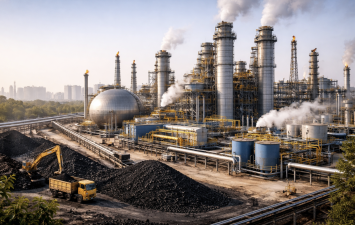
The ongoing West Asian conflict in 2026 has triggered a global energy crisis. India faces shortages in domestic LPG supplies due to disruptions in Persian Gulf imports. This situation echoes the 1973 Oil Shock when OPEC cut oil exports, prompting India to explore alternative fuels. Coal gasification, a technique revived from earlier decades, is gaining renewed attention as a solution to energy security and climate goals.
Historical Background of Coal Gasification in India
Coal gasification was first proposed in India in 1955 by Syed Husain Zaheer, director of the Regional Research Laboratory Hyderabad. He envisioned producing fuel gas by gasifying indigenous coal types like lignite and bituminous coal. Zaheer’s plan included a national gas grid to supply fuel gas to cities and industries. Despite initial enthusiasm from Prime Minister Nehru, the project faced resistance from government bodies citing transport and economic concerns. Political and financial hurdles delayed pilot plants until the 1970s, when the 1973 Oil Shock revived interest.
Technology and Early Developments
The coal gasification process involves converting coal into fuel gas using high-pressure oxygen. Sulphur compounds are removed to produce clean gas. Early uses of coal gasification globally were for town gas lighting. India’s first pilot plant was delayed by wars and funding issues. By the 1980s, integrated gasification combined cycle (IGCC) technology was developed, combining coal gasification with electricity generation. Bharat Heavy Electricals Limited (BHEL) commissioned India’s first IGCC plant in 1985, using syngas to power turbines efficiently.
Recent Renewed Focus and Policy Initiatives
India launched the National Coal Gasification Mission in 2021 to gasify 100 million tonnes of coal by 2030. The mission aims to reduce dependence on imported natural gas and chemicals like methanol and ammonia. Investments of ₹85,000 crore have been committed. In 2024, Coal India Limited and BHEL formed Bharat Coal Gasification & Chemicals Limited to advance clean coal technologies. This marks a strategic shift towards utilising abundant coal reserves sustainably amid climate action pressures.
Challenges and Future Prospects
Despite technological progress, coal gasification faces challenges such as high capital costs and environmental concerns. Efficient removal of pollutants and integration with renewable energy are critical. The success of India’s coal gasification depends on strong policy support, industrial partnerships, and innovation. It offers a pathway to energy security while balancing climate commitments.
Topics for Prelims:
Syed Husain Zaheer
- Director of Regional Research Laboratory Hyderabad (RRLH).
- Proposed India’s first coal gasification plan in 1955.
- Later became director-general of the Council of Scientific and Industrial Research (CSIR).
- Advocated for a national fuel gas grid using gasified coal.
- Faced resistance but influenced India’s energy policy.
Coal Gasification Technology
- Converts coal into fuel gas using high-pressure oxygen.
- Removes sulphur compounds to produce cleaner gas.
- Used globally since the 1940s for town gas supply.
- Integrated Gasification Combined Cycle (IGCC) links gasification with power generation.
- Reduces reliance on crude oil and natural gas imports.
National Coal Gasification Mission
- Launched by India in 2021.
- Aims to gasify 100 million tonnes of coal by 2030.
- Focuses on producing syngas for fuel and chemicals.
- ₹85,000 crore investment committed.
- Bharat Coal Gasification & Chemicals Limited formed in 2024.
Questions for Mains:
- Discuss in the light of India’s energy security, how coal gasification can reduce dependence on imported fuels and support sustainable development. [GS-III-Economic Development]
- Analyse the technological and environmental challenges of coal gasification in India and suggest policy measures to overcome them. [GS-III-Science & Technology]
- With suitable examples, examine the role of alternative energy technologies in managing global energy crises, taking the 1973 Oil Shock and 2026 energy crisis as references. [GS-III-Environment & DM]
- Critically discuss the importance of government-industry collaboration in advancing clean coal technologies in India, considering historical and current perspectives. [GS-II-Governance]
Answer Hints:
1. Discuss in the light of India’s energy security, how coal gasification can reduce dependence on imported fuels and support sustainable development. [GS-III-Economic Development]
- India’s heavy reliance on imported petroleum and natural gas creates vulnerability to global supply disruptions, as seen in 1973 and 2026 crises.
- Coal gasification utilizes abundant domestic coal reserves, reducing import dependency and enhancing energy self-sufficiency.
- Produces syngas that can be used as fuel and chemical feedstock, diversifying energy sources and supporting industrial growth.
- Enables cleaner and more efficient use of coal compared to direct combustion, aligning with sustainable development goals.
- Supports rural and industrial energy needs through potential pipeline networks and decentralized plants, improving access and affordability.
- Integration with technologies like IGCC can improve energy efficiency and reduce carbon footprint relative to conventional coal use.
2. Analyse the technological and environmental challenges of coal gasification in India and suggest policy measures to overcome them. [GS-III-Science & Technology]
- High capital costs and complex technology limit large-scale deployment and require investment and skilled manpower.
- Removal of sulphur and other pollutants is essential to minimize environmental and health hazards; requires advanced gas cleaning systems.
- Water usage and management pose sustainability concerns, especially in water-scarce regions.
- Integration with renewable energy and carbon capture technologies needed to reduce greenhouse gas emissions.
- Policy measures – increased R&D funding, incentives for clean coal tech adoption, and public-private partnerships to share risks and expertise.
- Regulatory frameworks ensuring environmental compliance and promoting innovation in pollution control and efficiency improvements.
3. With suitable examples, examine the role of alternative energy technologies in managing global energy crises, taking the 1973 Oil Shock and 2026 energy crisis as references. [GS-III-Environment & DM]
- 1973 Oil Shock led India to explore offshore oilfields (Bombay High) and revive coal gasification to reduce oil import dependence.
- Coal gasification provided an alternative fuel source during petroleum shortages, showcasing resilience through diversification.
- 2026 West Asian conflict triggered LPG shortages, again denoting vulnerability and need for indigenous alternatives.
- Renewed focus on coal gasification, IGCC, and National Coal Gasification Mission exemplify strategic responses to crises.
- Alternative energy technologies like renewables (solar, wind) and nuclear also complement fossil fuel alternatives in crisis management.
- These crises underline the importance of energy diversification, technological innovation, and strategic reserves for energy security.
4. Critically discuss the importance of government-industry collaboration in advancing clean coal technologies in India, considering historical and current perspectives. [GS-II-Governance]
- Historically, lack of government funding and industrial linkage delayed coal gasification pilot projects despite scientific advances.
- Political and bureaucratic resistance impeded early adoption despite support from leaders like Nehru and Indira Gandhi.
- Successful IGCC plant in 1985 was a result of collaboration between CSIR labs and BHEL, showing benefits of partnership.
- Current initiatives like Bharat Coal Gasification & Chemicals Limited reflect strengthened public sector cooperation for clean coal tech.
- Government policies, financial commitments, and industry expertise together drive innovation, scale-up, and commercialization.
- Effective collaboration ensures alignment of research, funding, infrastructure, and market needs for sustainable energy solutions.