
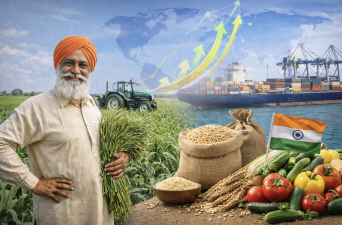
India’s agriculture sector has achieved remarkable growth in recent years. In 2024-25, India recorded a record foodgrain output of 357.73 million metric tonnes. Horticulture production also rose sharply to 362.08 million tonnes. These gains reflect improved farming practices, technology use, and strong government support. India continues to expand its global presence through rising exports and diversified crop production.
Production Performance and Crop Diversity
India is a leading global producer of cereals, pulses, millets, fruits, and vegetables. Rice and wheat production reached over 150 and 117 million tonnes respectively in 2024-25. Pulses and millets also saw strong output, with India ranking first worldwide in millet production. Horticulture output includes 114.5 million tonnes of fruits and 219.7 million tonnes of vegetables. High-value crops like sugarcane, cotton, tea, spices, coconut, and coffee contribute to the economy and exports.
Policy Support and Productivity Enhancement
Government initiatives focus on boosting productivity and farmer welfare. Budget allocations for agriculture have increased substantially. Schemes like the National Food Security Mission, Mission for Aatmanirbharta in Pulses, and National Mission on Edible Oils target self-sufficiency and reduced imports. Quality seed production and soil health management are promoted through dedicated programmes. Irrigation coverage has expanded under Pradhan Mantri Krishi Sinchayee Yojana. Credit access improved with 7.72 crore Kisan Credit Card accounts and increased farm mechanisation.
Market Reforms and Value Chain Development
India is strengthening farm-to-market linkages through infrastructure and digital platforms. The e-National Agriculture Market (e-NAM) connects farmers, traders, and FPOs across states. Food processing sector growth is supported by Pradhan Mantri Kisan Sampada Yojana and Production Linked Incentive Scheme. Public procurement ensures price support and food security for millions. The One Nation One Ration Card scheme enhances ration portability and transparency in public distribution.
Resilience, Sustainability, and Global Integration
Agricultural growth aligns with Sustainable Development Goals on zero hunger, climate action, and innovation. Natural farming and resource-efficient practices expand. Crop insurance schemes protect farmers against risks. Cooperative reforms and collective farmer organisations strengthen resilience. India’s diverse and balanced agricultural base supports stable global food supplies and robust rural livelihoods.
Topics for Prelims:
India’s Major Crops and Production
- India is the world’s second-largest producer of rice and wheat.
- It leads globally in millet and pulse production.
- Horticulture production includes over 114 million tonnes of fruits and 219 million tonnes of vegetables.
- India ranks first in dry onion and coconut production worldwide.
- High-value crops include sugarcane, cotton, tea, spices, and coffee.
Key Agricultural Schemes and Policies
- National Food Security and Nutrition Mission aims to increase staple crop production.
- Mission for Aatmanirbharta in Pulses targets self-sufficiency by 2031.
- Pradhan Mantri Krishi Sinchayee Yojana promotes irrigation coverage and water efficiency.
- Kisan Credit Card scheme provides timely credit to farmers.
- Pradhan Mantri Fasal Bima Yojana offers crop insurance against natural calamities.
Market and Infrastructure Developments
- e-National Agriculture Market (e-NAM) integrates over 1,600 mandis digitally.
- Pradhan Mantri Kisan Sampada Yojana supports food processing and cold chain infrastructure.
- One Nation One Ration Card scheme enables ration portability across states.
- Government procures millions of tonnes of foodgrain annually at Minimum Support Prices.
- Custom Hiring Centres provide access to farm mechanisation for smallholders.
Questions for Mains:
- Critically analyse the role of government schemes in enhancing agricultural productivity and farmer welfare in India. With suitable examples, discuss their impact on rural livelihoods. [GS-II-Governance]
- Point out the challenges and opportunities in integrating digital platforms like e-NAM with traditional agricultural markets. Estimate their effect on price transparency and farmer incomes. [GS-III-Economic Development]
- Underline the significance of crop diversification and high-value crops in India’s agricultural export growth. How does this diversification contribute to climate resilience and economic stability? [GS-III-Environment & DM]
- With suitable examples, critically analyse India’s agricultural policies in the context of Sustainable Development Goals. How do these policies balance productivity growth with environmental sustainability? [GS-II-Constitution of India & Polity]
Answer Hints:
1. Critically analyse the role of government schemes in enhancing agricultural productivity and farmer welfare in India. With suitable examples, discuss their impact on rural livelihoods. [GS-II-Governance]
- Government schemes like National Food Security and Nutrition Mission, Mission for Aatmanirbharta in Pulses, and National Mission on Edible Oils have increased crop production and self-sufficiency.
- Pradhan Mantri Krishi Sinchayee Yojana expanded irrigation coverage to 55.8%, improving water-use efficiency and crop yields.
- Kisan Credit Card scheme with 7.72 crore accounts enhances timely and affordable credit access for farmers, supporting cultivation and allied activities.
- Pradhan Mantri Fasal Bima Yojana provides crop insurance, covering 4.19 crore farmers, mitigating risks from natural disasters and market volatility.
- Direct income support through PM-KISAN (Rs. 4.27 lakh crore disbursed) and social security via PMKMY pension scheme improve farmer welfare and rural livelihoods.
- Increased budget allocations (from Rs. 21,933.50 crore in 2013-14 to Rs. 1,30,561.38 crore in 2026-27) reflect sustained government commitment to agriculture.
2. Point out the challenges and opportunities in integrating digital platforms like e-NAM with traditional agricultural markets. Estimate their effect on price transparency and farmer incomes. [GS-III-Economic Development]
- e-NAM integrates 1,656 mandis, connecting 1.8 crore farmers and 2.72 lakh traders, enhancing market access and reducing intermediaries.
- It enables digital price discovery, AI-based quality assaying, e-bidding, and direct e-payments, improving transparency and efficiency.
- Challenges include digital literacy gaps, internet connectivity issues in rural areas, and resistance from traditional intermediaries.
- Expansion of Farmer Producer Organisations (10,000 FPOs) supports collective bargaining and better market linkages.
- Improved price transparency can lead to better price realization for farmers, reducing exploitation and increasing incomes.
- However, infrastructural gaps and uneven adoption limit full potential; capacity building and infrastructure investment are needed.
3. Underline the significance of crop diversification and high-value crops in India’s agricultural export growth. How does this diversification contribute to climate resilience and economic stability? [GS-III-Environment & DM]
- Crop diversification includes cereals, pulses, millets, horticulture (fruits & vegetables), and high-value cash crops like sugarcane, cotton, tea, spices, coconut, and coffee.
- Horticulture output (362.08 million tonnes) and processed food exports (20.4% of agri exports) reflect shift towards value addition and diversified exports.
- Diversification reduces dependency on few staple crops, spreading risk and enhancing climate resilience by promoting drought-resistant millets and pulses.
- High-value crops generate higher farm incomes, improve export earnings (e.g., rice exports USD 12.95 billion, spices USD 4.52 billion), and stabilize rural economies.
- Region-specific promotion of crops (coconut in coastal areas, nuts in hilly regions) harnesses agro-climatic strengths, supporting sustainable livelihoods.
- Diversification also supports environmental sustainability by encouraging crop rotation, soil health, and reduced monoculture vulnerabilities.
4. With suitable examples, critically analyse India’s agricultural policies in the context of Sustainable Development Goals. How do these policies balance productivity growth with environmental sustainability? [GS-II-Constitution of India & Polity]
- Policies like Soil Health Card scheme (25.55 crore cards issued) promote balanced nutrient management, supporting SDG 12 (Responsible Consumption and Production) and SDG 13 (Climate Action).
- Natural farming expanded to 17,632 clusters with 15.79 lakh farmers, reflecting sustainable agriculture practices aligned with SDG 2 (Zero Hunger) and SDG 13.
- Pradhan Mantri Krishi Sinchayee Yojana improves water use efficiency through micro-irrigation, conserving resources and supporting SDG 6 (Clean Water).
- Crop insurance (PMFBY) and income support (PM-KISAN, PMKMY) strengthen farmer resilience, reducing vulnerability to climate risks and economic shocks.
- Investment in post-harvest infrastructure, food processing (PMKSY, PLISFI), and digital markets (e-NAM) promote SDG 9 (Industry, Innovation and Infrastructure) and reduce food wastage.
- Overall, policies integrate productivity enhancement with environmental sustainability by promoting technology, resource efficiency, risk mitigation, and inclusive growth.