
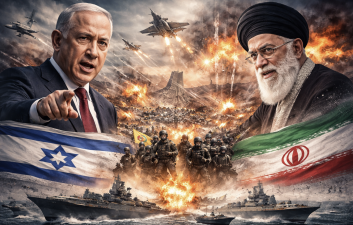
The ongoing conflict in West Asia, which began on 28 February 2026, involves large-scale military operations by the United States and Israel against Iran. This war, known as ‘Operation Epic Fury’, has caused severe human and economic damage. Despite heavy losses, including the assassination of Iran’s Supreme Leader Ayatollah Ali Khamenei, Iran remains resilient. The conflict threatens global stability, especially through disruptions in oil supply and regional security.
Background and Current Situation
The war started as a joint US-Israel military campaign targeting Iran’s nuclear and military infrastructure. Earlier skirmishes, such as the June 2025 conflict, were precursors to this intensified war. Thousands of Iranians, mostly civilians, have died. Iran’s command structure has been hit but not destroyed. The country’s uranium stockpile remains intact. Iran is prepared for a prolonged conflict and aims to retaliate by blocking the Strait of Hormuz, a vital oil shipping route.
Strategic Implications and Regional Impact
Iran’s survival has complicated US and Israeli plans. The blockade of the Strait of Hormuz threatens global oil markets, pushing energy prices higher. Many US allies have refused to support American calls to reopen the route. Iran offers safe passage only to friendly nations. The conflict risks spreading to Lebanon, Iraq, and Syria. Israel’s objective of regime change in Iran faces opposition from the US, Europe, China, and Russia. The war’s economic and geopolitical fallout affects global stability.
Religious and Cultural Dimensions
The conflict has a strong sectarian element, centred on Shia Islam’s political culture. The memory of the Battle of Karbala fuels Iranian resistance. The appointment of Mojtaba Khamenei as Supreme Leader has intensified radical Shia militancy. This war is seen by many as an attack on Shia political identity, not just a geopolitical struggle. The resilience of Shia groups may prolong the conflict and complicate peace efforts.
Military and Global Security Concerns
The US strategy relies heavily on air power, which has limitations against Iran’s terrain and forces. Israel bears much of the ground pressure but risks escalating the conflict. War weariness is growing within US military ranks. The conflict’s continuation threatens to drag in global powers and destabilise the region further. Attacks near sensitive sites like Iran’s Bushehr nuclear plant risk catastrophic outcomes.
Topics for Prelims:
Operation Epic Fury
- Started February 28, 2026, by US and Israel against Iran.
- Thousands of Iranian casualties, mostly civilians.
- Includes assassination of Iran’s Supreme Leader Ali Khamenei.
- Iran’s uranium stockpile remains secure.
- Iran prepared for prolonged war and economic retaliation.
Strait of Hormuz
- Vital oil shipping route, nearly 30% of global oil passes through.
- Iran threatens blockade to provoke oil crisis.
- US allies hesitant to intervene in reopening the strait.
- Iran offers safe passage to friendly countries only.
- Blockade disrupts global energy markets and economy.
Shia Political Culture
- Inspired by the Battle of Karbala symbolising resistance.
- Focuses on patience, sacrifice, and endurance.
- Mojtaba Khamenei’s leadership boosts radical Shia militancy.
- Conflict seen as attack on Shia identity and politics.
- Shia resistance complicates prospects for regime change.
Questions for Mains:
- Analyse the strategic implications of Iran’s survival in the 2026 US-Israel conflict and its impact on global energy security. [GS-III-Economic Development]
- Discuss in the light of recent events how sectarian identities influence geopolitical conflicts in West Asia, with examples from the Iran war. [GS-I-Indian Society]
- Examine the role of international law and norms in the context of unilateral military actions like ‘Operation Epic Fury’ and their impact on global governance. [GS-II-International Relations]
- With suitable examples, critically discuss the limitations of air power in modern warfare, particularly in asymmetric conflicts such as the Iran war. [GS-III-Science & Technology]
Answer Hints:
1. Analyse the strategic implications of Iran’s survival in the 2026 US-Israel conflict and its impact on global energy security. [GS-III-Economic Development]
- Iran’s survival despite heavy losses and leadership assassinations shows resilience and readiness for prolonged conflict.
- Blockade threat on Strait of Hormuz (30% global oil transit) risks severe disruption in global oil supply and price volatility.
- US allies’ reluctance to intervene in reopening the strait weakens coordinated response and global energy stability.
- Prolonged conflict escalates regional instability affecting oil-producing countries and global markets.
- Economic sanctions and military actions increase energy prices, impacting global inflation and growth.
- Iran’s strategic use of energy infrastructure weaponisation complicates geopolitical calculations for the US and allies.
2. Discuss in the light of recent events how sectarian identities influence geopolitical conflicts in West Asia, with examples from the Iran war. [GS-I-Indian Society]
- Shia Islam’s political culture, rooted in the Battle of Karbala, fuels Iranian resilience and resistance against foreign aggression.
- Appointment of Mojtaba Khamenei strengthens radical Shia militancy and messianic-apocalyptic narratives.
- Conflict perceived as attack on Shia identity, intensifying sectarian polarization in the region.
- Shia groups’ transnational networks (in Iran, Lebanon, Iraq, Syria) complicate conflict dynamics and prolong war.
- Sectarianism shapes alliances and oppositions, influencing regional power balances and proxy wars.
- Religious symbolism and martyrdom narratives sustain popular support for Iran’s regime and its geopolitical stance.
3. Examine the role of international law and norms in the context of unilateral military actions like ‘Operation Epic Fury’ and their impact on global governance. [GS-II-International Relations]
- ‘Operation Epic Fury’ initiated by US-Israel is widely viewed as violating principles of sovereignty and non-intervention.
- Absence of UN Security Council authorization undermines legitimacy under international law.
- Limited global condemnation reflects geopolitical alignments and selective enforcement of international norms.
- Such unilateral actions weaken global governance frameworks and encourage norm erosion.
- Disregard for international law risks setting dangerous precedents for future conflicts and state behavior.
- Global instability from the conflict marks need for stronger multilateral conflict resolution mechanisms.
4. With suitable examples, critically discuss the limitations of air power in modern warfare, particularly in asymmetric conflicts such as the Iran war. [GS-III-Science & Technology]
- Air power alone insufficient to achieve decisive victory against large, well-prepared ground forces like Iran’s.
- Terrain and guerrilla tactics reduce effectiveness of saturation bombardment and precision strikes.
- Iran’s survival despite heavy air assaults shows resilience and adaptability of asymmetric warfare opponents.
- High cost and logistical challenges in replenishing advanced missiles and interceptors (Patriot, THAAD, Tomahawk) strain US resources.
- Air strikes risk collateral damage, civilian casualties, and strategic backlash fueling resistance.
- Ground presence often necessary for regime change objectives, which US and Israel lack or hesitate to commit.