
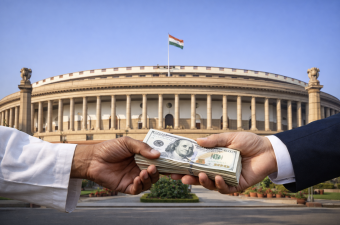
The Union government deferred the discussion on the Foreign Contribution (Regulation) Amendment Bill, 2026 in Lok Sabha. The Bill aims to amend the 2010 Foreign Contribution (Regulation) Act (FCRA). It focuses on regulating foreign funds to ensure they do not harm national interest, public order, or security. Opposition parties, especially from Kerala, have raised concerns that it targets minority institutions, particularly Christian organisations. The Bill’s timing ahead of Kerala’s Assembly election has intensified the debate.
Background of the FCRA
The FCRA was first enacted in 1976 during the Emergency to prevent foreign interference through funding. The 2010 Act consolidated regulations on foreign donations to NGOs and individuals. It requires registration to accept foreign funds for cultural, economic, social, educational, and religious purposes. Around 16,000 organisations are registered under the Act, receiving about Rs 22,000 crore annually. Amendments in 2016, 2018, and 2020 increased government oversight.
Key Changes Proposed in the 2026 Amendment
The Bill introduces a designated authority appointed by the government to manage foreign contributions and assets if an organisation’s FCRA registration is cancelled or expires. This replaces Section 15 of the existing Act. The authority can take over, supervise, and dispose of assets in cases of non-renewal or refusal of registration. It can also entrust management of places of worship while maintaining their religious character. Unused funds must be returned if registration is renewed.
Controversies and Opposition Concerns
Opposition parties argue the Bill could be misused to control minority and civil society organisations dependent on foreign funds. They fear arbitrary cancellation of registration and seizure of assets. Kerala’s political leaders, including the Chief Minister and Congress leaders, have voiced concerns about the Bill’s impact on religious and charitable institutions. The government claims the Bill addresses legal gaps and prevents misuse of foreign funds for activities like forced religious conversions.
Political and Social Impact in Kerala
Kerala’s large Christian population makes the Bill a sensitive issue before the April 9 Assembly election. The BJP has attempted outreach to Christian voters but faces criticism over the Bill. The government agreed to delay the Bill’s discussion to allow proper explanation and public consultation. The debate marks tensions between national security concerns and minority rights.
Topics for Prelims:
Foreign Contribution Regulation Act (FCRA)
- Enacted in 1976 to regulate foreign funding.
- 2010 amendment consolidated laws on foreign contributions.
- Requires registration for NGOs and individuals accepting foreign funds.
- Funds allowed for cultural, social, educational, economic, and religious use.
- Amended thrice post-2010 to tighten controls.
2026 FCRA Amendment Bill Key Provisions
- Creates a designated authority to oversee foreign funds if registration ceases.
- Authority can manage, transfer, or dispose of assets.
- Registration deemed ceased if renewal is not applied for or denied.
- Places of worship management to maintain religious character.
- Unutilised funds returned upon renewal of registration.
Kerala’s Political Context
- Kerala has a large Christian minority, over 61 lakh population.
- Assembly elections scheduled for April 9, 2026.
- Opposition parties from Kerala strongly oppose the Bill.
- BJP attempts outreach to Christian voters amid controversies.
- Bill’s discussion deferred to allow public consultation.
Questions for Mains:
- Discuss in the light of the Foreign Contribution (Regulation) Amendment Bill, 2026, the challenges of balancing national security and minority rights in India. [GS-II-Constitution of India & Polity]
- Analyse the role of foreign funding in civil society organisations and its impact on democratic governance with suitable examples. [GS-II-Governance]
- Examine the political significance of religious minorities in Kerala and its influence on state elections, considering recent legislative developments. [GS-I-Indian Society]
- Critically discuss the effectiveness of regulatory frameworks like the FCRA in preventing foreign interference while ensuring freedom of association and expression. [GS-II-Constitution of India & Polity]
Answer Hints:
1. Discuss in the light of the Foreign Contribution (Regulation) Amendment Bill, 2026, the challenges of balancing national security and minority rights in India. [GS-II-Constitution of India & Polity]
- FCRA aims to prevent foreign interference threatening national security via foreign funding to NGOs and institutions.
- Minority rights are protected under the Constitution, including freedom of religion and association.
- The 2026 Amendment empowers government-appointed authority to manage assets if registration ceases, raising concerns of misuse against minorities.
- Opposition fears arbitrary cancellation of registration and asset seizure disproportionately affecting minority religious and charitable organizations.
- Balancing act – safeguarding sovereignty and public order vs. protecting minority institutional autonomy and democratic freedoms.
- Need for transparent, time-bound procedures and safeguards to prevent misuse while addressing security concerns.
2. Analyse the role of foreign funding in civil society organisations and its impact on democratic governance with suitable examples. [GS-II-Governance]
- Foreign funding supports NGOs in social, educational, cultural, economic, and religious sectors, enabling welfare and development work.
- It enhances capacity-building, advocacy, and service delivery, supplementing government efforts.
- Excessive or opaque foreign funding can raise concerns about external influence or agenda-setting in domestic affairs.
- Examples – NGOs working on human rights, environment, minority welfare often rely on foreign funds but face scrutiny under FCRA.
- Regulation like FCRA aims to ensure transparency and prevent misuse without stifling legitimate civil society functions.
- Effective governance requires balancing facilitation of civil society with safeguarding national interest and democratic processes.
3. Examine the political significance of religious minorities in Kerala and its influence on state elections, considering recent legislative developments. [GS-I-Indian Society]
- Kerala has a substantial Christian minority (~61 lakh), second largest in the state, forming a key voter base.
- Religious minorities influence electoral outcomes, with parties actively courting their support.
- Recent legislative developments like the FCRA Amendment Bill have triggered concerns among Christian institutions about autonomy and funding.
- Opposition parties in Kerala (LDF, Congress) have voiced strong opposition, linking the Bill to minority rights and electoral politics.
- BJP’s outreach to Christian voters is complicated by the Bill’s controversy, affecting political strategies.
- The timing before the April 9 elections accentuates communal and political sensitivities around minority issues.
4. Critically discuss the effectiveness of regulatory frameworks like the FCRA in preventing foreign interference while ensuring freedom of association and expression. [GS-II-Constitution of India & Polity]
- FCRA (1976, amended 2010, 2016, 2018, 2020) regulates foreign contributions to prevent misuse affecting sovereignty and public order.
- It mandates registration, transparency, and government oversight of foreign funds received by NGOs and individuals.
- Recent amendments (2026 Bill) introduce a designated authority for asset management post-registration cessation to plug legal gaps.
- Criticism arises over potential misuse, arbitrary cancellations, and impact on freedom of association and expression.
- Effectiveness depends on clear procedures, accountability, and balancing security with democratic freedoms.
- Need for judicial oversight and safeguards to prevent harassment of legitimate civil society actors while curbing foreign interference.