
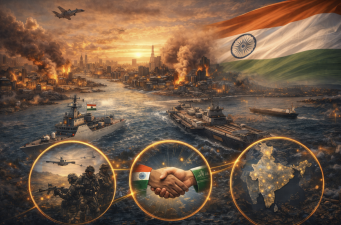
The 2026 Middle East crisis escalated sharply after the U.S.-Israel Operation Epic Fury led to the death of Iran’s Supreme Leader Ayatollah Ali Khamenei. This conflict, which began with the 2023 Hamas attack on Israel, has expanded into full-scale Israel-Iran warfare. The turmoil impacts India directly, forcing New Delhi to navigate complex geopolitical and economic challenges.
Escalation of Middle East Conflict
The conflict began in October 2023 with a deadly Hamas attack on southern Israel. Hezbollah opened a second front from Lebanon. Iran-backed militias launched missile and drone strikes from Syria and Iraq. Yemen’s Houthis targeted Red Sea shipping, endangering maritime routes. By early 2026, Israel and the U.S. conducted airstrikes on Iran. Iran retaliated with ballistic missile attacks on Israel and Gulf states. The region faces multi-front instability with global repercussions.
India’s Diplomatic and Strategic Position
India maintains a balanced diplomatic stance. Prime Minister Narendra Modi affirmed Israel’s right to self-defence and condemned terrorism. Simultaneously, India calls for de-escalation, humanitarian access in Gaza, and respect for sovereignty. Modi supports the U.S.-proposed Gaza ceasefire as a peace pathway. India’s policy reflects strategic autonomy and balanced engagement amid competing regional interests.
Economic and Security Implications for India
Energy security is India’s top concern. India imports 85% of its crude oil, mainly from the Gulf. Oil price spikes widen India’s current account deficit and weaken the rupee. Strategic petroleum reserves and alternative suppliers help mitigate risks. Maritime security has gained urgency as Red Sea disruptions force costly shipping reroutes. The India-Middle East-Europe Economic Corridor faces threats, prompting renewed interest in alternate routes like the International North-South Transport Corridor.
Impact on Indian Diaspora and Domestic Stability
Over nine million Indians live in the Gulf region, contributing 38% of India’s remittances. Airspace closures stranded thousands of Indian travellers. The government issued advisories and arranged special flights. The crisis risks disrupting money flows, mobility, and connectivity. Domestically, authorities monitor radical preaching to prevent communal tensions. India also focuses on protecting strategic investments like the Chabahar Port amid Iran’s instability.
Topics for Prelims:
Middle East Conflict 2023-2026
- Hamas attack on Israel in October 2023 caused 1,200 deaths.
- Hezbollah opened a second front from Lebanon.
- Iran-backed militias struck from Syria and Iraq.
- Yemen’s Houthis targeted Red Sea shipping.
- U.S.-Israel airstrikes on Iran followed by Iranian missile retaliation.
India’s Strategic Autonomy
- India affirms Israel’s right to self-defence.
- Calls for Gaza ceasefire and humanitarian corridors.
- Maintains balanced relations with Gulf states and Israel.
- Focuses on strategic autonomy in diplomacy.
- Monitors internal security for communal harmony.
Economic and Security Concerns
- India imports 85% of crude oil, mainly from Gulf.
- Oil price spikes widen current account deficit.
- Maritime disruptions force longer shipping routes.
- India-Middle East-Europe Economic Corridor faces risks.
- Renewed interest in International North-South Transport Corridor.
Questions for Mains:
- Critically analyse India’s diplomatic strategy of strategic autonomy amid the 2026 Middle East crisis, with suitable examples.
- Point out the economic impact of Gulf instability on India’s energy security and maritime trade routes.
- Estimate the challenges India faces in protecting its diaspora and investments in West Asia during regional conflicts.
- Underline the role of maritime security in India’s foreign policy, and discuss how disruptions in the Red Sea affect global trade. [GS-III-Economic Development; GS-II-International Relations]
Answer Hints:
1. Critically analyse India’s diplomatic strategy of strategic autonomy amid the 2026 Middle East crisis, with suitable examples. [GS-II – International Relations]
- India affirms Israel’s right to self-defence while condemning terrorism, showing balanced diplomatic messaging.
- Simultaneously calls for Gaza ceasefire, humanitarian corridors, and respect for sovereignty, maintaining neutrality.
- Maintains strong ties with Gulf states despite deepening defence partnership with Israel (drones, intelligence sharing).
- Emphasizes strategic autonomy by avoiding alignment with any single power bloc amid U.S.-Israel-Iran conflict.
- Monitors internal security to prevent communal tensions, reflecting holistic approach to foreign policy impact.
- Example – PM Modi’s speech in Israeli Knesset affirming zero tolerance for terrorism but supporting peaceful resolution.
2. Point out the economic impact of Gulf instability on India’s energy security and maritime trade routes. [GS-III – Economic Development]
- India imports about 85% of crude oil, largely from Gulf; price spikes widen current account deficit and weaken rupee.
- Strategic petroleum reserves and diversified suppliers (Russia, U.S., Africa) mitigate but do not eliminate risk.
- Disruptions in Strait of Hormuz threaten oil supply continuity and increase fertiliser prices, impacting farmers.
- Red Sea instability forces rerouting of shipping around Africa, adding 10-14 days and higher costs.
- India-Middle East-Europe Economic Corridor (IMEC) faces risks; renewed focus on International North-South Transport Corridor.
- Airspace closures disrupt aviation connectivity, affecting trade and diaspora mobility.
3. Estimate the challenges India faces in protecting its diaspora and investments in West Asia during regional conflicts. [GS-II – International Relations]
- Over 9 million Indians in Gulf; remittances constitute 38% of India’s total inward flows, critical for economy.
- Airspace closures in Israel, Qatar, Iran, Iraq, Gulf states stranded thousands of Indian travellers.
- Government advisories and special flights arranged to ensure safety and mobility of diaspora.
- Potential communal tensions domestically due to radical preaching linked to regional unrest; monitored by Home Ministry.
- Strategic investments like Chabahar Port face uncertainty amid Iran’s leadership vacuum and possible sanctions.
- Balancing defence ties with Israel while maintaining Gulf relations complicates diplomatic protection of diaspora and assets.
4. Underline the role of maritime security in India’s foreign policy, and discuss how disruptions in the Red Sea affect global trade. [GS-III – Economic Development; GS-II – International Relations]
- Maritime security is a priority for India to safeguard energy imports and trade routes linking Gulf, Africa, and Europe.
- Red Sea disruptions by Yemen’s Houthis forced rerouting of shipments around Africa, increasing transit time and costs.
- Disrupted sea lanes threaten India-Middle East-Europe Economic Corridor, a strategic counter to China’s Belt and Road.
- India’s navy involved in joint patrols and anti-piracy missions to secure western Indian Ocean and Red Sea lanes.
- Maritime security ensures uninterrupted flow of crude oil, essential commodities, and diaspora connectivity.
- Red Sea instability has global ripple effects, increasing insurance premiums and destabilizing supply chains.