
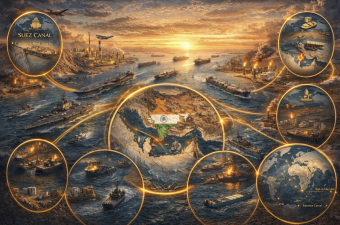
Recent discussions show the enduring strategic significance of the Strait of Hormuz. This narrow waterway remains a vital chokepoint for global oil supplies and international trade. The region’s geopolitical tensions reflect long-standing power struggles over control and influence. Historical simulations like Operation Hormuz, a 1989 virtual combat game, anticipated these challenges decades before they became real-world issues.
Historical Context and Geopolitical Significance
The Strait of Hormuz links the Persian Gulf to the Arabian Sea. It is critical for global energy security, as a large portion of the world’s oil passes through it. The area’s strategic value increased after the 1979 Iranian Revolution, which replaced a pro-American regime with a theocratic government. Cold War tensions, including the Soviet invasion of Afghanistan, further complicated the region’s stability. Control over Hormuz means influence over global trade routes and energy flows.
Operation Hormuz – Early Strategic Simulation
Operation Hormuz was a computer game released in 1989 by Durell Software Ltd. It simulated a military mission to destroy enemy bases controlling the Strait. Although fictional, it reflected real military concerns about the region. The game’s creator, Robert James Durell White, was a self-taught programmer with no official military ties. The simulation demonstrated how imagination and foresight can predict geopolitical conflicts before they unfold.
Maritime Chokepoints and Global Power Dynamics
Maritime chokepoints like Hormuz, Hambantota in Sri Lanka, and Djibouti are crucial for global naval and trade dominance. China’s control of Hambantota port has alarmed Western powers due to its strategic location in the Indian Ocean. Similarly, Djibouti hosts China’s first overseas naval base. These ports serve not only commercial but also military and political purposes. Control of such chokepoints offers leverage in international relations and regional security.
Strategic Imagination and Future Challenges
Historical proposals, such as using nuclear explosives to create canals, show the extent of strategic thinking about geography and infrastructure. Today, the challenge lies in developing national consciousness and strategic patience to manage these chokepoints effectively. Nations that fail to anticipate or understand the stakes risk losing influence and security. The balance between foresight, moral courage, and strategic action remains critical.
Topics for Prelims:
Strait of Hormuz
- Connects Persian Gulf and Arabian Sea.
- Transits about 20% of global oil supply.
- Strategic chokepoint for energy security.
- Site of geopolitical tensions post-1979 Iranian Revolution.
- Control impacts global trade and military strategy.
Operation Hormuz (1989 Game)
- Developed by Durell Software Ltd, UK.
- Simulated military mission in Strait of Hormuz.
- Featured McDonnell Douglas VTOL BA Harrier aircraft.
- Opponents included MiG-21 fighters.
- Illustrated early digital simulation of geopolitical conflict.
Maritime Chokepoints
- Critical narrow sea routes controlling trade.
- Examples – Strait of Hormuz, Hambantota, Djibouti.
- Control offers strategic military and economic advantage.
- China’s port leases raise global security concerns.
- Historically since ancient trade routes.
Questions for Mains:
- Discuss in the light of the Strait of Hormuz’s strategic importance how maritime chokepoints influence global energy security and international relations. [GS-II-International Relations]
- Critically examine the role of digital simulations like Operation Hormuz in shaping military strategy and geopolitical foresight. [GS-III-Science & Technology]
- Explain the geopolitical implications of China’s expanding naval presence in ports like Hambantota and Djibouti, and discuss their impact on Indian Ocean security dynamics. [GS-II-International Relations]
- With suitable examples, discuss how historical and contemporary control over maritime chokepoints has affected the rise and decline of empires and nations. [GS-I-Modern World History]
Answer Hints:
1. Discuss in the light of the Strait of Hormuz’s strategic importance how maritime chokepoints influence global energy security and international relations. [GS-II-International Relations]
- Strait of Hormuz links Persian Gulf to Arabian Sea; ~20% of global oil passes through it.
- Control over Hormuz enables influence on global energy supply and trade routes.
- Post-1979 Iranian Revolution heightened regional tensions and risk of supply disruption.
- Maritime chokepoints serve as strategic leverage points in international diplomacy and military strategy.
- Blockades or conflicts at chokepoints can cause global energy price volatility and economic instability.
- Global powers maintain naval presence to secure free navigation and energy security.
2. Critically examine the role of digital simulations like Operation Hormuz in shaping military strategy and geopolitical foresight. [GS-III-Science & Technology]
- Operation Hormuz (1989) was an early digital simulation anticipating conflict scenarios in Strait of Hormuz.
- Simulations enable testing of military tactics, strategy, and crisis management without real-world risks.
- They encourage imaginative foresight, helping anticipate geopolitical tensions before they materialize.
- Such tools bridge theory and practice, informing policy and operational readiness.
- Limitations include reliance on programmer assumptions and lack of real-time intelligence.
- Demonstrates how technology aids strategic planning beyond traditional intelligence methods.
3. Explain the geopolitical implications of China’s expanding naval presence in ports like Hambantota and Djibouti, and discuss their impact on Indian Ocean security dynamics. [GS-II-International Relations]
- China’s control of Hambantota (Sri Lanka) and naval base in Djibouti extends its strategic reach in Indian Ocean.
- These ports offer China permanent influence over critical maritime trade routes and military projection.
- Western powers view these moves as challenges to their traditional dominance and regional balance.
- Port leases and naval bases serve dual commercial and military purposes, increasing geopolitical leverage.
- Impact includes increased militarization, strategic competition, and security dilemmas in Indian Ocean region.
- Raises concerns for India and allies regarding freedom of navigation and regional influence.
4. With suitable examples, discuss how historical and contemporary control over maritime chokepoints has affected the rise and decline of empires and nations. [GS-I-Modern World History]
- Ancient trade routes like those described in Periplus of the Erythraean Sea show chokepoints’ role in commerce and empire-building.
- Control over chokepoints enabled empires to dominate trade, collect tariffs, and project power (e.g., British control of Suez Canal).
- Loss or inability to control chokepoints often signaled decline or loss of influence (e.g., Ottoman decline impacting Mediterranean control).
- Modern examples include China’s port acquisitions reflecting continuation of historical strategic competition.
- Chokepoints serve as critical nodes for military bases, influencing geopolitical alignments and conflicts.
- Overall, maritime chokepoints have been decisive factors in shaping global power dynamics across history.