
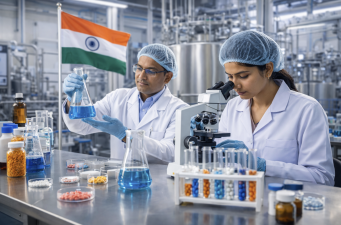
The Indian pharmaceutical sector, known as the “Pharmacy of the World,” is undergoing a major shift. As of April 2026, the Government of India is pushing hard for “Atmanirbharta” (self-reliance) in the drug industry, encouraging companies to cut down their dependence on imported raw materials. This move comes amid rising geopolitical tensions and increasing logistics costs that threaten the global supply of essential medicines. While India leads in finished generic drugs, its heavy reliance on China for Active Pharmaceutical Ingredients (APIs) and Key Starting Materials (KSMs) remains a key vulnerability.
The Current Landscape – Dependence vs. Progress
Despite being the largest global provider of generic medicines, accounting for 20% of global supply, India’s upstream supply chain is still largely imported.
- Import Statistics (FY 2025–26): India imports about 65-70% of its total API requirements by value from China. In FY 2024–25, imports from China reached approximately ₹29,064 crore, making up 74% of India’s total API imports.
- The Export Paradox: In FY 2024–25, India’s API exports (₹41,493 crore) actually surpassed its imports (₹39,215 crore) for the first time. This shows that while India is becoming a hub for certain bulk drugs, it still lacks domestic production for specific high-value or fermentation-based APIs needed for its own formulations.
Strategic Shifts in Modern Pharma Warfare
The pharmaceutical industry is moving from high-volume generics to high-value innovation and resilient supply chains. The government’s strategy focuses on three main pillars:
1. Production Linked Incentive (PLI) Schemes
The PLI Scheme for Bulk Drugs, with an outlay of ₹6,940 crore, is already showing results. By March 2026, 48 greenfield projects were approved, with 38 commissioned. India has begun domestic production of critical drugs like Penicillin G and Clavulanic Acid, previously 100% imported. These efforts have helped avoid imports worth about ₹2,190 crore.
2. The Biopharma SHAKTI Initiative
Launched in the Union Budget 2026–27 with ₹10,000 crore funding, this initiative focuses on Biologics and Biosimilars. As traditional chemical APIs become commoditized, the government is encouraging complex manufacturing of large-molecule drugs, aiming to make India a global biopharmaceutical hub by 2030.
3. Infrastructure via Bulk Drug Parks
To cut manufacturing costs by 25-30%, the government is funding three mega Bulk Drug Parks in Gujarat, Himachal Pradesh, and Andhra Pradesh. These parks offer “plug-and-play” facilities with common effluent treatment plants and steam labs, enabling MSMEs to compete with China’s low-cost industrial clusters.
Implications for Global Security and Resilience
- Health Security as National Security: Geopolitical disruptions in West Asia in 2026 spiked shipping costs and threatened ₹5,000 crore in exports, denoting how fragile pharma supply chains are. Self-reliance is now essential for national health security.
- Diversification (China+1 Strategy): The global security landscape is shifting towards “friend-shoring.” By reducing API dependence on China, India not only secures its own supply but also becomes a reliable partner for Western countries looking to de-risk their medicine supply chains.
- Quality and ESG Standards: To maintain export growth to regulated markets like the US and EU, India’s pharma sector is adopting Green Chemistry and AI-driven pharmacovigilance. This ensures “Made in India” medicines meet strict environmental and social governance standards required internationally.
| Initiative | Outlay (₹ crore) | Key Outcomes |
| PLI Scheme for Bulk Drugs | 6,940 | 48 projects approved, 38 commissioned; domestic production of Penicillin G, Clavulanic Acid; import avoidance ₹2,190 crore |
| Biopharma SHAKTI Initiative | 10,000 | Focus on biologics and biosimilars; positioning India as biopharma hub by 2030 |
| Bulk Drug Parks | Not specified | Three mega parks in Gujarat, Himachal Pradesh, Andhra Pradesh; reduce costs by 25-30%; support MSMEs |
The path to a self-reliant pharmaceutical sector is a long journey. While PLI schemes have jumpstarted domestic production of 33 critical drugs, the continued 70% dependence on China for certain intermediates remains a challenge. The success of upcoming initiatives like Biopharma SHAKTI and PRIP (Promotion of Research and Innovation) will be key in transforming India from the “world’s pharmacy” to the “world’s laboratory.”
Further Resources
- India’s Pharmaceutical Sector – Strategy for 2026 – A detailed video explaining government initiatives and economic data behind India’s API self-reliance push.